Wednesday, December 29, 2010

True believers


In a conspiracy unrivaled in the annals of American politics, "President" Obama has pulled the wool over almost everyone's eyes, and has passed himself off -- successfully, so far -- as an American Christian. But -- in reality -- he is a citizen of Kenya and a Muslim.

Thus the cry of the "birthers" -- stating a firmly held belief impervious to certification from the State of Hawaii that Obama was born in Honolulu. Impervious to birth announcements within days of his birth in the Honolulu newspapers. And, it appears, impervious to the statements of the present governor of Hawaii, Neil Abercrombie, that he was a personal friend of Obama's parents, knew them at the time of Obama's birth, and has a firm recollection of Obama's parents' bringing him to parties within days of his birth. These "proofs" are merely confirmation to the birthers of the complexity, deviousness, and audacity of the conspiracy.

Gov. Abercrombie has had enough. He wants to end the debate by obtaining an exemption to Hawaii's privacy rules, allowing release of hospital records of the birth and of the original form of the birth certificate (a form that's not ordinarily produced as proof of birth).

Gov. Abercrombie means well, but such a release of documents will accomplish nothing. It will merely confirm in the birthers' minds that the conspiracy is even more far-reaching and diabolical than they first believed.

Erif Hoffer wrote a book called The True Believer, back in 1951. He pointed out that mass movements are not based on the truth or falsity of their beliefs, but on their adherents' psychological need to escape their own flawed personalities and unite in a collective whole.

He who is free to draw conclusions from his individual experience and observation is not usually hospitable to the idea of martyrdom... All active mass movements strive, therefore, to interpose a fact-proof screen between the faithful and the realities of the world. They do this by claiming that the ultimate and absolute truth is already embodied in their doctrine and that there is no truth or certitude outside it. The facts on which the true believer bases his conclusions must not be derived from his experience or observation but from holy writ.

Hoffer was interested primarily in mass movements that embody a complete philosophy of life or, at least, political life -- fascism, communism, nationalism, and certain religious movements. But his observations regarding unwavering adherence to a belief apply as well to a belief coalescing around a single alleged fact -- such as the existence of UFO's and alien abductions -- when belief in that fact similarly satisfies the believer's need to escape himself and merge into a collective movement.

If Gov. Abercrombie is able to obtain release of further documentation regarding the president's birth, that will be useful, and perhaps reassuring to any conservatives who are tempted by the birthers' position, but are open to persuasion by factual data. But the governor should have no illusion that anything he or anyone else can do or say will affect the belief of the hard core of true believers.

Obama's a foreigner, and that's that.

Tuesday, December 28, 2010

Enforced rarity


Remember the periodic table of elements? I first saw it as a child in the end papers of a science book. If you took chemistry in either high school or college, it probably was displayed on one of the larger walls of the room. It made interesting viewing when the lectures got boring.

Some tables were full-sized, with every element in its proper place, based on the configuration of its electrons -- a configuration, as you recall, that determines the chemical properties of the element. Many charts, however, including the one in that book that impressed me as a youngster, had to be presented in a condensed form in order to fit into the space available.

One box on the table would thus be identified as the lanthanide series -- elements 57-71. Those fifteen elements were lined up, off the chart, at the bottom of the page. They were safely ignored. They were elements a kid had never heard of and that seemed to have no practical use: lanthanum, cerium, praseodymium, etc., ending up with lutetium, No. 71. Hardly in the same class as hydrogen, oxygen, iron, gold, chlorine, and many of the other commonly known elements. In fact, the lanthanides were called "rare earths." The name sounded appropriate, and that's all I knew about them.

But the "rare earths" -- now generally defined to include scandium and yttrium, in addition to the lanthanide series, since those two elements commonly accompany ore containing the lanthanides -- are crucial in many areas of modern technology. And have actually been increasingly crucial for decades, ever since the development of semiconductors, which require "doping" with trace amounts of those elements . Although the rare earths are plentiful in the earth's crust, they are sufficiently concentrated to make commercial mining practical only in certain areas, and are commercially mined at present in very few areas.

Primarily, China.

China at present has a virtual monopoly on production of rare earths, and produces 96 percent of the most critical rare earths. And China has been increasingly tightening up on export controls, recently announcing a 35 percent decrease in export quotas from last year, and increases in export taxes. China claims it wishes only to assure enough of a supply for domestic use, but mutterings of darker motives are being heard. China allegedly shut off exports to Japan for a couple of months earlier this year, in silent retaliaton for a dispute between the nations regarding ownership over islands in the South China Sea.

Fortunately, deposits of rare earths also exist in the U.S. and in Australia, Brazil, Canada and South Africa. In fact, not long ago, most of the world's production came from these sources. But production was shut down worldwide when China vastly increased mining and undercut market prices in about 1990. Now, because of the time required to restart production, experts estimate that it will take 15 years to again satisfy Western needs from Western sources. Mining of rare earth metals also raises environmental concerns that need to be addressed.

Business and government leaders have been getting nervous. Maybe China's restrictions on rare earth exports are wholly benign. But it never hurts to develop backup supplies to any critical resource. Rare earths will be scarce enough in the coming years without having to worry about China's aggravating that scarcity in order to further its own foreign policy.

Wednesday, December 22, 2010

Student housing


New construction starts in Seattle screeched to a stop, as they did in the rest of the country, once the recession began in 2008. One exception has been Paul Allen's continuing development of the South Lake Union area -- his financial situation is such that he doesn't need to twist bankers' arms to borrow money. The other is residence hall construction at the University of Washington.

I rarely mosey over into the West Campus area, a large, slightly grungy area of land adjacent to the western border of the bucolic main campus. The West Campus is not so much a "campus" as it is simply property that's owned by the university. It consists of entire city blocks, or portions thereof, located on the Seattle street grid. Two large dormitories were built on the West Campus in the 1950's, and the law school moved into a highly unpopular new building facing those dorms in 1974 (and has since moved on to a larger and more elegant new building, located back on the main campus). Besides these three structures, the West Campus area for generations has consisted mainly of shabby residential homes converted to university offices, a few old apartment houses adapted for student housing, and -- most significantly -- numerous large university parking lots.

During the past year, however, several large dormitories -- "residence halls," I guess we now call them -- have been under construction. I decided to wander around on foot and check them out. At least three buildings are nearing the finishing stage of construction. They are huge! They are so large, and of such bulk, that they make the area virtually unrecognizable to someone who hasn't been there for a couple of years. Furthermore, demolition and clearing is nearing completion near-by for at least two more buildings of equal size.

The U-Dub has had a housing shortage for a number of years. The school has been shoehorning three roommates into rooms designed for two, and has converted common rooms and lounges into temporary housing. I haven't personally visited one of these sardine-packed dorms, but newspaper descriptions bring to mind emergency army housing in World War II. Or life aboard a submarine as shown in WWII movies.

The new dorms will provide housing for about 2,400 more students. This will, at least temporarily, alleviate increased demand that has resulted from the increasing size of the university (now about 43,000), an increased number of out-of-state and foreign students, the increased cost of private housing, and a renewed desire by students to live on-campus in a community setting with other students.

While most of the older residence halls -- those located on the main campus -- tend to be focused inward toward the campus, the University hopes that the new dorms now under construction will have a more outward focus, a focus that encourages students to be engaged with their urban setting as well as with college life. Certain architectural features have been designed with that goal specifically in mind. I suppose that one could look at NYU as an example of what the administration has in mind: NYU's academic and residential buildings are all located on the Greenwich Village street grid, not set apart on an enclosed campus. When I visit the Village, I can rarely tell whether any given building is part of the "campus."

How this approach will work at the UW remains to be seen. The hope is obviously to combine the traditional appeal of private, off-campus housing with the security and engagement in student communal life offered by campus residential housing. But however it works out, the effort is certainly changing -- and changing for the better -- a formerly somewhat shabby and under-utilized portion of Seattle's University District.

---------------------
Somehow, I sense your question: And this post is interesting why? And I can't answer it, except to say that I myself am fascinated by (1) the UW campus; (2) building construction; and (3) student life. I'm not satisfied that I've written a post that creates or satisfies similar interests in my readers. All I can say is: "Merry Christmas!"

Tuesday, December 21, 2010

Lunar moment


A monumental event occurred early this morning. I slept through it. I'm referring to the eclipse of the moon, of course, an eclipse that was total in Seattle and that was visible in Seattle -- believe it or not -- because of the lack of cloud cover.

And not just any old eclipse. This was the first time that an eclipse of the moon occurred on the winter solstice since 1638. How's that for a dark occurrence? Black on black. Ain't seen the like since King Charles I was ruling in England, waiting for an ax to bring about his own personal eclipse.

And yet, I forgot all about it, went to bed without looking outside to see its commencement, and slept right through its reaching totality after midnight. Have to wait now until 2094 for such a momentous event to occur again. Some question as to whether I'll be around at that time.

The event was as rare and wondrous as some baseball landmarks. "First time in World Series play that a shortstop has re-tied his left shoelace more than once during extra innings." See what I mean? I'd probably shut off the TV early and miss that critical benchmark as well.

Sunday, December 19, 2010

Down and out


To prepare for my April visit to Iran, discussed in an earlier post, I've been reading a small book about Islamic history, written by the gentleman who will be our guide. Our ambassador to Pakistan under President Clinton, he prepared this book based on a series of lectures that he delivered at Stanford about ten years ago.

I try to keep up on world events, and I actually took courses in Middle Eastern history as a student. But, like most of us, my mind gets caught up in the urgency of current events and our emotional responses to acts of terrorism. Too often, I find myself agreeing with internet comments suggesting that Muslims -- or, at best, radical Muslim terrorists -- are uniquely evil, and that terrorism is a movement that has emerged from something peculiarly violent about Islam itself.

In his book, our guide puts today's events in historical context. An academic specialist in both Islamic and Eastern European civilizations (he also has served as ambassador to Poland), he draws parallels between today's Islamic terrorism and the terrorism -- anarchist, socialist, Marxist -- that threatened governments throughout eastern Europe, and especially Russia, just one century earlier.

Both Russia in the late 19th century and the Middle East in the late 20th century saw economic changes that caused massive migrations from rural areas to large cities. A rapid decrease in infant mortality also led to enormous population growth and to a consequent demographic bulge of young people. Educational improvements, in combination with demographics, produced a far larger class of educated young people than their backward societies could absorb and use productively. As a result, large cities contained -- and in the Middle East still contain -- a large under-class of bitter, well-educated, unemployed young people, youth who see no hopes for their future.

In both Russia and the Middle East, pre-existing utopian idealogies embraced by intellectuals had the potential to threaten existing repressive and inept governments -- anarchism, socialism, Marxism threatened the czarist government in Russia; restoration of Islamic purity as it existed in its Arabian origins threatened "Arab socialist" governments in the more advanced areas of the Middle East. These utopian ideals appealed strongly to impoverished urban youth; they provided young people with intellectual vehicles for their opposition to forces they saw as oppressive, forces they believed were denying them their dreams for the future.

In both Russia and the Middle East, the tinder was in place for the explosions that actually occurred.

The writer asks us to remember the protagonist in Dostoevsky's Crime and Punishment -- the impoverished, bitter, student intellectual who contemplates and finally commits a shocking and violent crime, the ax-murder of an old woman in order to use her money for idealistic purposes. How different from the student Raskolnikov, really, in their underlying psychology, were those young men and women who blew themselves up in Iraq, and who caused the 9-11 tragedy? To what extent is Islam the cause of today's terrorism, and to what extent is it merely an intellectual or emotional justification for it? To what extent should we be fighting Islamic fundamentalism, and to what extent should we be fighting the social and economic conditions that make it so attractive?

Lots to think about, and several other strongly recommended books to read, before I leave for Tehran.

Friday, December 17, 2010

All aboard!


With horror, I look at the calendar Only a week until Christmas Eve! Naturally, I haven't even started my shopping. Actually, this year will be easier than most. My family, now almost entirely adult, has adopted the salutary procedure of drawing names, so that each person buys just one present for just one other person -- a donee who won't know the identity of his benefactor until presents are opened. (The few remaining munchkins in the family are exempted from this -- to them -- ghastly and unnatural process.)

I'm not a shopper by inclination, and the whole present-buying routine seems tedious. At least it does until I actually get out onto the streets, see the lights, hear the crowds, and abandon my natural Scrooge-like tendencies.

A far cry from my childhood, when kids seemed more numerous, adults seemed less visible, and gifts were fantastic blessings from heaven. Christmas, then, was the most spectacular day of the year. In those days, our ceiling-high Christmas tree was engulfed by stacks of presents -- the stacks made more amazing by our own diminutive size. Christmas was, simply, magic. Magic not only because of the beauty of the tree, the wrapped presents, the carols being sung, the entire family's excitement, the presence of relatives we saw only occasionally -- but, most of all, because of the anticipated loot.

Every Christmas was joyously exciting, at least until college. But my best Christmas ever, without a question, was the year I was 10. That was my Lionel train year. I'm not sure where I got the idea that I wanted an electric train; I probably had seen train displays in department stores or toy stores, and had been transfixed.

To a kid, life feels like a world designed exclusively for adults. In pre-computer days, there were few ways by which a ten-year-old boy could exert control over his environment. A train set, with an array of levers and push-buttons -- the more, the better -- at his disposal, each causing some instant, unquestioning and gratifying response from the train layout, gave him that longed-for illusion of personal power.

For months before Christmas, I'd pored over the Lionel catalog. I could tell you the composition of every Lionel train set offered for sale. I knew the strengths and weaknesses of each locomotive, both steam and diesel. I knew the capabilities (and prices) of all the accessories ("As your powerful freight comes highballing down the pike, watch as our grade crossing guard comes running out of his shack, waving his red lantern to warn automobile traffic!" -- yes, yes!)

It had to be Lionel, of course. A younger kid in the neighborhood owned -- well, I suspect his dad actually owned -- an American Flyer train. American Flyers bragged that they were more realistic, because they used two-rail rather than three-rail track. Big deal. No serious kid would want a train set where the locomotives themselves had no whistles, sets sold by a train company that tried to make up for this lack by also selling clunky, phony looking billboards from which a whistle could be coaxed. And did American Flyer have electromagnetic knuckle couplers, couplers that looked exactly like real couplers on real rolling stock? Hahahaha, are you serious? Have you ever seen how American Flyer couples its cars together? What a pathetic joke!

This is the time of year when you've been watching re-runs of the movie about the kid who begs his folks for months for a "Red Ryder carbine-action, two hundred shot Range Model air rifle," right? Well, that was me, during the months before my tenth Christmas. But my "holy grail" was a gift for a budding intellectual with an engineering mind, not something that would "put your eye out"!

Christmas Eve, when my family opened presents, finally arrived, and had gone well. I'd made a good haul. I'd actually pushed thoughts of the electric train -- which hadn't appeared under the tree -- to the back of my mind. Having my own Lionel train had been too much of a delirious fantasy for me to really and truly expect to receive it. I was playing with one of my gifts when my dad said -- just like in the movies -- oh, wait, here's one more present for Donny! Somehow, a cardboard box -- unwrapped, oddly enough for a family that took extravagant care to wrap everything -- appeared out of nowhere. I was confused. I pried open the top, like an explorer opening a treasure chest -- and then I saw it. The cardboard box contained a large number of smaller boxes. Each box was colored orange and blue, a combination that (until Boise State) meant only one thing -- Lionel.

When I recall that evening, I re-experience vividly the golden, dream-like aura that seemed to surround its events. It was one of Lionel's smallest train sets -- a steam locomotive, a coal car, a gondola, an oil tanker and a caboose. It had just 8 sections of O-27 gauge curved track, 3 sections of straight track, and an electromagnetic straight track used for uncoupling cars. The only layout that could be built, without further, future investments in track, was a simple oval. No matter. I was in heaven, and unbelieving that my parents had actually figured out what I really wanted, amazed despite my nearly daily conversations with them about the wonders of train ownership.

My dad and a couple of uncles, being grown-up boys themselves to varying degrees, were also interested in this technological marvel. I was told finally to head off to bed, so that Santa could make his visit and fill our stockings for the morning. I couldn't bear to leave my train in the hands of grown-ups who lacked my own expertise in railroading, and who were showing an unhealthy interest it.

Like Ralphie with his new BB gun, I actually tried to take the electric tranformer to bed with me, to protect my exclusive ownership in my train. Or maybe just to sleep close to it.

So far as I can tell, no one within my family today has such urgent desires. Nothing I could buy for anyone could conceivably create so much happiness. But I suppose I'd better tramp around downtown tonight, and at least make some sort of effort.

Wednesday, December 15, 2010

The silent stars go by


"At this festive season of the year, Mr Scrooge," said the gentleman, taking up a pen, "it is more than usually desirable that we should make some slight provision for the poor and destitute, who suffer greatly at the present time."
--Charles Dickens

I rarely watch C-Span, but the Senate action on Obama's compromise tax bill -- paying the wealthy tribute in exchange for a few crumbs tossed to the poor and unemployed -- drew my fascinated attention, and I tuned into the debate. While the Senate fended off amendments one by one on C-Span 2, the House was passing weird resolutions one by one on C-Span.

The resolutions themselves weren't actually so weird -- in fact, they were so innocuous that I can now recall only the one congratulating Cam Newton for winning the Heisman trophy, the only resolution that drew any negative votes at all. What was weird was watching the House devote an inordinate portion of the day to considering and voting on these resolutions. What was even weirder was that -- although all but the Newton resolution passed unanimously -- a Republican stood and demanded the yeas and nays on each, rather than allow passage by voice vote.

Over in the Senate, meanwhile, the amendments to the tax bill were being defeated, each one after limited debate and an interminable calling of the roll by the Senate clerk. Considering the importance of the measure, I wasn't particularly shocked by the time it took to dispose of the amendments, and to reach the final vote.


What did shock me was that the next major matter to be considered was approval of the critical nuclear arms reduction treaty, and that some Republicans planned to demand that the entire treaty be read to the Senate, an effort that would consume another 12 hours of the Senate's time. They just had to learn what the treaty was all about, they claimed, although the treaty was signed eight months ago, and was approved by the Senate Foreign Relations Committee, after hearings, three months ago. When you're a busy Senator, I suppose, it's hard to keep track of these things.

Still pending after ratification (maybe) of the START treaty are a large number of judicial confirmations, action on repeal of Don't Ask, Don't Tell (passed today by the House), and re-passage of a food safety bill to correct a procedural error when it was approved earlier, a minor matter that was being used for delay by the GOP. The Senate leadership wants to keep the Senate in session to clear these matters off the agenda before adjourning for Christmas. The Republicans are outraged at having to stick around town worrying about the nation, rather than going home early for the holidays:


“It is impossible to do all of the things that the majority leader laid out without doing — frankly, without disrespecting the institution and without disrespecting one of the two holiest of holidays for Christians and the families of all of the Senate, not just the senators themselves but all of the staff.”

Gosh, guys, where was your concern for families, staff, Christianity, and the revered institution of the Senate when you were metaphorically reading the phone book into the Congressional Record?

Business as usual in today's America.

Merry Christmas.

Sunday, December 12, 2010

Here's looking at me, kid


Each morning, I turn on the computer, sigh with pleasure as the Northwest Corner appears as my home page, admire my blog's well-designed format, shiver with happiness as I read over once more my last posting, and wonder whether I should add an even more handsome photo of myself to the "About Me" section. I then turn to Facebook to make sure everyone else has found my last status to be as clever as it truly was.

Only on particularly happy mornings, I hasten to add, do I actually hug my monitor, gently nuzzling the on-line entity that is I.

In rare darker moments, I will admit, I've wondered idly whether this is all quite -- how should I say -- "normal?" In fact, when browsing DSM-IV, the diagnostic manual of the American Psychiatric Association, I've sometimes come across the diagnostic criteria for Narcissistic Personality Disorder, introduced with an unnerving -- to me -- summary:

The essential feature of Narcissistic Personality Disorder is a pervasive pattern of grandiosity (either in fantasy or actual behavior), need for admiration, and lack of empathy that begins by early adulthood and is present in a variety of situations and environments.

Now, I have to say that I do find all portions of the DSM-IV to be a bit unnerving, not excepting the really alarming definitions for schizophrenia and bipolar disorder. But the definition of NPD (as we call it, in the profession) has always seemed to hit especially close to home.

Imagine my relief when I read recently that when the new edition (DSM-V) comes out in 2012 (or 2013, depending on who you believe), NPD will be dropped entirely as a specific personality disorder. Why? Oh, there are various technical reasons the shrinks throw out at us. But I agree with those who say that defining narcissism in an American as a "disorder" is like accusing a French speaker of "excessive nasality." Like, dude, it's who we are.

In any event, whatever the reason for dropping NPD from the DSM, I'm relieved. If smoking marijuana weren't proscribed in the criminal code, it wouldn't be a crime. Right? And if narcissism isn't in the DSM, it's not a disorder -- that's how I see it. Therefore, I'm as normal as a Republican on a couch, watching TV while balancing a bottle of Bud on his chest. Q.E.D.

Now, while we're all here talking about me ... do you think the color of my new tie brings out the piercing, deep-blue intelligence of my eyes? I'm thinking of running for the Senate in 2012, and I want my brilliance to be obvious to voters at first glance.

Friday, December 10, 2010

Hadrian's world


As I hiked along Hadrian's Wall last summer, I repeatedly tried imagining the scene a couple of millennia earlier -- Roman legions marching about, keeping wary eyes on the barbaric Picts and Scots to the north. But the wall was but one marker of the outer limits of the Roman Empire, an empire that -- under Hadrian -- had finally ceased expanding. One of Hadrian's first acts as emperor, in fact, was to pull back the legions from certain territories that his immediate predecessor, Trajan, had just conquered, leaving a strong Empire within the most defensible perimeter possible.

All of this I'd learned at one time in college, but it was impressed upon me far more vividly a couple of weeks ago -- while staying at a house in the land the Romans called "Gaul," where I had a view out the front window of a Roman amphitheater across the road -- when I discovered in a bookcase a copy of Marguerite Yourcenar's French language novel, Memoirs of Hadrian. Her novel, translated by Grace Frick into sonorous and stately English, tells the story of Hadrian's life, as narrated by him in a long letter to a still teenaged Marcus Aurelius, himself destined to become both emperor and a noted philosopher.

Hadrian was one of the most interesting of Roman emperors: a hardened soldier who amply represented the Roman virtues of duty and stoicism -- but also a devotee of Greek philosophy and art. A man who possessed great curiosity about both the physical world and the shadowy world beyond death; a man never fearful of diversity, who rejoiced in the differences he observed among the multitudes of nationalities that had been brought under Roman rule. Although comfortable enough when residing within his capital city of Rome, Hadrian had seen enough of the world to be well aware of the provinciality, narrowness and intellectual limitations of that city's citizens -- not just the common people, the mob, but Rome's Senators and patricians, as well.

No Roman emperor before him had ever spent so little time in the capital city of Rome; none had ever spent so much time, displaying so much curiosity, traveling throughout the many provinces of the empire.

Hadrian respected Trajan, admiring the talents of a highly skilled military mind, but he saw the lack of any profound thought behind so many of Trajan's policies, including his obsessive desire to conquer new provinces. Without questioning the need for a strong military, Hadrian's own experiences and temperament led him to rely far more heavily on negotiation and seeking common ground with Rome's enemies -- a reliance that turned many former enemies into allies.

Within the empire, Hadrian recognized the impossibility of ever building a strong society where great extremes of wealth existed, where the poor and the slaves had no hope to lead satisfying lives apart from open revolt. Although no one in Roman times ever acquired much insight into the workings of economic forces, Hadrian did make some effort to narrow the chasm between rich and poor.

Above all, Hadrian sought to unite the strengths of Rome -- law, politics, sense of duty, self-discipline, organizational skills -- with those of Greece -- love of beauty, intellectual curiosity, creativity, art and architecture, philosophical thought. Although his final decade as emperor was haunted by the devastating death of Antinoüs, the quiet Greek youth with whom he shared his happiest years, his sense of duty never permitted his personal grief to interfere with his plans and efforts to ensure Rome's prosperity and continuing security.

Although Hadrian died in A.D. 138, after 21 years of rule -- and although Yourcenar's fictionalization of his life was written back in 1951 -- Memoirs of Hadrian speaks uncannily to our own world, to our lives as 21st century Americans.

Hadrian's policies gave the Roman empire peace and stability for at least another century. His historical life is worth studying as an example of wise governance under conditions not wholly dissimilar to our own. And Yourcenar's book is worth reading as a moving and lyrical evocation of his life and times.

Saturday, November 20, 2010

Thanksgiving recess


The Northwest Corner will be in extended recess over the Thanksgiving holidays. Drop back during, oh, say, the second week of December, well after the turkey and dressing have been consumed, and the cranberry sauce has been wiped off your faces, and see what we have to offer. Meanwhile, best wishes to you all, and ...

Happy Thanksgiving!

Thursday, November 18, 2010

Confederacy of dunces


The reality of the existence of anti-matter has been known for decades. The ion track of a positron -- the anti-matter counterpart of an electron -- was first observed in 1932. Positron emission tomography (PET) scanners are used routinely in hospitals to observe metabolic processes within the human body.

But because positrons, and other anti-matter particles, interact violently with matter, their existence has been observable only as short tracks, evidencing the infinitesimal length of their life spans from creation to annihilation. This week, the CERN laboratories in Geneva revealed that their scientists had been able to collect 38 anti-atoms of hydrogen -- each anti-atom being an antiproton surrounded by a positron -- and to keep them in existence for a tenth of a second. This period of existence is much longer than that of prior anti-matter observations. Apparently, even a tenth of a second will be long enough for the chemical properties of anti-hydrogen to be studied.

So far as I can tell, this development is more of an engineering feat -- keeping the anti-matter away from the "matter" walls of its container, using electromagnetic fields and temperatures of 0.5 degrees K. -- than any advance in theoretical understanding. Nevertheless, it's an impressive accomplishment, and scientists hope that it will enable significant advances in our understanding of anti-matter.

What impresses me enough to mention this accomplishment here, however, is not the accomplishment itself, but the on-line reaction from readers. The reaction has been about 90 percent negative, almost violently negative. The negative reactions can be fit into any one of several categories, although many comments cross category lines.

1. This research is just another waste of money. What's in it for me?

2. Only an atheist would be interested in this stuff. Trust in God. Not in these so-called scientists who are trying to play God themselves. Remember the Tower of Babel?

3. This is the first step in building an anti-matter bomb that will destroy civilization.

4. Scientists lie, and so do journalists. There's probably no such thing as anti-matter. Don't believe all the crap you read; I sure don't.

There is also a large category of responses -- I'm disregarding them -- that somehow attempt to use this scientific news as the basis for either anti-Obama or anti-Republican rants, as well as the occasional anti-Switzerland diatribe.

This country desperately needs a revival of interest in pure scientific research -- increased numbers of students majoring in the sciences, more accessible scientific writing for non-scientists, and better scientific journalism to keep the general public aware of how their world is changing scientifically. We need, as a nation, an increased appreciation of the obvious fact that pure scientific research can ultimately result in discoveries that benefit our lives. We also need somehow to inculcate in our citizens -- especially the young people who are still flexible in their thinking and open to new ideas -- an appreciation of pure science, apart from any potential applications to which it may lead, as a valuable and exciting means of understanding the universe and our place in it.

Surely, a generation that so much loves fantasy and wizardry can be shown the excitement of scientific discovery as the door to real-life magic. Once again, we lack only the teachers with the necessary enthusiasm and background, and the ability to bring that enthusiasm and scientific background to children in ways they can understand and appreciate.

Not that many years ago, science, math and engineering were favored majors for bright kids starting college. That excitement was reflected in attitudes shared by the entire society. The Seattle World Fair in 1962 -- Century 21 -- was dedicated to future scientific achievement, and the United States Science Pavilion was the most impressive, and probably popular, attraction of the fair.

Our universities, still the best in the world, are filled each year with increasingly large percentages of foreign students, studying math and science, as American students show decreasing interest in those subjects. But countries like China and India are developing universities of their own, with a quantity and quality of students studying in scientific fields that may eventually surpass our own. Soon, they won't really need our universities. Meanwhile, in this country, we are losing not only our excitement about the world of the future, but our ability to compete economically with other nations.

Somehow -- for both our economic and our psychological welfare -- we need to regain our former enthusiam for scientific studies, our craving to learn more about the nature of our physical world, where it's come from, and how it works.

And we certainly have to be alarmed at the popular scientific illiteracy, and the contempt for scientific education and research, that have been all too amply illustrated by the responses shown today to the news from CERN.

Monday, November 15, 2010

Guilt in the wilderness


It was in 1850 that Nathanial Hawthorne wrote The Scarlet Letter, his fictional reconstruction of certain events two centuries earlier in a primitive Boston that was then little more than a village. He based his novel, or "romance" as he called it, on a mysterious letter "A" made of cloth and a bunch of old papers and documents, all of which he uncovered in the Salem Custom House where he was employed, unhappily, as Surveyer of the Revenue.

The Scarlet Letter is the sort of book you read in school, and, in fact, I last read it when I was a college sophomore. But this past week, I saw Intiman Theatre's dramatization of the story, and was both enticed and puzzled into re-reading the book. Enticed, because the play nicely evoked with spare staging the atmosphere of Puritan Massachusetts, and recalled to mind the mysterious spiritual and psychological world inhabited by its inhabitants. Puzzled, because the climactic scene in Intiman's play was the Rev. Dimmesdale's dying speech from the same scaffold where Hester had received her "A" seven years earlier, a speech in which he essentially told his Puritan audience that nothing but love matters, that only love survives death, and that the moral rules they found so important to their lives were nothing more than meaningless and hurtful man-made restraints on love, rules that would die with the flesh.

To paraphrase, as I recall Dimmesdale's speech from the play, love between two human beings is always good; no one should ever tell another person who to love or not love. Really? This theme sounds shiny, modern and contemporary, but it doesn't sound like a speech that would come from the mouth of a clergyman who was overwhelmed with a sense of guilt -- or from anyone else, for that matter -- in the Boston of the 1640's. And more to the point, I suppose, it doesn't even sound like something a well-received author would have written in the America of 1850 -- not even Hawthorne, who often surprises one with his modern "feel," and with his fascination for human psychology and historical romanticism.

So I sat down and re-read The Scarlet Letter. And I liked it very much! The Scarlet Letter, like so many "classics," is really too good a book to waste on college kids who are frantically trying to absorb information to regurgitate back on examinations. The book's sense of the Puritan world as a very alien society, but one populated by human types common to every era, is there, just as I recalled. Also conveyed are: The feel of a society whose primary goal, at least nominally, is the salvation of souls rather than business and entertainment. Life in a small theocratic town (representing Christian civilization) surrounded by a vast primeval forest (representing heathenism, witches, and the Devil and his worshippers). The daily preoccupation with sin, guilt, repentance, forgiveness. One's daily closeness to heaven and hell.

What I didn't find was a sense by anyone -- including Hester Prynne (the wearer of the scarlet letter) or her guilty, one-time lover, Rev. Dimmesdale -- that sin is merely an illusion, that actions don't have consequences, or that love necessarily conquers all.

Rev. Dimmesdale gives his final speech on the scaffold, all right, confessing his long-secret liaison with Hester -- just as as he does in the play. But in the book, the speech did not represent a joyful shout of triumph over conventional morality, but a hard-won defeat of Hester's betrayed husband, a veritable fiend who had sought to secure Dimmesdale's ultimate damnation as his cruel revenge, and -- more critically -- Dimmesdale's healing end to his seven years of hypocrisy and his fearful hope for -- but hardly certainty of -- final salvation.

His speech ended, Dimmesdale gives his final farewell to Hester and their little daughter. And he then dies, his soul perhaps saved but his body consumed by his years of concealed guilt, leaving his survivors to make their way in life as best they can.

The Scarlet Letter may not immediately appeal to our modern tastes. Lots of talk about Satan, perhaps, but no romantically inclined vampires or werewolves. But it's an absorbing read, a good story, and a dramatic picture of the Puritan society that contributed to the birth of our present civilization.

Saturday, November 13, 2010

A kid for all seasons


Like brilliant stars shining out of the darkness and gloom of today's world, the best and brightest of today's kids offer assurance that we haven't yet, after all, toppled into a new Dark Age.

For example, college football has become an embarrassing mess, the current problems in the SEC being just the most publicized of the problems. But today's New York Times carries a story about a college player -- Stanford's Owen Marecic -- who turns all the stereotypes upside down. An outstanding fullback and linebacker on Stanford's sixth-ranked team, he is one of the few players in recent years to play both offense and defense -- at a time when both offenses and defenses have become devilishly complex. And he does so, not as a P.E. major, but as an articulate and hard-working biology major with an A average. While many football players are out partying between practices, Marecic studies late into the night. He spent the past summer interning at Stanford Hospital.

Reading about Marecic reminds me of another accomplished young man -- 16-year-old Kiril Kulish -- a teenager who answers to what I suspect will be a household name, internationally, in another ten years. Kulish is best known today as one of the three original rotating "Billys" in the Broadway production of Billy Elliot, winning a Tony award for Best Actor in 2009. But he is much more than a Broadway dancer and entertainer.

Kulish's parents immigrated to California from Kiev before he was born, and Kiril grew up in San Diego. He was the youngest dancer ever admitted to the Junior Company of the San Diego Academy of Ballet, from which he successfully auditioned for the role of Billy Elliot. As part of his lengthy preparation for the role, he was given intensive training in tap dance, acrobatics, singing, acting, and pronunciation of the Geordie accent of northeastern England, to supplement his already excellent ballet training. Along with another "original" Billy, David Alvarez, he has been described as one of the world's two best male ballet dancers in his age group.

Kulish is also a concert pianist. He recorded a video of his informal performance of the Chopin Nocturne in B-flat and, more formally, of Chopin's Fantaisie-Impromptu, in 2008, shortly before Billy Elliot opened on Broadway.

After nearly a year on Broadway, Kulish grew too tall, and his voice too deep, for the part of Billy, and he "retired" in October 2009. He returned to school in San Diego, where he performed with the San Diego Academy of Ballet, including a starring role in their 2009 Christmas production of the Nutcracker. He now lives in New York, where he studies at the School of American Ballet.

Besides his exploits in ballet and on Broadway, he has also won the U.S. Ballroom Latin Dance championship, and the World Classical Chopin Award. He is a kick-boxer, karate (national awards each year from 2005-07) and taekwondo fighter, an inline skater and skateboarder, and a competitive water polo player. He plays the guitar, presumably when he finds piano tiresome....

What else? I ran into an interview of Kulish prepared for Russian television -- an informal conversation betwen Kiril Kulish and the Russian interviewer as they wandered around New York, showing off backgrounds of Times Square, Lincoln Center, and other iconic scenery. Kulish easily chatted and joked with his interviewer. All in fluent Russian, of course.

As one awestruck teenager commented, after watching one of Kulish's videos, "Jesus ... I've wasted my life."

Kiril Kulish has already accomplished more in his 16 years than most of us could ever do, even if we were granted multiple lifetimes. Some child prodigies burn brightly in childhood, shining at the one thing on which they've focused their entire lives, only to burn out when they hit their teens. But this kid seems too much at ease in his own skin, too well-grounded by his parental upbringing, and too well-adjusted socially for any such sad ending to be likely.

Kiril Kulish. Keep that name in mind. It's a name I predict you'll come across often in years to come.

Wednesday, November 10, 2010

Better living through electricity


I've never really understood the concept of an electric blanket. I don't mean that the physics is beyond my intellectual powers. I mean rather that it sounds like an electric dog, or electric strawberries, or an electric maple tree. The original performs a useful function as is. Why electrify it?

But here I am in the Northwest Corner in November, and once again the weather is turning cold. Once again, I shudder at the sound of my oil furnace clanking into another cycle, more even than I shudder at the cold itself. The last few winters, I've been saving oil by turning the thermostat down below 60 degrees at night, and gradually adding blankets to my bed as the outside temperature decreases.

I should explain that when the temperature is, say 58 degrees, in my dining room -- where the thermostat is located -- it's much colder upstairs in my bedroom under a poorly insulated roof. (Why don't I simply add insulation? Hush, you tell your stories and I'll tell mine.) And the colder it gets outside, the steeper the temperature gradient between upstairs and down.

By December, I'll have a wool blanket, a quilt, and an unzipped cotton sleeping bag on my bed, and a puffy down comforter on top of that. It's a heavy burden, resting on a skinny guy's chest, especially when you top it all off with two cats clinging to the pile of bedding for warmth. Turning over during the night, getting out of bed in the morning -- these require more than just will power -- they demand a certain amount of physical strength.

So I finally broke down, yesterday, and bought an electric blanket. I brought it home and removed it from its packaging, gazing somewhat askance at the lengths of electrical cord and the control box that come with the blanket. I've never heard of anyone being electrocuted in his sleep by an electric blanket, but various scenarios in which this would be a probable result passed through my mind -- my nervousness heightened by not really quite understanding the blanket's internal wiring. Obviously, resistance wiring somehow threads itself around the innards of the blanket. All I can think of is the sight of my toaster when it's toasting. Glowing red hot wires, wires from which, after too much probing, one can receive a nasty shock. Surely, the wire inside the blanket is insulated? But can't the insulation melt from the heat?

Toast, I envision myself. Burnt toast, surrounded by the shimmering aura of an electric field.

My saving grace is that I usually know when I'm being silly. I shake my forebodings aside, place the blanket on the bed, and connect the wire to the connector at the foot of the blanket. Now I have only to plug in the blanket.

I plug it in. The LED indicator comes on, and then goes off. I do it again. Same result. I need to explain. Sometime before I moved into my circa 1922 house, a former owner rewired it. But he only rewired the lower floor. The upstairs has odd sockets from olden days, sockets that make only loose connections with plugs. The socket near my bed is the worst. But, by bending the prongs of the plug experimentally in several directions, I finally get the connection to hold. Barely.

A few hours later, joined by my usual feline entourage, I get ready for bed. Electric blanket plugged in? Check. LED on? Check. Heat set at appropriate level? Check. I climb into bed. Hey! This isn't like sitting inside a toaster! I'm just lying in a comfortably warm bed. And the blanket is light!

I like this. Do other people know about electric blankets, or am I once again avant garde, ahead of the curve? I settle down to do a little reading in bed before calling it a night. But, hark! The cats are alert and suspicious. This wire, plugged into the wall, is SOMETHING NEW! The investigation begins. They knock the loosely inserted plug loose. I admonish them, and carefully reconnect. Oh, "Master" is playing a game! Their excitement seems to reach a frenzy, and they are once again tapping the plug with their paws before I'm even settled back into bed. It's loose, again. It's painstakingly reconnected. Cats are admonished. I return to bed. [Go to beginning and repeat above scenario.]

Has anyone ever accomplished anything by admonishing a cat?

Finally, their feline curiosity is exhausted. While their master's behavior is mildly amusing, the plug itself proves to be pretty inert and non-combative. They'd rather go to a corner and stare at a spot on the wall for an hour or two. I go to sleep. I sleep well. I wake up in the morning. The plug is undisturbed; the LED indicator is still lit; the blanket is still light in weight and normally comfortable in warmth; the cats are lying contentedly atop the warm blanket without feeling the need to lie on top of me.

I am alive. I was neither electrocuted nor toasted black during the night.

Once more I sally forth into the world of modern living. Smug with self-satisfaction, I suspect I can adapt to this novel "electric blanket" concept.

Monday, November 8, 2010

Beethoven à la Korea


Don't start rolling your eyes -- those of you who've been following this blog over the past couple of years -- but for those of you who do not know it already, I've been working on Beethoven's Pathétique sonata ever since returning to piano lessons. To give myself some idea of what I'm doing, I regularly play YouTube interpretations of the sonata by serious pianists, both renowned and amateur.

As with most YouTube videos, these interpretations are accompanied by viewer comments, both informative and ignorant. Among these comments, I kept running into the question: Isn't this song [sic] called Beethoven Virus? I assumed (correctly, as it turns out) that someone had done a popularization of the Beethoven work (the last movement), and that some folks were enjoying it without realizing that it was based on an actual classical sonata. Today, my curiosity finally caused me to do a little research. Even after perusing the internet, however, I'm still a little confused -- maybe some of you more attuned to contemporary music can leave a comment for the edification of both me and other readers.

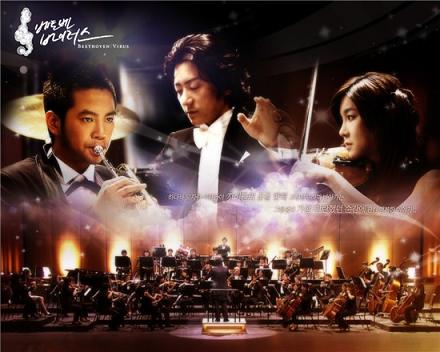
"Beethoven Virus" is apparently the name of a 2008 Korean television series, telling the story of a highly talented but tyrannically demanding orchestra conductor and his complicated relationships -- both musical and romantic -- with several members of his orchestra. The series has been critically acclaimed, and was praised as unique in its portrayal of the lives of Korean classical musicians.

I'm not quite certain how the music called Beethoven Virus relates to this show. I've found articles discussing the TV series, and articles discussing the composition, but none discussing the relationshiop between the two. There is a two-CD album of music that was performed on the TV series, but the cuts all appear to be traditional classical compositions. The Beethoven numbers listed are all symphonies, requiring full orchestra, with the exception of one violin sonata. There are no piano sonatas

My best guess is that Beethoven Virus is the introductory theme music to the program, but this is strictly a guess. The best known interpretation of the music appears to be by a Korean group called BanYa, a group known for performing various forms of contemporary music, including classical cross-overs. BanYa's version is an interesting simplification of the piano sonata, performed by what sounds like a small orchestra, and it features a recurring trumpet obbligato and a heavy drum beat. (Other versions highlight different instruments, for example, violin.) Here is the YouTube video. Those of you more familiar with rock than I am may be able to classify this particular sound by genre.

It's pretty catchy.

Ironically, some amateur pianists have doubled back, and recorded YouTube piano arrangements of Beethoven Virus. These arrangements come out sounding like well-played but simplified (and syncopated) versions of the original sonata. As one commentor puts it, why not just learn Beethoven's original Pathétique?

One of my relatives warned me recently that "writing about music is like dancing about architecture." I have to agree. But hey, look at me! I just tried doing it, anyway!

-------------------
And for something a little different, here is Beethoven Virus played as a recorder duet by a couple of kids in Mexico.
-----------------------
(11-9-10) If anyone's interested, further research has given more insight into the origin of Beethoven Virus. The song was apparently arranged by BanYa, which is described by Wikipedia as an in-house (and mainly anonymous) collective working for a Korean company called Nexcade, which produces arcade games. The song was prepared for use in a series of music video games called "Pump it Up " (PIU). Beethoven Virus appears to have been developed specifically for the game "PIU: Perfect Collection." This game definitely pre-dated 2008, and so the Korean television series must have derived its name from the song.

I'm still interested in learning how the song was used in the series, if it was at all, and any other information any fans of computer/arcade games and/or contemporary music and/or Korean television may have to offer.