


 My long-suffering piano teacher showed me a book this morning, a book written for grade school children. The book shows beginning pianists how to relax their arms while playing, so that they use their fingers, not their shoulders, to exert pressure on the keys. "One thing you never learned as a child, apparently," she sighed. "One of many things," I agreed.
I began thinking of the many things I never learned as a child. To what extent are our adult talents and abilities shaped and limited by what we learned or failed to learn when we were kids? Is it, ultimately, all Mom's fault?
If you've been awake this past week, you know about the Chinese-American author Amy Chua and her book, Battle Hymn of the Tiger Woman. She describes the draconian tactics to which she resorted in pushing her daughters to be the brilliant adults that they clearly are today. And competent musicians. One daughter performed at Carnegie Hall, but only after a childhood of forced four-hour practice sessions at the piano, and maternal threats to burn her stuffed animals if she failed to play a composition perfectly. (No, I haven't read the book, nor do I intend to read it. Life's too short. I'm relying on a story in the New York Times.)
Thoughtful readers of my posts may assume that Amy has my whole-hearted approval, but she doesn't. She has only my half-hearted approval. Her parenting techniques, as she describes them, fall at one barely acceptable extreme of the parenting continuum; the parent who sits before the TV every night and considers his or her child's education to be the function of the local school district would be at the other end. Somewhere in between lies the ideal approach, and I suspect that ideal balance varies from child to child. Unfortunately, the optimum balance is easier to locate in retrospect, after the kid's already grown up, than it was at the time the knowledge was needed.
The reader comments to the NY Times article, and to a follow-up column in the Times, vary widely in how they view Ms. Chua -- from admiration to suspicion of child abuse. The comments are all interesting and thoughtful, and the experiences each reader has had with his/her own children show the wide variety of child rearing approaches that can lead to the development of successful adult lives. Or, for that matter, to failures.
My own parents, like most in the milieu in which I grew up, took a rather laissez faire approach to bringing up their kids. More so than average, perhaps, even for our place and time. They wanted good grades from us, and college educations, but they pretty much left it up to us to figure out how best to achieve those results. That approach gave me an enormous amount of room as a kid for exploration and experimentation, for following my own sense of curiosity. It also gave me a lot of room to develop rather lazy habits of thought and poor self-discipline.
If I had my childhood to live over again, I'd hope for a bit more pressure from my parents, a setting of the bar of acceptable achievement a bit higher, rather than their relying entirely on my own sense of self-pride and ambition. On the other hand, I have to admit I'm glad they didn't refuse me access to the bathroom until I'd finished perfecting, to their satisfaction, the piano piece I was playing. As Ms. Chua cheerfully admits to doing.
I've known plenty of people whose parents tended toward either extreme. In general, those with the stricter parents have developed certain enviable talents -- like playing an instrument well -- more frequently than the others. But I can't really say that either approach by the parents has led consistently to adult lives that were either happier or more productive. Different kids respond differently to different parenting approaches. Parenting remains an art rather than a science.
This week's debate among readers of the Times articles is a microcosm of a national debate that will grow increasingly sharp in the years just ahead -- between those who feel that today's form of American education best develops the creativity and social skills that are needed for both personal and national success, and those who feel that the Chinese/Indian/Jewish model of hard work and, at times, rote learning in childhood teaches the self-discipline and analytical skills that Americans are increasingly failing to develop, especially compared to kids in the developing Asian nations that will be our competitors in the next decades.
As expected, I think both sides are right, and that what we need is a proper blend of the two approaches. But then, my own lackadaisical education taught me to be just that way -- non-judgmental to the point of sounding wishy-washy.
And the music still doesn't flow to my finger tips -- through relaxed arms -- as I strike the keys on the piano!
Tuesday, January 18, 2011
Sitting up straight

Sunday, January 16, 2011
Beyond the horizon
 What do we really know about the universe in which we live? More importantly, perhaps, what can we know?
Brian Greene, a Columbia University physics professor, discusses today, in a New York Times feature article, the consequences of the fact that the universe is expanding at an accelerating rate -- not, as one would expect, at a slower rate. This accelerating expansion suggests that some force -- in addition to the original force of the Big Bang -- is more than counteracting the mutual gravitational attraction of all the matter in the universe. Dr. Greene describes this force as Einstein's posited "repulsive gravitation" or, in modern terms, "dark energy" -- something that is inherent in the nature of space itself.
Regardless of the mysterious nature of dark energy, its observed effect is that the universe is expanding, and expanding faster and faster. Eventually, this expansion will result in remote galaxies distancing themselves from each other at a speed faster than light.1 At that point, such galaxies will become permanently invisible to each other. In perhaps 100 billion years from now, our descendents on earth, gazing at the sky through telescopes, will see nothing but the stars in our own Milky Way galaxy.
Dr. Greene notes, somewhat whimsically, that such future astonomers, if confronted with ancient documents from earlier times describing galaxies as numerous as the stars themselves in our own galaxy, will have to decide whether to believe their own observations or the accounts from those documentary relics from the past. Accounts of a sky full of galaxies will seem as dubious to them as stories of the Greek or Hindu gods do to us today.
The moral is clear: we can never learn everything, or even very much, about the nature of reality. What critical information is already unknowable to us today because of analogous shielding of past events? Dr. Greene notes:
We've grown accustomed to the idea that with sufficient hard work and dedication, there's no barrier to how fully we can both grasp reality and confirm our own understanding. ... [But] sometimes the true nature of reality beckons from just beyond the horizon.
When considering how we "know" our world on the human scale, I'm always amazed at how our bodies perceive a narrow band of electromagnetic radiation ("light"), some neurological reactions to pressure on the skin ("feel"), and waves of compression in the atmosphere ("sound") -- and how our brains build a mental image of what lies around us out of this limited data, and how we then confidently believe that we have "observed" reality. How different would the "reality" of life on earth look if we perceived only ultraviolet light? Or x-rays?
And we are here as on a darkling plain
Swept with confused alarms of struggle and flight,
Where ignorant armies clash by night.
--Matthew Arnold
Dr. Greene's article makes it clear that we not only are limited in our perception of reality by the limitations of our sensory perceptions and our brain's ability to process all those perceptions that it does receive -- we are limited by the very nature of the universe itself.
We should feel a certain humility when we assert claims of absolute certainty about anything. But of course we don't. And won't.
------------------------------1As Dr. Greene explains it, this expectation does not contradict relativistic limitations. Relativity applies to the motions of objects, relative to each other, within space. "Dark energy" is not causing objects to fly apart within space; it is causing space itself to rapidly expand.
Tuesday, January 11, 2011
Fanaticism
 Today's New York Times carries an article discussing the growth of Islamic fanaticism in Pakistan. A Pakistani political analyst notes that the country has been drifting for some time into religious extremism.
This conservatism is fueled by an element of class divide, between the more secular and wealthy upper classes and the more religious middle and lower classes.
--New York Times, quoting Najam Sethi, a former Pakistani newspaper editor
The article discusses the recent assassination of the Punjab's governor by one of his own bodyguard, and the fact that younger and more religious members of the legal profession now consider the killer a hero. Lawyers showered the defendant with rose petals when he appeared in court to face charges. The growing religious fervor is reinforced by a strong strain of populism.
"Salman had an easygoing, witty, irreverent, high-life style,” he [Sethi] said, “so the anger of class inequality mixed with religious passion gives a heady, dangerous brew."
Moderate Pakistanis blame the religious parties and fundamentalist clerics for inciting such attacks. They also blame the press: “Democracy has brought us a media that is extremely right-wing, conservative,” according to Sethi.
While Pakistan is a far different country from the United States, Pakistan being a country that is actually on the verge of becoming a failed state, certain dynamics in both countries are uncomfortably similar. Here we have fundamentalist Christianity rather than fundamentalist Islam. This similarity should not be exaggerated; most Christian fundamentalists abhor violence and focus on individual rather than national salvation. We have certainly seen an uglier and more politicized side to that fundamentalism among some national religious figures, however.
This fundamentalism is reinforced by a growing populism -- not just in the benign sense of sticking up for the common man, but in an uglier sense of detesting all forms of authority -- government, business, unions, universities, academic experts, science, experts of any kind. This is a throwback to the populism of Andrew Jackson, but is a dangerous development today, appearing in a highly technological, non-frontier society.
We also have Fox News and certain of its commentators, media figures who have discovered that inciting hatred brings in far more readers and money than does dispassionate discussion of political issues. To Fox, both religious fundamentalism and anti-intellectual populism are trends to be cultivated, whether to advance its owners' actual political beliefs or simply to maximize profits. Beyond Fox, even, we have a plethora of blogs and message boards that are truly scary to read.
The assassinations in Tucson this week may well be the result of the killer's serious mental illness. Jared Loughner's political views, such as they are, don't really match those of any one extremist party or cult. But the hatred filling the media over the past decade -- the loathing of "liberals," the belief that the Constitution has been hijacked, the hatred of government in general, the bewildering (at least, to a liberal) fury at health reform legislation -- may well have given focus to Loughner's paranoia and emotional turmoil, leading him to target a Democratic member of Congress serving in a state not particularly receptive to Democratic party principles.
Regardless of any connection or lack of connection between Loughner and the radical right, the shooting should at least call our attention to dangerous currents within our society, and a growing decrease in our ability as concerned citizens to reason out political solutions using logic rather than falling back on abstract dogma, name-calling, and mutual loathing.
We still have a long way to go before we reach the plight in which Pakistan now finds itself. But let's not go any further.
Friday, January 7, 2011
Frontier talk
 A fair-to-middlin' American writer named Ernest Hemingway once observed, famously, that "all modern American literature comes from one book by Mark Twain called Huckleberry Finn. …All American writing comes from that. There was nothing before. There has been nothing as good since."
Good old Hem's opinion hasn't prevented repeated attempts to ban the novel from American high schools. The reasons advanced have varied over the years. In earlier times, the problem was primarily with Huck's character and with the plot. Huck, the hero, is rebellious. He repeatedly gets the "nice boy," Tom Sawyer, into trouble -- and does so with the author's apparent full approval and enjoyment. He runs away from home and floats down the Mississippi with a runaway adult slave for his friend. (A prominent literary critic argued in the 1950's that Twain was suggesting an interracial, pedophile relationship!) He encounters a number of American frontier types, none of whom is in any way admirable or edifying.
At the end of the book, after returning to Aunt Sally and the world of respectability, Huck confides to his readers, in one of the more memorable final paragraphs of any novel, that he plans to run off again:
But I reckon I got to light out for the Territory ahead of the rest, because Aunt Sally she's going to adopt me and sivilize me, and I can't stand it. I been there before.
Not the sort of lesson that many adults wanted impressionable young students to learn.
Later, the concern seemed more with the texture of the novel. Mark Twain excelled in casting dialogue in the dialect appropriate for each of his fictional characters. Huck's language is full of grammatical solecisms. "Ain't" is used regularly and consistently. Jim, the slave, speaks in the black dialect of the time. Even the earliest critics of the novel complained of the "coarseness" of the language. It was, well, too realistic.
Many of these earlier complaints have continued up to the present, but the issue is now primarily "racism." Use of nineteenth century black dialect by black characters, such as Jim, connotes ignorance, it is claimed. Particularly when the novel is used in the classroom, it hurts the feelings of African-American students and suggests inherent black inferiority to the others. Why not have all the characters speak standard English, even if none of them would have done so in real life? Why, for that matter, I suppose, should Charles Dickens have differentiated between various classes and regions of England by writing each character's dialogue in an appropriate dialect?
All these arguments tend to be summed up in the horror often expressed with respect to the frequent use (219 times, according to someone's count) of the word "nigger" in Huckleberry Finn. (Note: I actually said "nigger" (there, I did it again!), unlike almost all recent journalistic reports on the subject. I didn't say "n-----" or "the n-word" or any other euphemism. I'm daring that way. I even italicized it for you.)
"Nigger," of course, began as a sloppy pronunciation of "Negro," which in turn is the Spanish word for "Black." Like most offensive words, there's nothing offensive in the word itself, but in the use that has historically been made of it. Dictionaries advise that the word was used in a derogatory fashion from the very beginning, but has become markedly more offensive in recent years. Fashions come and go in many words; once offensive words become accepted and once accepted words become offensive.
In pre-Civil War days, when the novel takes place, the word was widely used, even in "polite" society. It was derogatory even then, but it was -- after all -- applied to persons who were treated by the law as the chattel property of their owners. African Americans -- being mostly slaves -- were not highly esteemed in law, by society, or by the great majority of the population. As a result, there was not much concern over the nicety of the terms used to describe them. I suspect that "nigger" in those days was considered considerably less offensive than we would consider "spic" or "kike" to be today.
In any event, the word was in daily use.
My present concern stems from the well-publicized recent publication of an expurgated version of Huckleberry Finn, where the expurgator (Alan Gribben, an Auburn professor) has converted every use of the word "nigger" into the word "slave," in an apparent belief that it's better to be called a slave than a nigger. The book is intended primarily for use in the schools, where young ears and young ears' parents might be offended.
Should we give in and go along with it? Don't be silly. Huckleberry Finn is considered a classic for many reasons, all of which remain valid right up to the year 2011. You don't tidy up classics to meet changing tastes, any more than do sane people put plaster fig leaves on nude Renaissance statues. And modifying 219 appearances of one word won't satisfy the novel's vocal critics.
Today's issue of the Seattle Times contains a letter from a reader, responding to a news story about Gribben's "masterpiece." The letter concludes:
Our shared humanity is now beyond debate, and we have outgrown Huck and Jim. There are more modern books that accept the premise of "Huckleberry Finn" as given, and address the more subtle questions of race that still exist. Those books should be read and discussed in schools, and "Huckleberry Finn" should be honorably retired.
This well written and non-inflammatory letter seems to miss the entire point of teaching English literature. Mark Twain's novel is a story of the American frontier and of the conflicts confronted by an intelligent and perceptive, but uneducated, adolescent. It's not a sociological tract. Would the writer suggest that we now have a better understanding of religious and sexual values, and that therefore Hawthorne's rather disturbing novel, The Scarlet Letter, should be retired from the curriculum in favor of a book about a modern pastor who provides wise counseling to unmarried couples who are expecting a child?
Teachers, teach the classics; don't tamper with the text; and do discuss the books with your students. The kids aren't oblivious, but if there's any doubt in your mind as a teacher, go ahead and explain that "nigger" is not acceptable language today, and that it was insulting even in Twain's day. Also explain that "ain't" is dialect, not standard English, and that "sivilize" is just plain bad spelling. Get all that out of the way. Then talk about the lessons Twain was teaching in the novel. Tell the students how times, values and conventions were different from those they are familiar with today. And make sure they discover for themselves how -- all didactic intent aside -- the book is just an exciting, funny and entertaining read.
Oh -- and by the way -- Gribben also converts every use of the word "injun" to "Indian." (I guess Injun Joe now becomes Indian Joe.) Don't even get me started -- at least he doesn't call them "cardinals."
-------------------------(1-9-11) Leonard Pitts, a syndicated, liberal, African-American columnist, in a well-reasoned column opposing Gribben's "modifications" to Huckleberry Finn that appears in today's Seattle Times, concludes:
Huck Finn is a funny, subversive story about a runaway white boy who comes to locate the humanity in a runaway black man and, in the process, vindicates his own. It has always, until now, been regarded as a timeless tale.
But that was before America became an intellectual backwater that would deem it necessary to censor its most celebrated author.
The one consolation is that somewhere, Mark Twain is laughing his head off.
Thursday, January 6, 2011
One more year

"I am committed to earning my degree in architectural design from Stanford University and am on track to accomplish this at the completion of the spring quarter of 2012."
--Andrew Luck
Thus did the consensus first pick for the 2011 NFL draft give up an immediate guarantee estimated at up to $60 million today, choosing instead to stay in college, get his degree, and play one more year of college football.
The message boards have been blazing all afternoon. A few commentators congratulated Luck on his decision. Many found his decision incomprehensible -- "you go to college to gain a skill so you can make money, and you're risking a fortune. If you really love architecture, why not grab the money and go back to school later?" "Doesn't Stanford teach you basic economics?"
And a large number of even more rabid commentators foamed at the mouth over a matter that had virtually no impact on their own lives. They appeared outraged by a decision that they sensed questioned their most hallowed belief -- that making a pile of bucks was the essence of life itself. They attacked Luck's intelligence, his father's wisdom, his coach's advice. One messsage board writer even said he hoped Luck would sustain an injury next year, to prove the foolishness of today's decision.
Luck had promised to carefully consider all the pros and cons of his choice. The money involved, the uncertainty over the future of the NFL's compensation system, and his probable draft by the Carolina Panthers -- each undoubtedly played a part in his decision-making. But his father, himself a university athletic director and former NFL quarterback, undoubtedly had the best insight into Andrew Luck's final decision:
Luck’s father, Oliver, said his son wanted to complete his degree in architectural design, a rigorous major in the college of engineering. Luck also felt, his father said, the tug of finishing his career with the players whom he entered school with.
“He wants to finish with those guys,” Oliver Luck said in a phone interview. “It’s a great group of players. That was by far the most important factor.”
Oliver Luck was listening to radio hosts criticize the decision on the radio Thursday and recalled the psychological test in which people perceive different things in inkblots.
“It’s a Rorschach test for people’s values system,” he said of the decision.
--New York Times (Pete Thamel)
No one would have criticized Luck if he had turned pro. But his critics are evaluating his decision as a business decision by a business. Instead, it was a life decision by a young man setting out in life. The choice he finally made reflects credit on himself, on his family, on his team and teammates, and on his school.
Friday, December 31, 2010
New Year's toast
 As I begin this post, we are a short 8½ hours until the dawn of 2011. Therefore, a special New Year's posting seems in order.
A couple of months ago, I had a Facebook exchange with a younger relative regarding "Tom and Jerries." To her, the term meant nothing but a couple of cartoon mice. She had no idea that it was a drink -- not only "a drink," but, in fact, "the drink" for this time of year, "the drink" with which to celebrate New Year's Eve and/or Day.
For those of you who don't know a Tom and Jerry from a Batman and Robin, here's the recipe:
Tom and Jerry
Ingredients
12 egg(s)
1 cup sugar
1 bottle brandy
Pinch of ground allspice
Pinch of ground cinnamon
Pinch of ground cloves
1 bottle dark rum
milk
nutmeg
Glass Type: Mug
Instructions
Separate the eggs. Beat the whites until they form a stiff froth, and the yolks -- to which you have added the sugar -- "until they are as thin as water," as the professor advises, gradually adding 4 ounces brandy (spiceaholics will also add a pinch each of ground allspice, cinnamon, and cloves). Fold the whites into the yolks. When ready to serve, give it another stir and then put 1 tablespoon of this batter in a small mug or tumbler. Now add 1 ounce brandy (although some die-hard Southernors may prefer bourbon) and 1 ounce Jamaican rum, stirring constantly to avoid curdling. Fill to the top with hot milk and stir until you get foam. Sprinkle a little grated nutmeg on top.
By cutting and pasting a recipe onto my blog, I have not only provided you with a source of happiness and contentment while watching the Rose Bowl tomorrow, but -- with minimal effort on my part, and with no imagination -- I've brought the number of my posts in 2010 up to a nice round 92!
Wednesday, December 29, 2010
True believers
 In a conspiracy unrivaled in the annals of American politics, "President" Obama has pulled the wool over almost everyone's eyes, and has passed himself off -- successfully, so far -- as an American Christian. But -- in reality -- he is a citizen of Kenya and a Muslim.
Thus the cry of the "birthers" -- stating a firmly held belief impervious to certification from the State of Hawaii that Obama was born in Honolulu. Impervious to birth announcements within days of his birth in the Honolulu newspapers. And, it appears, impervious to the statements of the present governor of Hawaii, Neil Abercrombie, that he was a personal friend of Obama's parents, knew them at the time of Obama's birth, and has a firm recollection of Obama's parents' bringing him to parties within days of his birth. These "proofs" are merely confirmation to the birthers of the complexity, deviousness, and audacity of the conspiracy.
Gov. Abercrombie has had enough. He wants to end the debate by obtaining an exemption to Hawaii's privacy rules, allowing release of hospital records of the birth and of the original form of the birth certificate (a form that's not ordinarily produced as proof of birth).
Gov. Abercrombie means well, but such a release of documents will accomplish nothing. It will merely confirm in the birthers' minds that the conspiracy is even more far-reaching and diabolical than they first believed.
Erif Hoffer wrote a book called The True Believer, back in 1951. He pointed out that mass movements are not based on the truth or falsity of their beliefs, but on their adherents' psychological need to escape their own flawed personalities and unite in a collective whole.
He who is free to draw conclusions from his individual experience and observation is not usually hospitable to the idea of martyrdom... All active mass movements strive, therefore, to interpose a fact-proof screen between the faithful and the realities of the world. They do this by claiming that the ultimate and absolute truth is already embodied in their doctrine and that there is no truth or certitude outside it. The facts on which the true believer bases his conclusions must not be derived from his experience or observation but from holy writ.
Hoffer was interested primarily in mass movements that embody a complete philosophy of life or, at least, political life -- fascism, communism, nationalism, and certain religious movements. But his observations regarding unwavering adherence to a belief apply as well to a belief coalescing around a single alleged fact -- such as the existence of UFO's and alien abductions -- when belief in that fact similarly satisfies the believer's need to escape himself and merge into a collective movement.
If Gov. Abercrombie is able to obtain release of further documentation regarding the president's birth, that will be useful, and perhaps reassuring to any conservatives who are tempted by the birthers' position, but are open to persuasion by factual data. But the governor should have no illusion that anything he or anyone else can do or say will affect the belief of the hard core of true believers.
Obama's a foreigner, and that's that.
Tuesday, December 28, 2010
Enforced rarity
 Remember the periodic table of elements? I first saw it as a child in the end papers of a science book. If you took chemistry in either high school or college, it probably was displayed on one of the larger walls of the room. It made interesting viewing when the lectures got boring.
Some tables were full-sized, with every element in its proper place, based on the configuration of its electrons -- a configuration, as you recall, that determines the chemical properties of the element. Many charts, however, including the one in that book that impressed me as a youngster, had to be presented in a condensed form in order to fit into the space available.
One box on the table would thus be identified as the lanthanide series -- elements 57-71. Those fifteen elements were lined up, off the chart, at the bottom of the page. They were safely ignored. They were elements a kid had never heard of and that seemed to have no practical use: lanthanum, cerium, praseodymium, etc., ending up with lutetium, No. 71. Hardly in the same class as hydrogen, oxygen, iron, gold, chlorine, and many of the other commonly known elements. In fact, the lanthanides were called "rare earths." The name sounded appropriate, and that's all I knew about them.
But the "rare earths" -- now generally defined to include scandium and yttrium, in addition to the lanthanide series, since those two elements commonly accompany ore containing the lanthanides -- are crucial in many areas of modern technology. And have actually been increasingly crucial for decades, ever since the development of semiconductors, which require "doping" with trace amounts of those elements . Although the rare earths are plentiful in the earth's crust, they are sufficiently concentrated to make commercial mining practical only in certain areas, and are commercially mined at present in very few areas.
Primarily, China.
China at present has a virtual monopoly on production of rare earths, and produces 96 percent of the most critical rare earths. And China has been increasingly tightening up on export controls, recently announcing a 35 percent decrease in export quotas from last year, and increases in export taxes. China claims it wishes only to assure enough of a supply for domestic use, but mutterings of darker motives are being heard. China allegedly shut off exports to Japan for a couple of months earlier this year, in silent retaliaton for a dispute between the nations regarding ownership over islands in the South China Sea.
Fortunately, deposits of rare earths also exist in the U.S. and in Australia, Brazil, Canada and South Africa. In fact, not long ago, most of the world's production came from these sources. But production was shut down worldwide when China vastly increased mining and undercut market prices in about 1990. Now, because of the time required to restart production, experts estimate that it will take 15 years to again satisfy Western needs from Western sources. Mining of rare earth metals also raises environmental concerns that need to be addressed.
Business and government leaders have been getting nervous. Maybe China's restrictions on rare earth exports are wholly benign. But it never hurts to develop backup supplies to any critical resource. Rare earths will be scarce enough in the coming years without having to worry about China's aggravating that scarcity in order to further its own foreign policy.
Wednesday, December 22, 2010
Student housing
 New construction starts in Seattle screeched to a stop, as they did in the rest of the country, once the recession began in 2008. One exception has been Paul Allen's continuing development of the South Lake Union area -- his financial situation is such that he doesn't need to twist bankers' arms to borrow money. The other is residence hall construction at the University of Washington.
I rarely mosey over into the West Campus area, a large, slightly grungy area of land adjacent to the western border of the bucolic main campus. The West Campus is not so much a "campus" as it is simply property that's owned by the university. It consists of entire city blocks, or portions thereof, located on the Seattle street grid. Two large dormitories were built on the West Campus in the 1950's, and the law school moved into a highly unpopular new building facing those dorms in 1974 (and has since moved on to a larger and more elegant new building, located back on the main campus). Besides these three structures, the West Campus area for generations has consisted mainly of shabby residential homes converted to university offices, a few old apartment houses adapted for student housing, and -- most significantly -- numerous large university parking lots.
During the past year, however, several large dormitories -- "residence halls," I guess we now call them -- have been under construction. I decided to wander around on foot and check them out. At least three buildings are nearing the finishing stage of construction. They are huge! They are so large, and of such bulk, that they make the area virtually unrecognizable to someone who hasn't been there for a couple of years. Furthermore, demolition and clearing is nearing completion near-by for at least two more buildings of equal size.
The U-Dub has had a housing shortage for a number of years. The school has been shoehorning three roommates into rooms designed for two, and has converted common rooms and lounges into temporary housing. I haven't personally visited one of these sardine-packed dorms, but newspaper descriptions bring to mind emergency army housing in World War II. Or life aboard a submarine as shown in WWII movies.
The new dorms will provide housing for about 2,400 more students. This will, at least temporarily, alleviate increased demand that has resulted from the increasing size of the university (now about 43,000), an increased number of out-of-state and foreign students, the increased cost of private housing, and a renewed desire by students to live on-campus in a community setting with other students.
While most of the older residence halls -- those located on the main campus -- tend to be focused inward toward the campus, the University hopes that the new dorms now under construction will have a more outward focus, a focus that encourages students to be engaged with their urban setting as well as with college life. Certain architectural features have been designed with that goal specifically in mind. I suppose that one could look at NYU as an example of what the administration has in mind: NYU's academic and residential buildings are all located on the Greenwich Village street grid, not set apart on an enclosed campus. When I visit the Village, I can rarely tell whether any given building is part of the "campus."
How this approach will work at the UW remains to be seen. The hope is obviously to combine the traditional appeal of private, off-campus housing with the security and engagement in student communal life offered by campus residential housing. But however it works out, the effort is certainly changing -- and changing for the better -- a formerly somewhat shabby and under-utilized portion of Seattle's University District.
---------------------Somehow, I sense your question: And this post is interesting why? And I can't answer it, except to say that I myself am fascinated by (1) the UW campus; (2) building construction; and (3) student life. I'm not satisfied that I've written a post that creates or satisfies similar interests in my readers. All I can say is: "Merry Christmas!"
Tuesday, December 21, 2010
Lunar moment
 A monumental event occurred early this morning. I slept through it. I'm referring to the eclipse of the moon, of course, an eclipse that was total in Seattle and that was visible in Seattle -- believe it or not -- because of the lack of cloud cover.
And not just any old eclipse. This was the first time that an eclipse of the moon occurred on the winter solstice since 1638. How's that for a dark occurrence? Black on black. Ain't seen the like since King Charles I was ruling in England, waiting for an ax to bring about his own personal eclipse.
And yet, I forgot all about it, went to bed without looking outside to see its commencement, and slept right through its reaching totality after midnight. Have to wait now until 2094 for such a momentous event to occur again. Some question as to whether I'll be around at that time.
The event was as rare and wondrous as some baseball landmarks. "First time in World Series play that a shortstop has re-tied his left shoelace more than once during extra innings." See what I mean? I'd probably shut off the TV early and miss that critical benchmark as well.
Sunday, December 19, 2010
Down and out
 To prepare for my April visit to Iran, discussed in an earlier post, I've been reading a small book about Islamic history, written by the gentleman who will be our guide. Our ambassador to Pakistan under President Clinton, he prepared this book based on a series of lectures that he delivered at Stanford about ten years ago.
I try to keep up on world events, and I actually took courses in Middle Eastern history as a student. But, like most of us, my mind gets caught up in the urgency of current events and our emotional responses to acts of terrorism. Too often, I find myself agreeing with internet comments suggesting that Muslims -- or, at best, radical Muslim terrorists -- are uniquely evil, and that terrorism is a movement that has emerged from something peculiarly violent about Islam itself.
In his book, our guide puts today's events in historical context. An academic specialist in both Islamic and Eastern European civilizations (he also has served as ambassador to Poland), he draws parallels between today's Islamic terrorism and the terrorism -- anarchist, socialist, Marxist -- that threatened governments throughout eastern Europe, and especially Russia, just one century earlier.
Both Russia in the late 19th century and the Middle East in the late 20th century saw economic changes that caused massive migrations from rural areas to large cities. A rapid decrease in infant mortality also led to enormous population growth and to a consequent demographic bulge of young people. Educational improvements, in combination with demographics, produced a far larger class of educated young people than their backward societies could absorb and use productively. As a result, large cities contained -- and in the Middle East still contain -- a large under-class of bitter, well-educated, unemployed young people, youth who see no hopes for their future.
In both Russia and the Middle East, pre-existing utopian idealogies embraced by intellectuals had the potential to threaten existing repressive and inept governments -- anarchism, socialism, Marxism threatened the czarist government in Russia; restoration of Islamic purity as it existed in its Arabian origins threatened "Arab socialist" governments in the more advanced areas of the Middle East. These utopian ideals appealed strongly to impoverished urban youth; they provided young people with intellectual vehicles for their opposition to forces they saw as oppressive, forces they believed were denying them their dreams for the future.
In both Russia and the Middle East, the tinder was in place for the explosions that actually occurred.
The writer asks us to remember the protagonist in Dostoevsky's Crime and Punishment -- the impoverished, bitter, student intellectual who contemplates and finally commits a shocking and violent crime, the ax-murder of an old woman in order to use her money for idealistic purposes. How different from the student Raskolnikov, really, in their underlying psychology, were those young men and women who blew themselves up in Iraq, and who caused the 9-11 tragedy? To what extent is Islam the cause of today's terrorism, and to what extent is it merely an intellectual or emotional justification for it? To what extent should we be fighting Islamic fundamentalism, and to what extent should we be fighting the social and economic conditions that make it so attractive?
Lots to think about, and several other strongly recommended books to read, before I leave for Tehran.
Friday, December 17, 2010
All aboard!
 With horror, I look at the calendar Only a week until Christmas Eve! Naturally, I haven't even started my shopping. Actually, this year will be easier than most. My family, now almost entirely adult, has adopted the salutary procedure of drawing names, so that each person buys just one present for just one other person -- a donee who won't know the identity of his benefactor until presents are opened. (The few remaining munchkins in the family are exempted from this -- to them -- ghastly and unnatural process.)
I'm not a shopper by inclination, and the whole present-buying routine seems tedious. At least it does until I actually get out onto the streets, see the lights, hear the crowds, and abandon my natural Scrooge-like tendencies.
A far cry from my childhood, when kids seemed more numerous, adults seemed less visible, and gifts were fantastic blessings from heaven. Christmas, then, was the most spectacular day of the year. In those days, our ceiling-high Christmas tree was engulfed by stacks of presents -- the stacks made more amazing by our own diminutive size. Christmas was, simply, magic. Magic not only because of the beauty of the tree, the wrapped presents, the carols being sung, the entire family's excitement, the presence of relatives we saw only occasionally -- but, most of all, because of the anticipated loot.
Every Christmas was joyously exciting, at least until college. But my best Christmas ever, without a question, was the year I was 10. That was my Lionel train year. I'm not sure where I got the idea that I wanted an electric train; I probably had seen train displays in department stores or toy stores, and had been transfixed.
To a kid, life feels like a world designed exclusively for adults. In pre-computer days, there were few ways by which a ten-year-old boy could exert control over his environment. A train set, with an array of levers and push-buttons -- the more, the better -- at his disposal, each causing some instant, unquestioning and gratifying response from the train layout, gave him that longed-for illusion of personal power.
For months before Christmas, I'd pored over the Lionel catalog. I could tell you the composition of every Lionel train set offered for sale. I knew the strengths and weaknesses of each locomotive, both steam and diesel. I knew the capabilities (and prices) of all the accessories ("As your powerful freight comes highballing down the pike, watch as our grade crossing guard comes running out of his shack, waving his red lantern to warn automobile traffic!" -- yes, yes!)
It had to be Lionel, of course. A younger kid in the neighborhood owned -- well, I suspect his dad actually owned -- an American Flyer train. American Flyers bragged that they were more realistic, because they used two-rail rather than three-rail track. Big deal. No serious kid would want a train set where the locomotives themselves had no whistles, sets sold by a train company that tried to make up for this lack by also selling clunky, phony looking billboards from which a whistle could be coaxed. And did American Flyer have electromagnetic knuckle couplers, couplers that looked exactly like real couplers on real rolling stock? Hahahaha, are you serious? Have you ever seen how American Flyer couples its cars together? What a pathetic joke!
This is the time of year when you've been watching re-runs of the movie about the kid who begs his folks for months for a "Red Ryder carbine-action, two hundred shot Range Model air rifle," right? Well, that was me, during the months before my tenth Christmas. But my "holy grail" was a gift for a budding intellectual with an engineering mind, not something that would "put your eye out"!
Christmas Eve, when my family opened presents, finally arrived, and had gone well. I'd made a good haul. I'd actually pushed thoughts of the electric train -- which hadn't appeared under the tree -- to the back of my mind. Having my own Lionel train had been too much of a delirious fantasy for me to really and truly expect to receive it. I was playing with one of my gifts when my dad said -- just like in the movies -- oh, wait, here's one more present for Donny! Somehow, a cardboard box -- unwrapped, oddly enough for a family that took extravagant care to wrap everything -- appeared out of nowhere. I was confused. I pried open the top, like an explorer opening a treasure chest -- and then I saw it. The cardboard box contained a large number of smaller boxes. Each box was colored orange and blue, a combination that (until Boise State) meant only one thing -- Lionel.
When I recall that evening, I re-experience vividly the golden, dream-like aura that seemed to surround its events. It was one of Lionel's smallest train sets -- a steam locomotive, a coal car, a gondola, an oil tanker and a caboose. It had just 8 sections of O-27 gauge curved track, 3 sections of straight track, and an electromagnetic straight track used for uncoupling cars. The only layout that could be built, without further, future investments in track, was a simple oval. No matter. I was in heaven, and unbelieving that my parents had actually figured out what I really wanted, amazed despite my nearly daily conversations with them about the wonders of train ownership.
My dad and a couple of uncles, being grown-up boys themselves to varying degrees, were also interested in this technological marvel. I was told finally to head off to bed, so that Santa could make his visit and fill our stockings for the morning. I couldn't bear to leave my train in the hands of grown-ups who lacked my own expertise in railroading, and who were showing an unhealthy interest it.
Like Ralphie with his new BB gun, I actually tried to take the electric tranformer to bed with me, to protect my exclusive ownership in my train. Or maybe just to sleep close to it.
So far as I can tell, no one within my family today has such urgent desires. Nothing I could buy for anyone could conceivably create so much happiness. But I suppose I'd better tramp around downtown tonight, and at least make some sort of effort.
Wednesday, December 15, 2010
The silent stars go by

"At this festive season of the year, Mr Scrooge," said the gentleman, taking up a pen, "it is more than usually desirable that we should make some slight provision for the poor and destitute, who suffer greatly at the present time."
--Charles Dickens
I rarely watch C-Span, but the Senate action on Obama's compromise tax bill -- paying the wealthy tribute in exchange for a few crumbs tossed to the poor and unemployed -- drew my fascinated attention, and I tuned into the debate. While the Senate fended off amendments one by one on C-Span 2, the House was passing weird resolutions one by one on C-Span.
The resolutions themselves weren't actually so weird -- in fact, they were so innocuous that I can now recall only the one congratulating Cam Newton for winning the Heisman trophy, the only resolution that drew any negative votes at all. What was weird was watching the House devote an inordinate portion of the day to considering and voting on these resolutions. What was even weirder was that -- although all but the Newton resolution passed unanimously -- a Republican stood and demanded the yeas and nays on each, rather than allow passage by voice vote.
Over in the Senate, meanwhile, the amendments to the tax bill were being defeated, each one after limited debate and an interminable calling of the roll by the Senate clerk. Considering the importance of the measure, I wasn't particularly shocked by the time it took to dispose of the amendments, and to reach the final vote.
What did shock me was that the next major matter to be considered was approval of the critical nuclear arms reduction treaty, and that some Republicans planned to demand that the entire treaty be read to the Senate, an effort that would consume another 12 hours of the Senate's time. They just had to learn what the treaty was all about, they claimed, although the treaty was signed eight months ago, and was approved by the Senate Foreign Relations Committee, after hearings, three months ago. When you're a busy Senator, I suppose, it's hard to keep track of these things.
Still pending after ratification (maybe) of the START treaty are a large number of judicial confirmations, action on repeal of Don't Ask, Don't Tell (passed today by the House), and re-passage of a food safety bill to correct a procedural error when it was approved earlier, a minor matter that was being used for delay by the GOP. The Senate leadership wants to keep the Senate in session to clear these matters off the agenda before adjourning for Christmas. The Republicans are outraged at having to stick around town worrying about the nation, rather than going home early for the holidays:
“It is impossible to do all of the things that the majority leader laid out without doing — frankly, without disrespecting the institution and without disrespecting one of the two holiest of holidays for Christians and the families of all of the Senate, not just the senators themselves but all of the staff.”
Gosh, guys, where was your concern for families, staff, Christianity, and the revered institution of the Senate when you were metaphorically reading the phone book into the Congressional Record?
Business as usual in today's America.
Merry Christmas.
Sunday, December 12, 2010
Here's looking at me, kid
 Each morning, I turn on the computer, sigh with pleasure as the Northwest Corner appears as my home page, admire my blog's well-designed format, shiver with happiness as I read over once more my last posting, and wonder whether I should add an even more handsome photo of myself to the "About Me" section. I then turn to Facebook to make sure everyone else has found my last status to be as clever as it truly was.
Only on particularly happy mornings, I hasten to add, do I actually hug my monitor, gently nuzzling the on-line entity that is I.
In rare darker moments, I will admit, I've wondered idly whether this is all quite -- how should I say -- "normal?" In fact, when browsing DSM-IV, the diagnostic manual of the American Psychiatric Association, I've sometimes come across the diagnostic criteria for Narcissistic Personality Disorder, introduced with an unnerving -- to me -- summary:
The essential feature of Narcissistic Personality Disorder is a pervasive pattern of grandiosity (either in fantasy or actual behavior), need for admiration, and lack of empathy that begins by early adulthood and is present in a variety of situations and environments.
Now, I have to say that I do find all portions of the DSM-IV to be a bit unnerving, not excepting the really alarming definitions for schizophrenia and bipolar disorder. But the definition of NPD (as we call it, in the profession) has always seemed to hit especially close to home.
Imagine my relief when I read recently that when the new edition (DSM-V) comes out in 2012 (or 2013, depending on who you believe), NPD will be dropped entirely as a specific personality disorder. Why? Oh, there are various technical reasons the shrinks throw out at us. But I agree with those who say that defining narcissism in an American as a "disorder" is like accusing a French speaker of "excessive nasality." Like, dude, it's who we are.
In any event, whatever the reason for dropping NPD from the DSM, I'm relieved. If smoking marijuana weren't proscribed in the criminal code, it wouldn't be a crime. Right? And if narcissism isn't in the DSM, it's not a disorder -- that's how I see it. Therefore, I'm as normal as a Republican on a couch, watching TV while balancing a bottle of Bud on his chest. Q.E.D.
Now, while we're all here talking about me ... do you think the color of my new tie brings out the piercing, deep-blue intelligence of my eyes? I'm thinking of running for the Senate in 2012, and I want my brilliance to be obvious to voters at first glance.
Friday, December 10, 2010
Hadrian's world
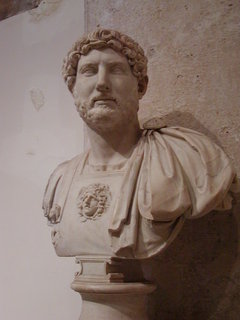 As I hiked along Hadrian's Wall last summer, I repeatedly tried imagining the scene a couple of millennia earlier -- Roman legions marching about, keeping wary eyes on the barbaric Picts and Scots to the north. But the wall was but one marker of the outer limits of the Roman Empire, an empire that -- under Hadrian -- had finally ceased expanding. One of Hadrian's first acts as emperor, in fact, was to pull back the legions from certain territories that his immediate predecessor, Trajan, had just conquered, leaving a strong Empire within the most defensible perimeter possible.
All of this I'd learned at one time in college, but it was impressed upon me far more vividly a couple of weeks ago -- while staying at a house in the land the Romans called "Gaul," where I had a view out the front window of a Roman amphitheater across the road -- when I discovered in a bookcase a copy of Marguerite Yourcenar's French language novel, Memoirs of Hadrian. Her novel, translated by Grace Frick into sonorous and stately English, tells the story of Hadrian's life, as narrated by him in a long letter to a still teenaged Marcus Aurelius, himself destined to become both emperor and a noted philosopher.
Hadrian was one of the most interesting of Roman emperors: a hardened soldier who amply represented the Roman virtues of duty and stoicism -- but also a devotee of Greek philosophy and art. A man who possessed great curiosity about both the physical world and the shadowy world beyond death; a man never fearful of diversity, who rejoiced in the differences he observed among the multitudes of nationalities that had been brought under Roman rule. Although comfortable enough when residing within his capital city of Rome, Hadrian had seen enough of the world to be well aware of the provinciality, narrowness and intellectual limitations of that city's citizens -- not just the common people, the mob, but Rome's Senators and patricians, as well.
No Roman emperor before him had ever spent so little time in the capital city of Rome; none had ever spent so much time, displaying so much curiosity, traveling throughout the many provinces of the empire.
Hadrian respected Trajan, admiring the talents of a highly skilled military mind, but he saw the lack of any profound thought behind so many of Trajan's policies, including his obsessive desire to conquer new provinces. Without questioning the need for a strong military, Hadrian's own experiences and temperament led him to rely far more heavily on negotiation and seeking common ground with Rome's enemies -- a reliance that turned many former enemies into allies.
Within the empire, Hadrian recognized the impossibility of ever building a strong society where great extremes of wealth existed, where the poor and the slaves had no hope to lead satisfying lives apart from open revolt. Although no one in Roman times ever acquired much insight into the workings of economic forces, Hadrian did make some effort to narrow the chasm between rich and poor.
Above all, Hadrian sought to unite the strengths of Rome -- law, politics, sense of duty, self-discipline, organizational skills -- with those of Greece -- love of beauty, intellectual curiosity, creativity, art and architecture, philosophical thought. Although his final decade as emperor was haunted by the devastating death of Antinoüs, the quiet Greek youth with whom he shared his happiest years, his sense of duty never permitted his personal grief to interfere with his plans and efforts to ensure Rome's prosperity and continuing security.
Although Hadrian died in A.D. 138, after 21 years of rule -- and although Yourcenar's fictionalization of his life was written back in 1951 -- Memoirs of Hadrian speaks uncannily to our own world, to our lives as 21st century Americans.
Hadrian's policies gave the Roman empire peace and stability for at least another century. His historical life is worth studying as an example of wise governance under conditions not wholly dissimilar to our own. And Yourcenar's book is worth reading as a moving and lyrical evocation of his life and times.