Tuesday, January 17, 2023

Hiking the Waihe'e Ridge Trail


I arrived home late Sunday night, following my four-night stay on Maui (plus a final night in Honolulu).  The weather was excellent, the accommodations were great, and the company was highly enjoyable.

As I mentioned in my last post, the occasion was the eightieth birthdays of two friends, Barton and Clinton (twin brothers), from undergraduate days, one of whom had later married my sister.  The celebration was organized by Barton's daughter, and was attended by Barton's two adult sons and adult daughter, as well as spouses and one of his granddaughters.  Clinton and my sister were there, but their son and granddaughter live in Thailand, and were unable to escape from school duties to make the trip.

This celebration came just four months after a week at Lake Como, Italy, with my closest graduate school friend, Jim, together with his brother and sister and their spouses, and with his own son.

Both gatherings gave me the opportunity to become acquainted -- with some, for the first time -- with the closest family members of my two closest friends from university days.  

Barton and Jim were and are quite different in many respects -- in personality and interests -- although both are now retired university professors.  Barton is more academic, and Jim is more "outdoorsy" and athletic.  I was impressed and a bit surprised, however, with the fact that both sets of family members all enjoyed -- with varying degrees of experience -- the act of hiking while on vacation.  

In Italy, we had many opportunities for hikes, both long and short, along the lake and in the neighboring hills.  On Maui, Barton's offspring decided to hike the Waihe'e Ridge Trail on the leeward side of the island, its trailhead lying somewhat north of Wailuku.  I enthusiastically joined the hike, of course.

The hike was quite steep in places, with an elevation gain of just under 1,700 feet.  After a short, initial, steep concrete-paved climb, the trail is generally broad and is surfaced with hard-packed earth.  I've read warnings that the dirt trail can become quite muddy and slippery during and after rains, but we met excellent weather -- sunny and cloudless, with little evidence of recent precipitation.

We completed the round trip to the summit in about four hours.  Some of us found the hike a bit more difficult than others, but everyone agreed that it was fairly strenuous, and everyone succeeded in reaching the top.  The scenery of the Pacific coast to the east and of the jungle-covered mountain ranges to the west were inspiring and made our labors fully worthwhile.  The scenery also provided excuses for frequent "photo stops" while we restabilized our breathing.

Hiking offers many pleasures and has many benefits.  One of those benefits is the ease with which conversations take place, overcoming any shyness that strangers or near-strangers might otherwise feel.  None of us, on either hike, were actual "strangers," but we learned more about each other's interests and personalities and coping skills than we could have in a week of sitting on the beach sipping Mai Tais.  (No disrespect intended toward that latter occupation, of course, which we also found entertaining!)

I loved Lake Como, and I've always loved Maui.  At both locations, I also enjoyed the opportunity to develop closer friendships with people whom I had known only casually in the past.

Travel is broadening.  So is hiking.  They make an excellent combination.

Wednesday, January 4, 2023

Eightieth birthdays on Maui


Thirty years ago, my family celebrated the eightieth birthday of my mother and her twin sister.  We encamped for a week in a low-rise hotel on Maui's Napili Bay, looking across the ocean waters at Moloka'i and Lanai islands.  And we gathered one night for the celebratory birthday dinner at the Ritz Carlton in nearby Kapalua. 

We had a great time. 

Next week, we gather again on Napili Bay to celebrate the eightieth birthday of another set of twins -- two guys who became close friends of mine as university undergraduates, and whose relationship to me and my family was cemented by the marriage of one young man to my sister.  

We will again celebrate this Big Eight-O with a dinner at the same hotel in Kapalua.

Thirty years ago, we younger folks did a day hike in Haleakala crater while the guests of honor relaxed on their deck overlooking the ocean.  They may have been thinking long thoughts about age and youth and the speedy flight of time.  If so, we young Indians (as we still viewed ourselves) were unaware, as we strode across the black sand trails of the crater.  This year?  The young Indians have all become wise and perhaps somewhat more sedentary elders.  Some of us still hike, but I've heard no suggestions that hiking is on the agenda.  Even the "kids," those invitees a generation behind us, seem more attracted to contemplation -- assisted by occasional gin and tonics -- than to strenuous trekking.

Our treks this year will probably be limited to a quarter mile morning hike to breakfast at The Gazebo (known to us, because of its profile, as The Witch's Hat) at Napili Point, on the southern end of the beach.  But, hiking aside, I anticipate a highly satisfying, if altogether too brief, vacation.  Why brief?  Because of a late start, I was able to reserve a room for only four nights -- keep in mind, you future visitors, that winter is High Season in Hawaii.  In past years, while my mother was alive, even a week felt much too brief -- I recall annoying others by my complaints: "Three days gone, only four more to go!"  

But sometimes a short visit has certain benefits.  Every moment is precious, and all the wonderful experiences feel condensed and heightened in intensity.  And so I hope it will be next week.

What can I tell you about this year's twins, this year's guests of honor?  Both were somewhat artistic when I first met them, and both seemed to flourish among the typical required courses of the undergrad liberal arts curriculum.  But one eventually became a radiology professor at Stanford's medical school, and the other became a much loved primary care physician and active member of the community in Sonoma, California.  We all stayed in touch, and skied together at Lake Tahoe for many years, until the Sonoma GP (then a resident of Berkeley) startled me by marrying my sister.

They were both pretty cool guys and good friends when I met them as undergraduates.  Their success in their careers and with their lives has been no surprise.  And now, 62 years later, we can celebrate the good times of the past, and look forward to the future, a future that is unpredictable but that we trust holds the possibility of many new satisfactions.

As the hopeful birthday wish goes, "And many more to come!" 

Tuesday, December 20, 2022

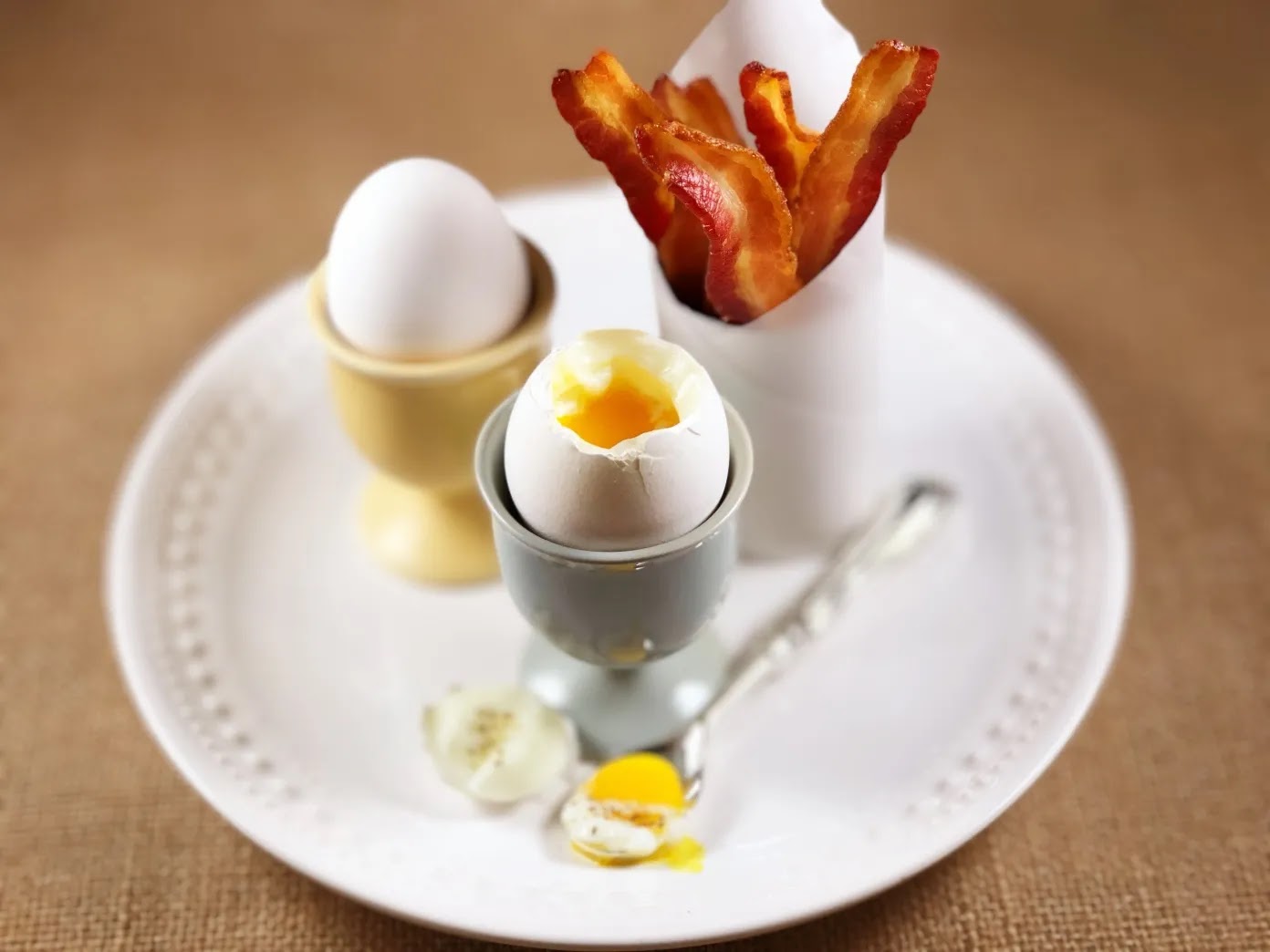
The egg and I (soft-boiled)


Three or four times a week, I jump out of bed, get dressed, and drive to a near-by diner where I have what the help -- who know me all too well -- call "your usual."  Two eggs over easy, with ham, potatoes, toast and coffee.  

It's enjoyable, although I have health-related doubts about the ham.  But it's not what I really crave.

And what do I really crave?  Two soft-boiled eggs, boiled precisely four minutes, served in egg cups, and accompanied by a tiny, well-designed egg spoon.

I've just finished reading, for the nth time, an essay by Ursula K. Le Gwin entitled "Without Egg," in her collection of essays No Time to Spare -- an essay that is a virtual hymn to a properly prepared and served soft-boiled egg.  She emphasizes, as would I were I to have written the essay, the importance of attention to detail.  And the use of the proper implements, especially the dedicated cup and spoon.  

You can't really ruin a soft-boiled egg, especially if you also like hard-boiled eggs.  But Americans, in general, miss the entire point.  Sure, you can scrape the innards out into a dish, salt and pepper them, and eat them with a normal spoon or fork.  It will taste the same as a properly consumed egg.  But as she points out, you thus miss the entire point:

... it tastes the same but isn't the same.  It's too easy.  It's dull.  It might as well have been poached.  The point of a soft-boiled egg is the difficulty of eating it, the attention it requires, the ceremony.

She discusses the egg cup, its appropriate use, and which end of the egg should be up (this last point an apparent matter of some controversy among soft-boiled egg aficianados).   Should one saw off the exposed end of the shell?  Or whack it off?  Le Gwin is an agnostic on this refinement.  As am I.  Both have their pros and cons.

But then the proper spoon.  Americans -- including myself, because often having no choice -- are apt to grab the nearest spoon handy and have at it.  They make a mess, and decide that next time they'll dump their eggs into their empty cereal bowl and eat it from there.  Le Gwin points out that the egg spoon is made tiny, because it must fit into the small opening you have made in the end of the shell -- the egg spoon is more a surgical instrument than a shovel.  Or, as she more delicately puts it, the egg spoon

does one thing only, but does it perfectly and nothing else can do it.  Trying to eat an egg from the shell with a normal spoon is like mending a wristwatch with a hammer.

She doesn't point this out, but I find that I can down two fried eggs in a few bites and still be hungry.  By the time I've worked my way through two soft-boiled eggs, however, I not only have been forced to eat slowly enough that I enjoy every nuance of flavor, but I find that my appetite is quite satisfied.  Although there's always room for a croissant or two.

But maybe Le Gwin understands this also.  She calls her essay a blow against double-tasking.  The concentration required to properly prepare and eat the egg from a shell precludes unnecessary talking, reading, or daydreaming until the immediate task has been completed.  Which is the best way to enjoy any food worth enjoying.  She relies on the exhortation in Ecclesiastes that whatever you set out to do (presumably, even eating eggs) you should do with

all thy might, for there is no work, nor device, nor knowledge, nor wisdom, in the grave whither thou goest.

Ursula Le Gwin adds "Nor is there any breakfast there.  The grave is without egg."  I say she thus has taken a morbid, if amusing turn.  I'll just say that if it's worth eating, it's worth eating properly.  And my soft-boiled eggs consumed in Europe, with proper spoon and cup, are far tastier than those gobbled down at home.  

Having written all that, I find I'm hungry enough to fly to Paris for breakfast.  But instead, I'm off in the morning to Santa Rosa for Christmas.  

Merry Christmas to all.  And eat egg.

Saturday, December 17, 2022

Music at Christmas


Once in royal David's city
Stood a lowly cattle shed,
Where a mother laid her Baby
In a manger for His bed.


The audience sat hushed as the ethereal, solo voice of a boy soprano reverberated throughout the austere interior of Seattle's St. Mark's Episcopal Cathedral, joined in the second verse by the full choir as it filed down the aisles in two parallel lines from the rear to the front of the church.  The Northwest Boychoir, in its 44th season, presented yet another annual Christmas "Festival of Lessons & Carols." 

Advent is traditionally a season of penance, and I decided to walk in the dark from my house to the cathedral.  The distance was only 1.5 miles, but the temperature was near freezing and the sidewalks were icy -- I came close to slipping to the ground as I started up one steep and treacherous stretch.  But the air was clear, and many of the houses I passed were brightly illuminated with holiday lights.

My timing was good, and I arrived forty minutes after setting out -- cold but bright-eyed, wide awake, and clear-headed.  Ready for the hour and a half service that each year transforms me into Christmas mode.

I like the fact that the format is always the same, based on the Christmas service of the choir of King's College, Cambridge, England.  It always commences with the solo first verse of "Once in Royal David's City."  After a couple of introductory carols, nine members of the choir -- beginning with younger and ending with older -- always offer the same nine readings from the books of Genesis, Isaiah, Micah, Luke, Matthew, and John.  Each reading is always followed by a carol sung by the choir, followed then by a familiar popular carol in which the audience joins in.

The choir consisted of 29 young members of Northwest Boychoir proper, 33 teenage boys from the associated group Vocalpoint Seattle, and 18 teenage female singers, also from Vocalpoint.  All singers were masked as a precaution against Covid and the flu.  This year, the proportion of teenage boy singers seemed higher than in the past; at least to my ears the tenor and bass voices, when all singers were singing together, seemed more predominant.  (At King's, there are equal numbers of each age group.)

My opinion is purely subjective, obviously, but -- even though the singers were still masked -- the singing impressed me as being sharper and more clear than it was last year.  And the excellent piano accompaniment sounded appropriately supportive, rather than dominating.

I was again moved and impressed by the entire performance.  After a final carol -- "O Holy Night" -- the audience burst into an extended applause, an applause appropriately delayed until the end out of respect for the religious context -- and another round of applause after the choir had filed out singing "Joy to the World."

Poised youngsters, still dressed in their choir gowns, greeted us as we left the cathedral, thanking us for our attendance.  My mind was full of musical phrases as I embraced the freezing air outside, and began my walk home.

Saturday, December 10, 2022

Christmas cards


Two weeks from Christmas Eve.  Christmas music on the stereo, cat on the sofa, and me.  Bent over the dining room table, filling out Christmas cards.

Yes, I know. Part of my annual tradition has become posting on this blog a short essay anguishing over whether I should still be sending cards, forcing myself to hang on to a dying tradition.  Or should I just shout out on Twitter, "Yo, dudes, merry whatever and eat lots of turkey."

But no.  This year I had no doubts.  I would send cards.

Then came the problem -- where will I get those cards?  I usually drop by the University of Washington Bookstore, and peruse tables covered with stacks of cards -- a tradition I began decades ago as a college freshman, perusing similar Christmas card displays at the Stanford Bookstore.  But what did I discover this year?  One-half of a table with a scant selection of uninspiring -- even somewhat ugly -- cards.  I recoiled, and returned home to my computer.  Surely Amazon would have oodles of cards on offer.

Well, it was better than the U Bookstore, but most of Amazon's cards didn't seem very attractive. I finally hit on one design that seemed somewhat acceptable, and ordered them.  They arrived today.  They look fine, but I've certainly had better ones in past years.  I'm certain that wonderful cards are out there, somewhere, still.  I just didn't look in the right places, or maybe I waited until too long after Thanksgiving?

But it's the thought that counts.  I have passed beyond the point of feeling awkward sending cards to people who don't reciprocate, although I do take their past instances of non-reciprocation into account in drawing up my address list.  I mean, if I don't get a card from them, I don't take it as a personal affront.  Quite possibly, they don't now and never have sent Christmas cards.  Or maybe it's been a bad year, and they just don't feel in the spirit. 

On the other hand, I've never encountered anyone who was offended by receiving a card, and it will hopefully make their Scrooge-like December a bit more cheerful.  And they hopefully will not brood, as I myself might do, at the fact that they didn't send me one -- or force themselves to send one to me next year!

As full-fledged adults, we're apt to worry too much about things, aren't we?  Things that don't call for concern.  I'll try to recall my youthful enthusiasm to simply wish everyone a wonderful Christmas, without worrying about what it all means, or how my wishes might be received.  Let's keep it simple.

Merry Christmas and a Happy New Year!  

Thursday, December 8, 2022

Family Christmas in Sonoma


Just over two weeks until Christmas.  

For us as kids, Christmas was ritually a very stable holiday.  My mother made sure that certain rituals were repeated each year, rituals that she had more or less devised herself, but which to us kids seemed to represent  the true way that all non-pathological Americans celebrated Christmas. 

We were a small family in terms of non-resident relatives -- parents, aunts and uncles, cousins -- and so the rituals of Christmas almost always were observed in our small house: my parents, my brother and sister, my mother's twin sister and her husband, and my grandmother on my father's side.

The period of time during which these stable rituals occurred was little more than a decade, but a decade to a child (or even a teenager) is a lifetime.

Life is more chaotic as an adult.  Relatives insist on living all across the country, sometimes around the world.  And even relatives who are geographically near often prefer to act out their own family rituals, rather than merge into a gathering of the clan.

But this year, we will have such a gathering -- either at Christmas itself or, for some of us, during the week following.

Readers will recall that we had a similar family reunion in April, when my nephew Denny returned from Thailand to his California hometown, Sonoma, for the first time since the start of the Covid pandemic.  I concluded my essay describing our get-together with a plea for more frequent family reunions -- and my plea seems to have been answered.

We gather again in Sonoma.  Denny will return once more from Chiang Mai, Thailand, together with his wife Jessie, his now-teenaged daughter, and his dad.  My sister and her youngest son will arrive from Challis, Idaho.  My brother and his wife, together with their daughter, her spouse, and their eleven-year-old daughter will arrive from Southern California.  

We will also be joined by Suzanne, the daughter of my closest friend from college days, together with her husband -- visiting from San Diego.  She has stronger ties to my family than merely those resulting from my college friendship with her father, but those ties require more explanation than required at this time!  But they are family, too.   

And it will be a multi-family reunion, to some extent, as Jessie's family lives in the Sonoma area, and some of our gatherings will be together with them.

My  own somewhat solitary life in Washington state, in the Northwest Corner of the nation, at times feels like that of a tender of a lighthouse on a rocky outcropping from the shore.  Even though Washington is the ancestral home of my family, where my siblings and I spent our pre-college years, all but I have since fled our wintry rains like rats leaving a sinking ship.  So I look forward eagerly to these large gatherings, masses of people all related to me in one way or another, and wish they occurred more often.  It makes Christmas feel more like Christmas, even when celebrated in a distant land (i.e., California!).

I leave home on December 21, and will return on the 28th  My brother and his wife won't show up until the day after Christmas, which I regret.  But I spent a wonderful five days with them over Thanksgiving at their home in Palm Desert.

Now, my only problem will be explaining my absence to my two cats, trying to convince them that while the master's away, the cats can play.

----------------------------------------------------

Photo:  Earlier family reunion.  Big Bear (California) (2011)

Saturday, December 3, 2022

Feuilletons


During the dark days and weeks since late October -- the period after my old computer crashed, but before I finally pulled myself together and secured a new one -- a computer that arrived only this week -- I had ample time to think about the nature of my blog.  

After nearly sixteen years, and over 1,500 posted essays, the time to think about it did seem ripe.

What exactly do I write?  Essays, but what kind?

Lots of book reviews and movie reviews. Lots of thoughts about politics.  Observations about nature, especially about Seattle's peculiarities of weather.  Holidays.  Travels, completed or anticipated.  Reprints of old travel  journals and newspaper articles.  Musical experiences.  As I look over the list of some 1,500 posts, there's a bit of everything.

I've even written a few feuilletons.  What's that, you ask?  And well you might.

I'm reading a biography of an author and journalist from the first part of the century, a Jew from what is now western Ukraine but that was then part of the Austro-Hungarian Empire.  His name was Joseph Roth, and his novels were largely autobiographical -- which isn't unusual -- but so was his journalism -- which was more so.

He was a foreign correspondent for a Frankfurt, Germany, newspaper.  But he preferred to take a subjective approach toward his news dispatches, rather than the purely objective approach they taught me and my classmates in high school journalism.  This objective approach was, he felt, despicably and soullessly German and American.  

I will discuss Roth's biography -- Endless Flight by Keiron Pim -- in a later post.  But I mention it now because -- in addition to his news articles written as a foreign correspondent -- he also wrote numerous feuilletons for his Frankfurt newspaper.  While journalists -- meaning American journalists -- don't like to let their feelings intrude obviously into their formal news stories, they often do write feuilletons -- feature stories -- without, probably, even knowing the word feuilleton.  

These tend to be fairly short feature articles based on the writer's observations, and discussing -- explicitly or by inference -- his own feelings about what he has seen.  The observation serves as a jumping off platform for the subjective feeling or thought that he wishes to convey.

I suppose that the readers of the New York Times who send in short discussions of their observations or experiences as they go about the city, designed to arouse laughter or sadness in the reader of those observations -- observations that are published each Sunday under the heading of "Metropolitan Diary" -- are writing (or attempting to write) very brief feuilletons.

Without categorizing what I was doing, I've written a number of such feuilletons, with greater or lesser success.  For example, in August 2017, I described watching a sobbing homeless person being escorted off a light rail platform by a security officer, and forced to enter a train stopped at the station.  I was unable to determine exactly was going on, but I felt free to imagine for my readers the mental state of the upset passenger and the events that had brought him to this unfortunate event.  And I wondered -- far too late -- what I might have done to ease his pain, and why I had failed to do it.

The objective observation was the interaction between the crying man and the security guard.  The subjective component, which converted the observation into a feuilleton, was my attempt to empathize with the man's feelings and reconstruct his history.

I know nothing about the bearded guy's back story, although I tend to make up stories for people in my head. But I'd say he was a gentleman who had no further physical or emotional resources available, regardless of what "act" of his life he was contemplating. I suspect we are surrounded by people like him. Maybe they still have enough pride not to cry. In public. But they want to.
Joseph Roth had written in 1919, with far greater artistic sensitivity:

I saw children blowing soap bubbles.  Not in 1913 -- yesterday.  They were real soap bubbles.  A little bottle full of soapy water, a straw, four children and a quiet alleyway in the bright sunshine of a summer morning.  The soap bubbles were big, beautiful, rainbow-coloured globes and they swam lightly and gently through the blue air.  There was no doubt these were real soap bubbles.  Not the soap bubbles of patriotic phraseology risen up from the muddy puddles of war editorials, the nationalist party, or the press corps, but beautiful, rainbow coloured soap bubbles.

The children and the bubbles were a simple observation, but Roth adds his own comparison of the children's innocence with the slimy, dirty "soap bubbles" of right-wing propaganda, as well as a reminder to his readers of the simple urban joys they had enjoyed in pre-war days.

Feuilletons are deceptively simple in  appearance, but not easy to do well.  I may make a conscious effort to write more of them, now that I better understand the form.

And know what they're called.  Even if I can't pronounce the word.

Wednesday, November 30, 2022

Light at the end of the tunnel


Yesterday, Seattle had a bit of snow  Not enough to cover my neighborhood's streets, but enough to put a white sheen over our lawns.  It snowed a bit, and it rained a bit, and the net effect so far hasn't been much.

Except that our November weather apparently sufficed to knock out power from 7:15 p.m. until about 10:15 p.m. last night.  I had given up and gone to bed at 9:30, and was awakened less than hour later by the lights coming back on.

You don't realize how much you depend on electricity until it isn't there.  My cats and I sat in a large dark living room, staring into the blackness and avoiding conversation.  I felt my way to a cupboard and grabbed my flashlight.  I didn't know how long this would last, so I also reached into a drawer for a couple of fresh batteries.

The window next door revealed lit candles.  True survivalists, obviously.

You can't read.  You can't listen to music.  You can't use your computer.  I did have my iPhone, but it was low on battery, and I just sent a fast, plaintive message to Facebook, advising them where to find my body.  Worse than the darkness, moreover, was the loss of my furnace.  It was when the temperature dropped below 60 degrees (15º C) that I gave up and headed to bed.  Throwing an extra quilt over me, since the electric blanket was useless.  

It wasn't just my house, and it wasn't just my neighborhood.  It was black at street level as far as I could see, but the clouds were reflecting light from some far off areas, which kept my street from the total blackness you might find in a horror movie.

Folks on Facebook chided me this morning:  "Poor guy.  It must have been like living in Ukraine!"  I know, I know.  I'm a pussy.  But my brief three-hour experience did give me increased empathy for the horror that Ukrainians endure, week after week, month after month.  I wonder how well I would hold up under not only the constant threat of bombing by a vicious neighbor, but from the loss of all the ordinary services we expect in a civilized society.  

Which brings me to the theme of this little essay.  Just as I have endured three hours of darkness and cold, so I have endured four weeks of loss of my computer, and you, my arguably faithful readers, have endured the blackness that you have discovered each day on my blog.

But, oh joy!  My new computer arrived yesterday, and I spent the afternoon setting it up and trying to struggle my way through Window's latest iteration of its operating system -- fighting to install Chrome as my browser and to resist Microsoft's tenacious struggles to keep me on "Edge"!  The battle isn't over, but I've mastered the simpler basics, such as how to continue with "Confused Ideas" in its usual format.

Life without blogging is like living without light and heat, and I sigh a sigh of relief as life returns to some version of normal.  Glad to be back!

Wednesday, November 16, 2022

Good news


 After an unconscionably long period of time, procrastinating and dithering over the problem of my frozen computer, I have ordered a new desktop.  A new computer won’t solve my problem of seven years of missing files, but that has no bearing on my ability to publish my blog.

The new computer is scheduled to arrive approximately the weekend after Thanksgiving (November 24, this year, for my non-American readers).  Barring some new disaster, some fascinating — more or less — essay should be forthcoming soon thereafter.

As businesses tell you, while you wait for hours on the phone for a company agent:  

THANK YOU FOR YOUR PATIENCE.


Tuesday, October 25, 2022

Computer crash


 As if my posts on this blog haven’t been infrequent enough over the past few months already, my computer has now crashed.  Apparently permanently.

I will need to order and install a new computer, and ascertain how much of a decade’s worth of data has been saved “in the cloud,” and how much has been lost irretrievably. 

Until that’s been completed, my readers will have to be even more patient than in past months.  The only way for me to post at present — as I’m doing now — is on my phone, which is unsatisfactory in many ways.  Especially for those of us addicted to touch typing.

Thanks for your continued patience and interest.  I love having readers.  Maybe, during the upcoming hiatus, you can peruse my past essays, posted over the past 15 years.


Friday, October 14, 2022

Two weeks at Lake Como


We now pass swiftly from my arrival in Milan on September 8 to my arrival at our rental property on Lake Como on September 10.  Eliding, thereby, the dispiriting events of September 9 -- already described two posts ago -- which resulted in my spending my remaining 16 days in Italy with only one usable arm.

Dispiriting, I say, but I was not dispirited.  I saw myself -- I see myself, now -- as leading my legions from the Lombardy plains to the Como lakeshore, much as one-armed Lord Nelson himself lead his ships into battle.  An heroic figure, one might conclude. Even though my arm had been lost not in battle in the Canary Islands, as had Nelson's, but in a bathtub in a Milan hotel.

Week One

Because of changed logistics, we abandoned our original plan, described in earlier posts, of taking the train to Como, a ferry from Como to Menaggio, and a bus thence to our rental.  Instead, we hired a taxi to take us directly from our Milan hotel to the lakeshore rental.  Less picturesque, but simpler.  Or it would have been simpler if the driver had not heard "Menaggio" as "Bellagio."  His mistake wasn't appreciated until I noticed that, once past Como city, the lake appeared to be on the left side of the road, rather than the right.  Words were exchanged, tempers flared, some euros changed hands, and all ended well.

Our taxi delivered us to the parking area above the winding, pedestrian-only streets of Rezzonico right on time, and we were greeted by the same friendly and helpful manager who had met my sister, my cousin and me one year earlier.  Her young helper Michael carried our bags down the multiple flights of steps to our rental house at lake level.  The manager, remembering me well from the year before, gave us this time only a quick tour of the house, and -- at our request -- made our Saturday reservations for dinner at the local pizzeria.  She left, the members of Week One looked around, making small exclamations of pleasure at what they saw, and we settled in.  

The villa became our villa for the following seven days.

The six members of Week One, aside from myself, were all members of the family of the same Jim with whom I'd been hiking in Scotland.  Jim, his brother, and his sister are children of a former Dean of the Forestry School at the University of Washington; they seem a close-knit family, with similar instincts and with interests that -- as you might suspect -- center around outdoor activities.  Finding things to do at Lake Como that everyone enjoyed was easy.

Some activities are almost obligatory for almost all first time visitors, of course.  We took the ferry to the picturesque cross-lake towns of Bellagio (of George Clooney fame) and Varenna, and a long distance ferry ride to Colico, at the far northern end of the lake.  We hung out in Menaggio, drinking coffee and eating gelati.  Menaggio was also where we did our grocery shopping and found access to local ATM machines.

And we walked.  On Tuesday, we did a long walk up into the hills behind Rezzonico, ultimately reaching the tiny village of San Martino -- a tiny village we later found quite noticeable from below, marked by the tall steeple of its church.  We met two New Zealand women, former teachers, who were renting a house in San Martino, who entertained us with much needed flasks of cold water, and, learning that one of our group was an educator, discussions of educational philosophy.  Later that week, we walked from Rezzonico along the lake shore south to Acquaseria, and then returned home by a high route, passing through agricultural fields and through the streets of small towns.  And on Wednesday, three of us walked northward, to the next village of Cremia.  None of these walks was overly strenuous; they were all scenic, and they all offered us a good picture of ordinary people, both tourists and local residents, going about their lives.

The gustatory climax of the week was our Thursday dinner at Lauro, an excellent but tiny, informal, and family-owned-and-run restaurant located in Rezzonico itself, a two or three minute walk from our rental home.

Week Two

But Saturday finally arrived, the people of Week One sadly left by bus to the railway station at Como city, and -- while the owner's staff prepared the house for the next group -- I hung around Menaggio waiting for their ferry to arrive.  It did, and the people of Week Two emerged, led by my grinning sister.  Also disembarking were my eldest nephew and his wife, one of my sister's oldest friends and her wife, and the friend's daughter, and the daughter's husband, and their son (age 4) and daughter (age 1).  Overall, a younger group, and somewhat different -- but not completely different  -- in interests and attitudes.  Actually, I was happy and a bit surprised to find that the entire group loved hiking as much as the Week One group had.  And while two pre-school kids, precocious as they seemed, definitely changed the atmosphere at times, their presence didn't curtail their parents' hiking -- the four-year-old was a bundle of non-flagging energy, and his young sister alternated between trying to keep up with him and riding in a carrier on the back of one parent or the other.

We did some of the same things as did the first week's group.  The mandatory ferry ride to Bellagio and to Varenna.  The long ferry ride northward, although we decided to go only as far as Dongo -- where Mussolini was nabbed, trying to escape to Switzerland -- rather than all the way to Colico.  We drank cappuccinos and ate gelati at small lakeside cafés.  More so than with the first week's group, much shopping was done and euros changed hands -- definitely not my activity, and all I can tell you is two words -- "silk scarves."

Our hiking was perhaps more ambitious than that of Week One, in distance if not in altitude.  We took the bus to Colonno, south of Menaggio, and hiked back northward eight miles along the lake shore to Griante, stopping for a very satisfying lunch in the beautiful town of Lenno.  We hiked the five miles from Rezzonico to Menaggio, Menaggio being our "big city" where, usually arriving by bus, we did our grocery shopping and hopped the ferries.  And one day, while others were plotting shopping expeditions, I walked northward once more to Cremia, and then onward to Pianello, an exhilarating hike reminding me why I sometimes enjoy walking alone.  

Week Two neared the end of their stay on Thursday with the same highly enjoyable group dinner at Lauro as had Week One, and then on Friday with a home-cooked birthday dinner for our one-year-old -- no longer one, but now two.  (Did I mention that both she and her four-year-old brother seemed older and more sophisticated than I recall kids at that age being when I was young?)  

And so on Saturday morning, after checking out and watching Michael once more haul our bags, this time up the endless steps, we found our selves waiting at the bus stop for the bus to Menaggio, connecting to the ferry to Como, connecting to the train to Milan.  An unforgettable two weeks for me, and I suspect for everyone.  

But I'm confident it will not be the last time I ever see Lake Como.

--------------------------------

This post may seem excessively detailed as a vacation summary.  Please be indulgent.  I write it to remind myself of various sequences of events, so that in future years as my memory fades, my endless stacks of photos will make some chronological sense!

-------------------------------------


Photo:  Isola Comacina, the only island in Lake Como.  Week Two walked past this island while we walked the lakeshore from Colonno to Griante.

Saturday, October 8, 2022

West Highland Way -- 2022 version


On Sunday, August 28, in late afternoon, I dragged my weary body from a downtown Glasgow airport bus stop several blocks to my booked hotel and collapsed.  It had been a long day and night of flight and six hours sitting in Heathrow, with little or no sleep.  Soon after arrival, Jim and Dorothy came by the hotel, and we all went out to dinner at the "Missoula Montana Bar & Grill."  No, it really happened, surreal as it seemed then, and as it seems now in recollection.

Four weeks later, I returned to Seattle from Milan.  That was almost two weeks ago, and some explanation for my delay in summarizing my trip may be called for.  First, jet lag.  Second, a bad cold that began the night before my flight home and that is still running its course today.  And, most dramatically, a dislocated shoulder (see last post) from which I'm still recovering, together with the dramatic warning from my orthopedist that I almost certainly had sustained a partial or even full tear of my rotator cuff, requiring surgery.  An MRI was scheduled.

Not all news is bad news.  The MRI apparently revealed that yes, I had a partial tear to my rotator cuff, but it had occurred long ago and my body had fully compensated for the damage by making substitute use of other muscles and ligaments.  No new tearing had occurred in Italy.  No surgery would be required.  He recommended physical therapy, to strengthen muscles and increase range of motion.

I know now how a condemned prisoner feels when he receives a pardon from the governor.

So after an all-too-un-Montanan dinner in Glasgow, we proceeded to Milngavie on Monday, as planned, loafed around the pleasant small town, and prepared to begin hiking on Tuesday, August 30.

As mentioned in an earlier post, I hiked the West Highland Way back in 2011.  I remembered parts of it well.  Some parts I didn't recall at all.  Other parts were different from how I remembered them.  Above all, hiking with two friends changed the experience -- from a solitary adventure into the unknown to a more social experience -- fewer thoughts of encountering ghosts of Highland rebels, smugglers, and drovers on the high moors, and more joking, more discussions of the pleasures and miseries we encountered on the trail and in each night's B&B or small hotel. 

The trail is considered moderately easy as British trails go, but it had its challenges.  The second day, as part of a 13 mile hike, we climbed  up and over "The Conic," a high peak with a gradual ascent but a precipitous decent into the village of Balmaha, a pleasant, well-touristed town on the south shore of Loch Lomond.  (An alternate route by-passes The Conic, for those wishing to avoid the climb.)   

The following night was spent at the stately Rowardennan Hotel, midway up the east side of Loch Lomond.  Our relaxed evening at the Rowardennan didn't prepare us mentally for the following day's formidable hike to Drover's Inn at the northern tip of the Loch -- formidable not so much for the 13 mile length of the hike, but for the very rough trail, composed mostly of rocks and tree roots.

Once past Drover's Inn, the hiking was relatively easy, even when the days were long.  My friends kidded me for being overly concerned about our meals -- both quality and quantity -- but I have to admit that the freshly-caught local trout served for breakfast, along with our eggs, at Tiigh Na Fraoch inn in Tyndrum, and the elegant Avocado Eggs Benedict served at the Inveroran Hotel in Inveroran were surprises, and a nice break from the usual "Traditional Scottish Breakfast." 

After Inveroran, we found ourselves crossing the vast expanse of Rannoch Moor.  My memory of the moor from 2011 was one of a mysterious realm -- a dry path leading through grassy marshes, surrounded by crags with threatening-sounding Gaelic names.  I walked alone, and encountered very few other hikers.  I wouldn't say the experience was at all scary, but it had the potential for being scary if I'd twisted an ankle, or had found myself walking alone after dark.  But this time, the sun was brightly shining, I had friends to talk with, and the trail was crowded with fellow hikers.  

The changes in experience were both gains and losses.  For me, perhaps, with my sense of imagination and love of telling stories to myself, more losses than gains.

This was especially true at the end of that day, when we came down off the moor to Kingshouse.  Kingshouse is very old, and was famous in the 18th century as a meeting place for smugglers.  It was a cozy place to stay overnight, at the head of Glen Coe, despite its obvious age.  But in the past eleven years, Kingshouse has changed radically.  No longer an isolated white building looming ahead on the trail, it is now surrounded by ancillary buildings.  The main building itself has been largely renovated and enlarged with modern additions.  No apparent attempt has been made to preserve the atmosphere of the old building, except in the bar.  

We did not stay in Kingshouse this time.  Because of demand, and probably price, the company that arranged our accommodations provided a cab ride from Kingshouse, down Glen Coe to the coast, and back up the next valley north to the old aluminum producing town of Kinlochleven.  The following morning, a cab returned us to Kingshouse, where we hiked back to Kinlochleven.  The trail out of Kingshouse leads you up the "Devil's Staircase," so named by British soldiers required to carry supplies on their backs up the switchbacks.  Although I was eleven years older, the hike seemed easier this time than last.  However, a photo taken of me at the top, attempting to pose in the same manner as I had in 2011, dispelled any illusion that I hadn't aged!

My second night at Kinlochleven was the end of the trail for me.  My companions hiked the final fifteen miles to Fort William the following day.  I beat them there by taxi, where I caught a train back to Glasgow.  A flight cancellation by British Air had forced me to fly from Glasgow to Milan a day earlier than planned.  Jim and Dorothy had excellent weather for that last day of the hike.  In 2011, it had poured during the entire day's hike -- a hike through what is described as the most scenic leg of the West Highland Way.  I saw nothing but the puddles in the trail beneath my feet.

I may have to return to Scotland some day just to hike that final fifteen miles!

Once I'd left Glasgow and arrived in Milan, the second half of my thirty day European vacation began.  But that's a story for a later post.

-----------------------------

Photo:  Bridge of Orchy, built by the English military in the mid-18th century to assist moving soldiers to the Highlands to put down rebellions.

Wednesday, October 5, 2022

Dislocation


"But no matter how much planning you do, one tiny miscalculation, one moment of distraction, can end it all in an instant."

--Jeannette Walls, Half Broke Horses

It had been an amazing two weeks, hiking the West Highlands Way in Scotland with my friends Jim and Dorothy.  But wait!  There was more to come.  On Thursday, September 8, I flew from Glasgow to Milan, where I was to meet up with a group of Jim's relatives, and proceed to a house we'd rented on Lake Como.

I arrived late in Milan, checking into my hotel near the Milan Central Station at about 9:30 p.m.  I'd been warned that my friends had already gone to bed; we were to meet over breakfast in the morning.

I bounced out of bed, full of excitement, the next morning.  I took a shower in the room's deep tub, thinking about the day to come.  I had to make sure everyone was gathered together -- Jim was flying in that evening, and Jim and Dorothy's son arriving early on Saturday, the tenth.  We had to be at the station reasonably early on Saturday to catch a train to Como, connect with a ferry to Menaggio, and arrive at our rental house some five miles north of Menaggio by the 4 p.m. check-in time.

My hair washed and my body scrubbed, I turned off the water and stepped out of the tub.  But I never quite made it.  My foot slipped on the soapy bottom of the tub, my head hit the wall, I tried to catch myself on the floor outside the tub with my right arm.  After that?  My only memory after that was of excruciating pain.  

Not just excruciating pain, as when you hit your finger with a hammer.  Excruciating pain that remained excruciating at the same level as the minutes went by.  It dawned on me, through my mental haze, that something had gone very wrong, something beyond twisting my wrist or shoulder.  Finally, I contacted Anne, one of the friends with whom I had planned breakfast.  She was alarmed by the sound of my voice, and sent John, her brother, to see what was wrong.  I somehow had managed to pull on some boxers before he arrived.

I suppose that, even when dying, I'll want to comb my hair before the undertaker arrives.

John and Anne and their spouses leaped wonderfully into the breach.  Somehow, an ambulance was summoned, my bags were packed while I squeaked out instructions, and we dashed to an orthopedic hospital, sirens wailing.

It's a cliché, but Italians do have a flair for the dramatic.

By now, I was well aware that I'd dislocated my shoulder.  Full props to the ambulance personnel for treating me gently and with compassion -- although our speed  on a rough road made an extremely uncomfortable ambulance ride.  But, to be honest, I was beyond being able to distinguish between degrees of "excruciating."

I was admitted immediately at the hospital ER, and -- after a frustrating conversation about my travel insurance -- was subjected to numerous x-rays.  I was then seen by an orthopedist who spoke quietly to me, held my hand, pulled my hand gently -- it felt good, the first improvement in my level of pain that morning.  She gradually pulled more strongly until -- wow! -- I felt great.  The pain almost totally vanished in an instant.  I was given post-reduction x-rays, and my right arm was wrapped up in a sling.

Great moments in medicine, as MAD Magazine once declared it -- the presentation of the bill.  I was expecting something in the order of several thousand dollars.  But it was 340 euros -- at a time when the euro was worth almost exactly the same as the dollar.  They didn't have enough information to bill my insurance company, and they couldn't take my credit card, so they handed me the bill.  Have your bank wire us the money, they requested, trustingly.

Was my stay at Lake Como ruined?  Hardly!  But it was changed.  My friends abandoned our plans for a train-ferry trip to the rental house, and hired a taxi.  Less problem with moving me and my baggage about, although by the time I returned to the hotel, aside from having one arm hors de  combat, I was back to being my usual excited, witty self.

I hiked (well, walked) long distances almost daily for the next two weeks, and did everything everyone else did, everything I'd planned on doing.  I just did it all one-armed, with my crippled arm tucked under my t-shirt.  

But I wasn't unaffected by my injury, even when the pain was minimal or non-existent.  Before, I had been, mentally if not physically, a young guy up for any adventure.  Afterward, I found myself considering each day's activities, asking myself if I could handle the challenge, and if I could do it safely.  Thoughts that rarely crossed my mind before the Great Shower/Tub Incident.

Returning home, I learn that I may have torn my rotator cuff, which might well require surgery with a long period of recovery.  I am scheduled for a shoulder MRI this evening.

Looking back, I keep pondering how my cheerful plans while showering, feeling excited about the day and capable of anything, were changed in an instant into extreme pain, and, worse, into a prolonged period of partial disability -- a period that continues today, and the full extent of which may not be known for months.

"One tiny miscalculation, one moment of distraction."  A lesson many learn to their sorrow at a much younger age than I have.  But a lesson that, whenever learned, changes one's sense of reality, of the continuity of life from one day to the next, from one moment to the next.

Friday, August 26, 2022

Writer's block, redux


So let's review the bidding.  Since July 28 -- nearly a month ago -- I have published one small essay on this blog:  On August 14, I reminded everyone that in two weeks I'd be in Glasgow.  Ready to begin my second walking of the West Highland Way. 

That was twelve days ago.  Tomorrow, I fly to Glasgow.

My blog has indeed been rich in content.  If by "rich" we mean one bare bones description of my planned vacation travel.  

And now?  It will be another 31 days from now before I return to Seattle.  To my computer.  To a place equipped to permit me to churn out my next feeble effort. 

Well, I do promise to give you, upon my return, a full accounting of my month's leave of absence.  

But there was a time -- say last summer -- when you were able to expect more from me -- in quality, and certainly in quantity.  Hopefully, my writing flows onward like a sine wave, and we have merely hit the bottom of that wave.  We're headed back up!  To amazing new peaks of quality, spun out several times a week. 

It could happen.

But then I remember the career of E. M. Forster.  Along with numerous short stories, Forster wrote five acclaimed novels between 1909 and 1924.  His 1924 novel, A Passage to India, was perhaps his best, the subject of a well-received movie in 1984.  Forster wrote that last novel when he was 45.  He lived to the age of 90, but never wrote another novel or other serious work, aside from some short stories published posthumously, during those final 45 years of his life.  

Now that's a serious writer's block.  I should post a photo of Mr. Forster above my computer as a stern warning.

Sunday, August 14, 2022

Return to the Highlands


Paths are made by walking.
--Franz Kafka

Two weeks from today, I'll be looking forward to a comfortable bed in Glasgow, following a long flight from Seattle to London, and a 6½-hour layover at Heathrow.  I hope that I will have been reunited with my checked baggage, but, in light of recent airline difficulties,  I'll take the precaution of putting a few overnight necessities into my daypack.

Once in Glasgow, I'll meet up with friends Jim and Dorothy, and -- after my much-needed night's sleep -- we'll take a commuter train ride the following day to the suburb of Milngavie -- a pleasant small town, and also the start of the 96-mile West Highland Way northward to Fort William.  Those of you with extraordinary memories may recall that I hiked the same trail alone back in 2011.  It was one of my favorite British hikes, and I look forward to doing it again.

Immediately following completion of the hike, Jim and I will return to Glasgow by train, where we will say goodbye to Dorothy and catch a flight to Milan.  In Milan, we will meet with other members of Jim's family, and proceed to Lake Como, where we will stay in the same lakeshore house that my sister, cousin, and I stayed in a year ago.

At least that was my simple plan until British Airlines canceled my flight, forcing me to leave Scotland a day earlier than planned.  As a result, I will lop off the last 14 miles of the hike, and travel by taxi (or possibly, bus) from our overnight accommodation in Kinlochleven to the train station in Fort William.  Jim had better luck getting an alternate flight, and will be able to complete the hike, arriving in Milan one day later than will I.    

I'll be sorry to miss the last leg of the hike, but I did finish the entire hike in 2011 -- walking that last stretch in a constant downpour, as so often happens during summers in Scotland.  I'm glad Jim and Dorothy will be able to complete the hike, and wish them better weather than I had on my last day.

The West Highland Way is a beautiful hike, varied in terrain and in atmosphere -- from the gentle terrain of the Loch Lomond shoreline, to the bleak beauty of Rannoch Moor, down to the head of Glen Coe, up the switchbacks of the aptly named "Devil's Staircase," and across a forested expanse through Kinlochleven and on to Fort William.  

Just two more weeks!