Tuesday, July 31, 2018

Putting it off


During the year or so before I turned 16, my fancy turned, not-so-lightly, to thoughts of -- getting my drivers license!

I remember, for some reason, walking home from school when I was about 14 or 15, and looking at a street I was crossing in a new way.  Suddenly, it was no longer just a hunk of concrete.  It was a conduit to every street, road, and highway in North America.  If you had a car -- or access to a car -- the continent was yours. 

Once you had a drivers license.  Within a day of turning 16, I was at the county courthouse taking the written portion of the exam.  Score: 100 percent.  Yay!  Within another week or so, I was sitting in the family car, an officer in the passenger seat, taking the driving portion of the test.

And failing it.  Parallel parking did me in.  I was devastated.  How could I -- whose self image was perfection itself -- have failed something so basic?  My self-confidence was momentarily shattered. But a few weeks later, I girded up my loins and returned to the scene of the crime.  I took, and passed, my second try at the test.

I recall vividly the highs and lows of my zealous drive to get my license -- a zeal shared by virtually every one of my contemporaries -- because of recent stories suggesting that getting a license is no longer that big a deal for kids as they turn sixteen.  Certainly not getting it right at sixteen.  And some are even put off by the whole idea of driving.

Heresy!

A recent study showed that in 1983, nearly 50 percent of American 16-year-olds had their license.  By 2014, that percentage had fallen to about 25 percent.

Teenagers offer a number of reasons for the change, a change that they don't consider particularly surprising or interesting.  The Seattle Times did an informal survey a few months ago, asking teenagers about their lack of interest in driving.  Their responses?

  •   The teenager didn't have his or her own car.
  •   Public transportation got them anywhere they wanted to go.
  •   Gas and other costs of driving were too expensive.
  •   Drivers education is today a prerequisite for obtaining a license before the age of 18, and -- unlike for my generation -- is rarely provided by public schools.  The course typically costs about $500.
  •   Thirty-five percent of those surveyed who had not obtained a license said they "just didn't get around to it."

The Detroit Free Press, discussing the same issue, quoted a driving instructor, Patrick Klubben:

He said the newer generation’s “mentality is a little different.”
“Some don’t want that responsibility and avoid it,” he said of driving.
Cultural norms around parenting have changed, too. Klubben said parents are now more willing to chauffeur their teens. If someone is willing to drive you around, why go through the trouble and expense of getting licensed?

I mull these factors -- these excuses -- over.  Most of them applied to some extent when I was a kid.  We -- I -- brushed them aside as inconsequential.  We needed a license with every fiber of our being.  We'd decide what we were going to drive and how we would pay for it afterwards.

The conclusion I draw is that, as Klubben notes, today's mentality -- today's teen's psychology -- is different.  We needed a drivers license because we needed to grow up, and in our world we had a limited number of ways to demonstrate our progress toward that goal.  Being able to drive was one of the great societal markers on the road to adulthood.  Today's teens may (or may not) have that same urgency for adulthood, but if they do they have other ways of achieving it. 

And besides.  If by the time you were eleven years old, you had already conquered the world repeatedly on your computer, and had wiped out impressive quantities of bizarre aliens, and if you had all of the world's knowledge at your fingertips on-line, what excitement would there be in receiving permission drive a four-wheel automobile?   Driving becomes a totally utilitarian skill that may or may not be of use to you "in real life."

You really need to go somewhere in town?  Don't you have an Uber app on your phone?  You need to travel across country?  Really?  Like that guy Jack Kerouac?  Why not just travel "virtually"?  It's safer, and cleaner, and a heck of a lot easier.  A computer never gets flat tires.

Damn kids!  They play their music too loud, too!

Sunday, July 29, 2018

Brahms al fresco


Attendance at the symphony leads one to unconsciously conclude that, in today's world, only old folks like classical music.  It was refreshing to grab a seat (a bit of grass) at Volunteer Park last night and observe the full age spectrum in attendance.

As an adjunct to their summer series each year, The Seattle Chamber Music Society performs a free concert in the park:  "Chamber Music in the Park."  This year, they played an Arensky string quartet, and the Brahms String Quintet in G Major.  Both were well performed by nationally renowned musicians.

As enjoyable as the music was the chance to observe the audience -- a very large audience.  I arrived a half hour early, and it was already tricky to find a place to sit that had a view of the performers that wasn't blocked by someone sitting on a camp stool.  Families and groups of friends were sitting on blankets -- some munching on sub sandwiches, others enjoying more refined fare.  A small group of 20-somethings next to me had covered their blanket with a buffet of finger food to go with their wine, illuminated (unnecessarily in the sunlight) by two lit votive candles.  Quite elegant.  Those who were older and a bit stiffer in the joints sat on camp chairs they had brought with them. 

And then there were the plebeians like me who sprawled out on the grass, eating nothing but watching with amusement those who were, in fact, eating quite elegantly.

Lots of kids, most of them kept busy with coloring books or iPads.  Not that many teenagers, but virtually every other age group was well represented, from babes in arms to octogenarians.

For older children -- and interested adults -- there was a "musical petting zoo."  If you've ever been interested in how it feels to play an oboe -- or to try to play it -- this was the place for you.  In the half hour before the concert began, a constant braying of brass instruments could be heard.  Violins?  Not so much. 

An enjoyable evening with music fans of all ages, and with ideal weather.  I'm reassured that if young people don't attend the symphony in great numbers, it has more to do with the expense and the formality than it does with lack of interest in the music.

Thursday, July 26, 2018

Vote again


On March 30, 2019 -- just eight months from now -- the British will wake up to find themselves outside the European Union.  Many consequences will flow from Brexit, but the most dramatic result for the British people will be the end to the free flow of goods and people between the United Kingdom and its most important market, the European Union.

One would suppose that Britain must be in crisis mode in preparation for this critical change in its position in the world community.  One would be mistaken, at least judging from what has been accomplished to date.

This week's New Yorker magazine contains a lengthy discussion of the problem, together with a study of the personality and political skills of the prime minister, Theresa May.  Ms. May has been dealt a logically impossible hand.  She has not played it particularly skillfully, but maybe no one could.

The article discusses the dramatic split and competing rivalries within the Conservative Party, which is perhaps the most serious obstacle to working out any satisfactory agreement with the EU.  Ms. May, after a disastrous election last spring, now heads a coalition government supported by an extreme right wing, pro-Brexit party.  Her own ministers disagree publicly with any proposal that she floats.  Some have resigned from the government. 

Britain's approach, throughout history, to whatever problems it confronts has been to "muddle through."  Muddling through appears to be the Conservative government's present approach.  Its ministers seem to assume that at some point British and European negotiators will sit down, be reasonable, and work out something that essentially allows Britain to have most of the advantages of EU membership but none of the responsibilities.

That sort of muddling through probably won't work.

The New Yorker article points out the different political philosophies between Britain and the Continent.

The Lisbon Treaty, which serves as the E.U.'s constitution, is two hundred and seventy-one pages long; the U.K. has no such thing.  In Westminster, no situation is completely unfixable; the rules can be made to bend.  … But, since the vote in 2016, the E.U. has maintained that Britain can choose only from a menu of trading relationships that already exist.

The EU's position is not based on stubbornness or animus toward Britain, but on its approach to solving problems.   An EU official explained to May:

I said, You have a problem, you try to solve it.  We on the Continent are different.  We need first a concept.  If we have a concept, then we are going to try and put every problem that we have inside that concept.

Just when things seemed as though they couldn't get worse, Trump blew into town full of swagger, blustering and insulting and giving the British unwanted advice.  Boris Johnson, May's foreign secretary (until he walked out) and a fanatical Brexit proponent was, not surprisingly, delighted by Trump.  If only Trump were prime minister, he fantasized.

He'd go in bloody hard. … There'd be all sorts of breakdowns, all sorts of chaos.  Everything would think he'd gone mad.  But, actually, you might get somewhere.

High praise for Mr. Trump, whose bluster hasn't got him much of anywhere at home.

As the discussion in the New Yorker makes clear, as if it weren't clear already, Ms. May's problems are virtually unsolvable.  Over the years since Britain joined the EU, its laws and regulations have been inextricably bound into those of the EU, and its economy has come to depend on the free flow of goods and services that EU membership permits.  None of the special relationships that the EU has developed with non-members -- Norway, Switzerland, Turkey -- permit those countries to enjoy advantages of membership without accepting duties, such as free movement between nations. 

The Ireland dilemma -- how to maintain a customs-free border between Northern Ireland and the Republic, a situation on which the tenuous peace between factions in Northern Ireland depends -- in itself makes withdrawal from the EU a potential (and probable) disaster.

My non-British opinion is that May should gather whatever support she can from her own party as well as from the opposition parties, and force through a replay of the 2016 referendum.  Referendums in the UK are not part of the normal legislative process as they are in many states in America.  Parliament is the ultimate decision maker, and the ultimate judge as to what is or is not "constitutional."  Forcing a second election would cost Ms. May her political career, but her career appears doomed in any event.  The New Yorker article suggests, in fact, that she does not now and never has enjoyed the office of prime minister.

She should remind Parliament and the British people that they voted in 2016 on the basis of assurances from Brexit advocates that the withdrawal from the EU would be smooth and would be of economic benefit to the British people.  It will not be smooth, and every economic projection indicates that the nation will be in economic turmoil for the foreseeable future.  Britain cannot rely on any sympathy or willingness to bend the rules from its present fellow members in the EU.

Texas also has its own culture and sense of identity, apart from being an American state.  It has a strong local economy.  But no one is seriously urging Texas to extricate itself from the American union.  Britain -- or England, really, since the other regions were opposed to Brexit -- can continue to maintain its cultural identity within the EU.

If the public, in a second referendum, votes again to exit the EU, so be it.  The nation will descend into chaos fully understanding the consequences and expressing a willingness to live with them.

Monday, July 23, 2018

Summer days


Seattle.  The finest city on earth.

Maybe not always.  The sunless skies, the rains of winter, the mud puddles, the rain that is almost snow (but not quite) -- some find all this dreary and depressing.  Even these dreary features, certainly, are charms for those of us who love them -- but they are an acquired taste.

No acquisition of taste necessary for Seattle in July.  Especially this July.  High today of 87, low of 60.  The same range -- highs in the 80s, lows in the 60s -- forecast for the next nine days.

I wake up in the cool of the morning, drink coffee and read the paper outside with just a hint of chill in the air.  It hits 70 before noon.  And then the days just grow warmer and warmer until late afternoon.  It's 86 now (6:15 p.m.).  It will still be 74 at 10 p.m.

I sit on my deck reading.  Temperatures in the mid-80s in Seattle feel warm, no question.  Walk some distance and you'll be perspiring.  But the heat is comfortable, not stultifying.  Like sitting on a lanai in Hawaii, where the temperature is cooler but the humidity is higher.

These are the days we dream of all winter.  Staring across my backyard at the trees that block my view -- in summer -- of the houses on the hill behind my house.  Watching the birds.  Enjoying a lawn that dries up in a pleasantly Seattle fashion -- brown but with a tint of green, soft not brittle.  Pleasant to look at, no longer demanding that it be mowed.

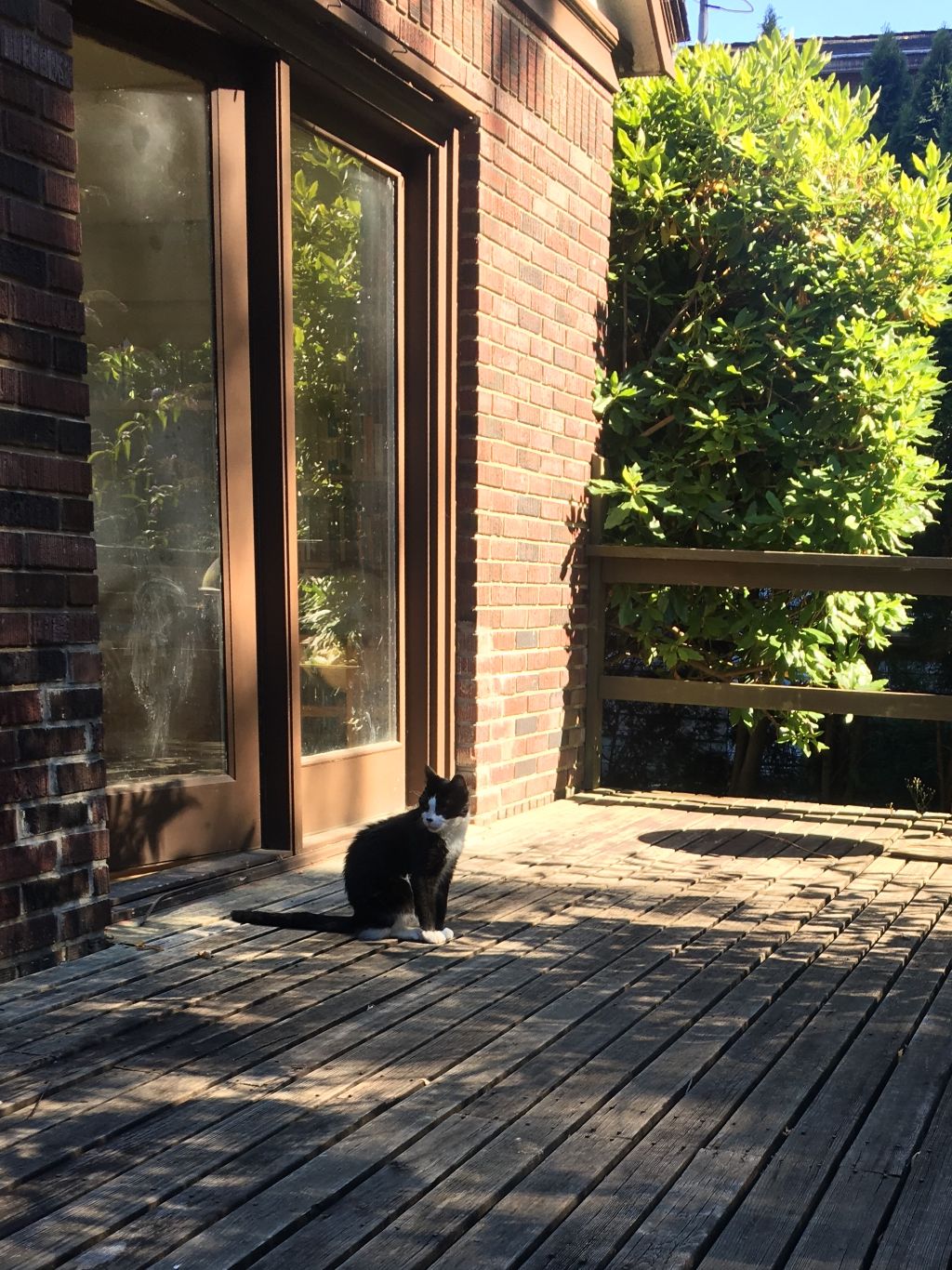
Joined on my deck by my radioactive cat, now more than half way through his post-treatment period of special care.  Iodine-131 has a short half life, and the radioactivity has already lost much of its potency.  Equally important, every time Muldoon uses his litter box, he leaves behind a portion of the radioactive iodine that was injected into him.  Let's be honest -- this coming week, despite the guidelines I was furnished, I'm not going to be particularly troubled by the ever diminishing number of beta particles and gamma rays that he emits.  I have few enough years ahead that I can't be troubled excessively by any increases in my lifetime exposure to radiation.

After Muldoon's initial shock, when he returned home from the veterinarian and discovered that I was keeping him at arm's length, he's no longer concerned about the strength of our relationship.  He's discovered that I no longer scoop him off the bed as soon as he jumps up on it, or push him away when he draws near.  He takes increasing liberties with my person.  The days of cuddling are returning.  He sits beside my chair on the deck, contemplating the backyard, keeping an eye out for any trespassing cats or unsuspecting birds.

The days already are becoming noticeably shorter.  The rains and cold of autumn will come when they will come.  But worrying about it now is like worrying about old age while you're thirty.

These are good times, for man and cat.  July in Seattle. 

Saturday, July 21, 2018

Queen of Yemen


I learned about the Queen of Sheba during my childhood.  She was a great ruler from the south.  She had heard of King Solomon's fame, and came to visit, bringing with her lavish gifts.  She chatted with Solomon and was totally blown away by his wisdom.  And, satisfied with what she had learned, she returned whence she had come.

So I was interested when this month's issue of National Geographic Traveler arrived with a sixteen page, lavishly illustrated article about the homeland of the Queen of Sheba. 

Ethiopia.

Ethiopia?  When I was a child, the location of "Sheba" was as mysterious to me as was the mysterious "Land of Nod," that place "east of Eden" to which Cain was exiled.  All I knew was that Sheba was someplace far away from Jerusalem, and someplace very rich.  But -- although the location of Sheba and the identity of its queen were hardly of major concern to me during my college years -- somewhere I had picked up the idea that Sheba was in Yemen.  Not across the Red Sea in Ethiopia.

As is so often the case, I was probably correct. 

The Bible itself assumes we are smart enough to know where Sheba is, and gives no further geographical information.  It simply states that the Queen of Sheba  entered "into Jerusalem with a great train, and riches, and camels that carried spices, and an immense quantity of gold, and precious stones." (1 Kings 10:2)  You can see why the story appealed to my childish imagination.  Riches beyond the dreams of even my avarice.

In any event, I now turn to the ultimate authority, Wikipedia:

Virtually all modern scholars agree that Sheba was the South Arabian kingdom of Saba, centered around the oasis of Marib, in present-day Yemen. Sheba was quite well known in the classical world, and its country was called Arabia Felix.

  (Sheba is, in fact, called "Saba" in my version of the Bible.) 

There were Sabaeans also living in Aksum, in northern Ethiopia, the Wikipedia article notes, but the writer claims that there are at least five places in the Bible where this area in Ethiopia is differentiated from Sheba.  Aksum was where the author of the National Geographic Traveler spent much of her time.  I'm willing to stick to my belief that if you want to see where the Queen of Sheba held court, you should go to Yemen.

But National Geographic Traveler does persuade me that if you want to visit a spectacular area, both scenically and historically, Ethiopia is a better bet.  And in today's world, a safer bet.  (The article concedes that no one really knows for sure the location of Sheba, but for the sake of the story takes Ethiopia's claim at face value.)

Wherever she lived, the Queen of Sheba was quite a lady.  She was impressed not by Solomon's palace or riches, nor by the extent of his harem ("And King Solomon loved many a strange woman..."  1 Kings 11:1), but, unlike many women, by his wisdom ("Thy wisdom and thy works exceed the fame which I heard."  1 Kings 10:7)  She heaped upon him piles of gold and precious stones, and spread before him camel-loads of spices.

Had the Queen of Sheba not lived and ventured north to meet King Solomon, our own age would never have developed such cultural riches as the 1963 movie, Queen of Sheba Meets the Atom Man.

Friday, July 20, 2018

Patience


Gilbert and Sullivan wrote the libretto and score, respectively, for fourteen comic operas between 1871 and 1896 (fifteen, if one includes the oratorio The Martyr of Antioch).  The Seattle Gilbert & Sullivan Society produces one of them each summer.  My law school friend, Pat M., and I have made it a tradition to be in the audience for each year's production.

Over the years, we have seen virtually every one of the fourteen operettas.  I say "virtually" because I believe there are one or two so obscure or unpopular that they have been attacked only once or twice in the 64 years of the Society's existence, ones that we somehow have missed.  Pat is our obsessive-compulsive list-maker, and he somewhere has the exact history of our attendance.  But we couldn't recall offhand last night which operettas we were still missing.

Once I see the entire Gilbert & Sullivan canon, I suppose I can die happy.

There are those who would argue that if you've seen one G&S comic opera, you've seen them all.  I admit to the substantial truth in this claim, but it is the small differences in plot and characterization that make watching each one fun.  As for the more significant factors -- musical style, stock characters, comic patter, happy endings with all romantic difficulties resolved -- well, I suppose that for some of us, the best surprise is no surprise.

Last night, we saw the 2018 offering -- Patience.   Opening in 1881, Patience was the second most successful G&S production in its initial London staging, following only The Mikado.  It was the sixth of Gilbert and Sullivan's collaborations, but the first staged in the new Savoy Theatre in London.  It was also the first staged using exclusively electric lights for illumination. 

Patience is perhaps less popular today, because of the topicality of its subject matter.  The opera satirizes England's contemporary "aesthetic movement" -- a form of somewhat precious late nineteenth century poetry, literature, and art.  The aesthetic movement was also known for the rarified style of the artists themselves, best remembered today by the work and person of Oscar Wilde (although Mr. Wilde hadn't really come into his own until after the operetta's production.). 

The aesthetic movement is represented in Patience by two competing poets, representing two competing styles within the movement.  Reginald Bunthorne is the worldly and self-regarding aesthete, languishing about in exotic clothing, clenching a lily in one fist or a tulip between his teeth, claiming to be admired by every woman.  Archibald Grosvenor is the spiritual aesthete, seeking goodness in himself and in others, but in Grosvenor's case forced to endure (and display) his ravishing personal beauty out of duty to mankind.

  Gifted as I am with a beauty which probably has not its rival on earth, I am, nevertheless, utterly and completely miserable. … These gifts — irksome as they are — were given to me for the enjoyment and delectation of my fellow-creatures. I am a trustee for Beauty, and it is my duty to see that the conditions of my trust are faithfully discharged.

Bunthorne conceives a devotion to Patience, a young milkmaid.  But Patience discovers that Bunthorne's rival, Grosvenor, is (surprise!) her childhood close friend, and would happily marry him. Or would until both she and Grosvenor remember that love must be selfless, and that for her to monopolize his incredible beauty and perfection for herself would be the ultimate in selfishness.

Meanwhile, a typically G&S troop of red-coated, and red-faced, dragoons are courting an equal number of interchangeable fair maidens who have eyes only for aesthete poets.

Hilarity ensues, as they say.  Without ruining the manifold surprises of this convoluted plot, I can tell you that everyone ends up perfectly matched with his perfect mate, and ready for matrimony.  All except the languishing Bunthorne, who sadly realizes that he will have only his ever-present flowers with whom to share his lonely life:

Single I must live and die —
I shall have to be contented
With a tulip or lily!

Does this sound a bit like the finale of Mikado or Pinafore?  Perhaps.  But the audience's joy comes from marking the small distinctions.

Monday, July 16, 2018

Humiliation for our time


"This morning I had another talk with the German Chancellor, Herr Hitler, and here is the paper which bears his name upon it as well as mine. Some of you, perhaps, have already heard what it contains but I would just like to read it to you: " ... We regard the agreement signed last night and the Anglo-German Naval Agreement as symbolic of the desire of our two peoples never to go to war with one another again."
...
"My good friends, for the second time in our history, a British Prime Minister has returned from Germany bringing peace with honour. I believe it is peace for our time. We thank you from the bottom of our hearts. Go home and get a nice quiet sleep."

--Prime Minister Neville Chamberlain (1938)

On September 29, 1938, Chamberlain met Hitler, along with French and Italian leaders, in Munich.  He agreed to Hitler's demands for German occupation of the Czech Sudetenland no later than October 1, and to a new demand that Czechs fleeing from German rule should not be allowed to take any property with them.  In exchange, Hitler would call off his military attack on Czechoslovakia.  In effect, Chamberlain capitulated to Hitler's demands made at Bad Godesberg one week earlier.

After the formal conference, Chamberlain requested a private meeting with Hitler, and offered a short "Anglo-German Agreement" stating that the Munich Agreement symbolized the desire of both  countries never to war against each other again.  Hitler agreed with enthusiasm.

Later that day, when the German foreign minister objected to the Anglo-German Agreement, Hitler commented,  "Oh, don't take it so seriously. That piece of paper is of no further significance whatever."

The Munich agreement was immensely popular with all segments of the British people.  One year later, Germany invaded Poland and Britain declared war.

After today's events, it's hard not to recall poor Neville.  President Trump met with Vladimir Putin in Helsinki, gave Putin everything he could hope for aside from the keys to the White House, and received nothing in return.  But the comparison is unfair to Chamberlain.

Chamberlain had been a member of Parliament since 1919, and had served terms as Minister of Health and as Chancellor of the Exchequer, before becoming Prime Minister in 1937.  Trump had owned hotels and casinos, and was an abrasive TV personality, before becoming President.

Chamberlain's Munich Agreement remains controversial to this day.  Many reputable historians believe that Britain was woefully unprepared for war with Germany in 1938, and that the Agreement gave the nation another year to re-arm.  The Agreement was received with acclaim by a frightened nation.  Hitler gained little from it, aside from a few more months during which he could appear as a possibly reasonable leader of his nation, and from having avoided the need to use military force to secure what would have been an overwhelming victory against the Czechs.  (France, Czechoslovakia's most important ally, had little interest in going to war over the Sudetenland.)

America has gained nothing from today's meeting in Helsinki.  Nothing of substance was agreed upon, or apparently seriously discussed.  Russian Prime Minister Putin was able to appear strong and powerful, and Trump appeared to follow him around embarrassingly like a pet dog.  Trump accepted Putin's "strong and powerful" word that Russia had not intervened in American elections.  He chose to take Putin's word rather than accept the unambiguous findings of American security agencies. 

After Trump had insulted the British Prime Minister and the Mayor of London, and attacked Ms. May's policies regarding Brexit, and after he had insulted the leaders of the NATO powers, suggesting that collective security was no longer of any interest to America, it was surreal to watch Trump fall all over himself just days later in his admiration of the Russian leader.

Britain celebrated Munich in the naïve belief that Chamberlain had won "peace for our day."  No one in America is celebrating Trump's performance in Helsinki -- at best, most Republican leaders are keeping their thoughts to themselves.

We have a poorly educated and impulsive leader whose admiration for the authoritarian leaders of other nations -- "That Putin, what a guy!  He's a man's man!" we can almost hear him exclaim -- knows no bounds. 

We bought him in 2016.  He's ours.  And his America has become, to the rest of the world, the real America. 

Monday, July 9, 2018

Radioactive kitty


Back on May 16, I described in some detail how my cat, Muldoon, was about to be treated with radioactive iodine, designed to kill a benign tumor in his thyroid, a small tumor that had -- unbeknownst to me -- been causing his thyroid to work overtime.

Too much thyroid juice circulating in his system was straining his heart and other organs -- and straining my ears from his frequent yowling.

Unfortunately, the specialist who does this work decided that Muldoon had some intestinal bug that needed to be cleared up before his little body could be strained with radioactivity.

His intestines now seem to be working fine.  While I was off galivanting around the Grand Canyon, leaving Muldoon alone and fuming at home, I received a phone call from the hyperthyroidism specialist's office wanting to reschedule.

So I will take him up to Shoreline on Thursday, after -- having learned my lesson last time -- dosing him first with Gabapentin (avoiding the temptation to swallow a couple myself) to ease his anxieties.  (He sits curled up on my mouse pad next to my hand as I write this, oblivious to his impending fate!)

I had been planning to abandon him for a second straight long weekend, while visiting relatives in Oxnard, but he now will be waiting for several days at the hospital while his radioactivity drops to an acceptable level.  I thus kill two birds with one stone.

When I get him back, after my return from California, he will still need to be handled carefully.  He will still be emitting gamma rays to some extent for a few more days.  I'm supposed to limit any close cuddling to about an hour a day for the first week.

But by the time I get him he won't be glowing in the dark.  He won't serve as a night light.

Thursday, July 5, 2018

Back to the North Rim


Sunset from the North Rim 
July 2017 

I'm off tomorrow for a long weekend at the Grand Canyon.  The North Rim again this year.

What draws me, year after year, to what is essentially a piece of serious soil erosion?  Good question.  Something ineffable about that hole in the ground clearly tugs at my soul.

Because of my procrastination in making plans this year, I'm limited to a two-night stay in one of the Grand Canyon Lodge's cabin facilities.  I might have had better luck on the South Rim, which has far more elaborate facilities and is where ninety percent of park visitors end up.  But mid-summer at the South Rim -- a thousand feet lower than the North -- is just a tad too warm for my Seattle metabolism.

I face nearly a full day traveling from Seattle to the North Rim, and another full day returning.  That leaves me with just one full day -- plus Friday evening and Sunday morning -- to poke about at my destination.  Not enough time to do any serious hiking, but enough for a bit of non-serious hiking along the rim and maybe down a bit into the upper reaches of the canyon.

And allowing time to study the geology of the canyon, mulling over the passage of millions of years, while sitting at the Lodge's canyon-side terrace, beer in hand.  To see Eternity in the canyon's geology, to hold Infinity in the palm of my hand.

Tuesday, July 3, 2018

Rescued


Reading a newspaper these days (or its digital equivalents) is a study in horrors piled on horrors.  Very few stories leave you feeling happy, or even just relieved.

Learning that twelve young Thai soccer players, lost in a flooded cave, had been found alive was one bright star in the black sky.  Blue states and red states, liberals and conservatives, everyone rejoiced that the boys, ages 11 to 16, had not only been found -- but found alive, without injuries.  Weak and hungry but still fully conscious and talking coherently.  "How long have we been here," seems to have been one of their first questions.

Chiang Rai province is immediately to the north of Chiang Mai province, where my nephew and his daughter live at present.  I've spent a couple of days in Chiang Rai province, but was unaware that the province contained a large complex of caves to be explored.  I'm not tempted to go seek them out now.

The cave where the boys were found -- largely flooded by monsoon rains -- offered plenty of water, water apparently safe to drink.  And, as one doctor remarked, a healthy human body is able to adapt for surprisingly long periods (ten days, in this case) without food.

Still to be determined is how the boys will be removed from the cave.  Rescuers were trained Scuba divers.  None of the boys can swim, apparently, let alone dive.  And so they may be stuck in the cave for a considerable period, dependent on food and other supplies brought in from the outside by divers.

Claustrophobia isn't really a problem for me.  But it is for many.  The fact that the boys voluntarily entered the cave may suggest a certain self-selection for tolerance to enclosed spaces.  But everyone has his limits.

I remember, at the age of about nine, crawling behind our living room sofa, squeezing myself between the sofa and the wall.  I found myself in a place where I could move neither forward or backward.  I recall the feeling of panic, and that panicky recollection gives me some empathy for those who do suffer from claustrophobia.  A totally dark cave, sitting on a rock island for ten days surrounded by water, might have pushed one too many buttons for me to tolerate.

But in the photos brought back from the cave, none of the boys visible seems emotionally upset or panicky.  Just tired and hungry.  I would think that after ten days, they would be very cold sitting on wet rocks in shorts and t-shirts, but then I remember that Thailand is not a chilly country.  And they are young.  They may be uncomfortable now, but I suspect they will recall this experience as one of the great adventures of their lives.  Something they can bore their children and grandchildren with, over and over, in decades to come.

Their parents, who have maintained a vigil for ten days at the mouth of the cave, beyond the point when hope still seemed reasonable, may take longer to recover. 

My thanks and gratitude to the rescuers -- of many nations -- who helped find the kids, and my hopes that they are returned quickly and in good condition to their families.

Saturday, June 30, 2018

Chestry Oak


Hungary is an interesting and rather complicated country.  After the dissolution of the Roman Empire, it was settled eventually by the Magyars, giving today's Hungarians a non-Indo-European language spoken by no other nation, but related distantly to Finnish and Estonian. 

It became the junior partner in the Habsburgs' Austro-Hungarian Empire, suffered the dissolution of that empire after World War I, became a perhaps reluctant ally of Hitler in World War II, a satellite of the USSR after the war, and eventually -- today -- a small Middle European state with a tendency toward authoritarianism.  It presents something of a problem to its fellow EU members.

In sixth grade -- a year when our teacher still read to us each day for a half hour after lunch -- I listened raptly day by day to readings from a book called Chestry Oak.  I remember my fascination much better than I do the actual plot, but I've always remembered that it was about a boy from a noble family who lived an idyllic life on a Hungarian country estate, a boy who loved horses.  His timing for living his childhood was unfortunate, as the Nazis were establishing control over the country, and nightly he heard the roar of war planes flying overhead.

The boy's family was forced to flee and never return to their estate.  I didn't recall what happened after that, but I now know that he and his family ended up on a farm in the Hudson River valley of New York.

Like other out-of-print books from my childhood -- like so much else from my childhood -- I was never sure how much of this I remembered accurately.  And just as I have no way of reproducing conversations remembered dimly from the past, I thought I'd never be able to recall any more about the book than I've indicated above.  I wasn't sure that "Chestry Oak was really the name of the book, or just a description of the estate on which he lived.  I didn't know the author's name.

But I discovered recently that the book has been re-issued in paperback form by "Purple House Press" of Kentucky as part of their "Classic Books for Kids" series.  It was originally published in 1948, after the Soviets had taken over Hungary, and would have been in print for about three or four years when our teacher read it to us. 

I've just started reading it.  The boy was Prince Michael, and his father was both respected and loved by the peasants under his jurisdiction.  The Hungary the book describes is not the Hungary of cosmopolitan Budapest, but a rural, feudal Hungary that feels little changed from centuries past.  Michael's family takes their hereditary rule for granted, and his father feels a strong sense of responsibility for the welfare of their peasants.

Although the book is anti-Nazi, it might also be a reaction to the subsequent workers paradise imposed by the Russians.  It certainly romanticizes the nobility, but in doing so it helps us understand how rural Hungarian life was lived before World War II.  When published, the book seems to have been perceived more as a children's "horse story" than as a political thriller or a story about refugees.

I've only read the first few chapters of the book.  The story is told from young Michael's point of view.  It is very descriptive, and moves slowly, surprisingly more slowly than I would have expected.  I conclude that kids used to have longer attention spans than I suspect most children would today. 

 I'm grateful to the Purple House Press for preserving this very interesting piece of children's literature  -- and am looking forward to the rest of the book.  Very high ratings on Amazon, primarily from readers who, like me, remembered it from long ago.

Friday, June 29, 2018

Lawnmower despotism


Clover from my childhood 
"A lawn is nature under totalitarian rule."
--Michael Pollan

I last mowed my lawn a few days before I left for Scotland.  I left for Scotland one month ago today.  Do the math.  It needs mowing.

But not as much as you might think.  In Seattle, lawns grow like, well, like weeds from March through May.  They grow slowly into July.  Then, if not watered, they dry up and await the inevitable rains of autumn.

So my lawn looks shaggy, with odd things growing out of it.  But it doesn't look like a hay field, as it would have in April if I'd skipped mowing it for a month.

Letting your lawn do its own thing -- freeing it from Pollan's "totalitarian rule" -- has its own pleasures.   First, there is the daily execution of the dandelions.  In spring, the dandelions grew close to the ground.  Between mowings, I'd go out and pluck the flowers before they went to seed, wondering if this would somehow cause dandelions to give up and go elsewhere (it doesn't). 

But in June -- and I'm no botanist, so don't ask for explanations -- the dandelions grow high before blooming.  Perhaps 18 inches to two feet high.  Overnight.  Literally. And they put out buds several days before the buds flower.  This gives me the opportunity to, as it were, nip them in the bud.  The occasional stalk with bud does occasionally escape my notice, and puts forth a defiant flower.  In a sense, this plant has beat me at my game, but it pays a high price.  Instant decapitation.

But life in the back yard isn't all life and death.  I also observe plants that I never see when I cut the yard regularly.  The hardy blackberry vine, whose struggles to survive I've discussed in past posts, slyly begins poking up in places.  The lawn becomes a carpet of small white clover flowers.  Various plants resembling wheat or other grains thrust up delicate stalks.  Buttercups abound, mistaken from a distance as offensive dandelions.  Prehistoric-looking horsetail ferns spread upward and outward, reminding me of playtime in open fields as a child. 

But most interesting of all -- and most reminiscent of childhood -- are the large purple flowers of a certain type of clover.  Flowers that offer a Mecca to delighted bumble bees -- bumble bees who I otherwise rarely see in this neighborhood, but who appear out of nowhere in appreciation of my rare purple clover.

But alas!  This blog posting has been written as only one more form of procrastination.  Today, the lawn gets leveled, the flowers fall, the bees disappear.  Ecology takes another hit. 

Totalitarian rule is once more imposed.

Tuesday, June 26, 2018

Walking in the Arboretum


I live essentially across the street from the Seattle Arboretum.  As shown in the map, the Arboretum is a long, skinny park, some 230 acres in size, and co-managed by the University of Washington and the City of Seattle.  It is squeezed between the Montlake neighborhood to the west, where I live, and the Broadmoor gated community and golf course to the east.

Within the park, close to the western border, flows Lake Washington Boulevard, a somewhat heavily trafficked arterial disguised as a scenic drive.  No part of the Arboretum is really out of earshot of Lake Washington Boulevard traffic, but the foliage is so dense and the paths so winding that, unless you're listening for it, you hear the traffic sounds simply as white noise, like a rushing stream or wind in the treetops.

Until this year, despite living next to the Arboretum, I rarely entered it.  Not because it wasn't beautiful, but because, except for an access road that ran next to the Broadmoor border, there was no simple way that I could run or walk while daydreaming within the park.  When I did venture in, I loved it.  The trails wound up and down hills, and were mazelike, totally disorienting.  A bit like a much larger version of the Rambles in New York's Central Park, without some of the sociological problems associated with that area.  You thought you were headed one direction, and ended up somewhere else entirely, which -- when in the right mood -- is a delightful way to discover a park, a city, or a country.

The Arboretum is both a laboratory and a park, and the functions don't always co-exist easily. It has only been within the last few years that the scientific aspects of the park have been emphasized.  Different areas of the park have been devoted exclusively to distinct ecological patterns or different species of plants, even at the expense of some beautiful old trees that were unfortunately removed.  Signage has been greatly improved, and the museum like quality of the park thus emphasized.

One change has been to construct a paved loop from one end of the park to the other, incorporating the old access road on the Broadmoor border for one side of the loop, and building a new pathway paralleling Lake Washington Boulevard for the other.  The loop is suitable for both bicycles and walkers.  I was appalled at this idea, because of my romantic attachment to the wilderness aspects of the park, the sense that large areas were discoverable only by exploration -- by trying out those winding paths and seeing where they led. 

But the loop works.  Its course is indicated by the faint white line that circles within the yellow portion of the map.  It makes an excellent walk, and has lured me into the park far more this year than ever before.  And most of the old network of winding paths still exists, still confuses wonderfully, and can be accessed from various points along the loop.

I was afraid that the Arboretum would be inundated by users, but so far that hasn't happened.  I just finished a walk at 7 p.m., and encountered only occasional walkers and bikers.

So, I remind myself once more: change isn't always bad.  Even if you could "stop progress," it might be a good idea to give progress a chance and see what happens.  Sometimes.  And certainly in the case of the Seattle Arboretum.

Friday, June 22, 2018

Equality and excellence


Stuyvesant High School

The tension between the pursuit of excellence and the search for equality is one theme in Mary Renault's novel, The Last of the Wine, set in fifth century B.C. Athens.  She has one of her characters ask whether fervent proponents of the latter will demand that every beautiful child have her face slightly disfigured, preventing her from beginning life with an undeserved advantage over her less favored peers.

This struggle between objectives is one that confronts any society that calls itself "democratic."  It is playing out at present in New York City. 

New York has eight public high schools with rigorous curricula that admit applicants on a competitive basis, one criterion being high scores on the "Specialized High Schools Admissions Test."  Another school, the LaGuardia  High School of Music and Art and Performing Arts, offers admission based on auditions.  These schools offer an excellent education, often the equivalent of that provided by expensive private schools.  The opportunity for talented and academically oriented students to attend such schools induces many better-off parents to keep their children within the public school system. 

They also have student bodies that are heavily white or Asian, and upper middle class.  Aye, there's the rub.

The city's mayor has suggested that twenty percent of the admissions to each special school should be awarded to students who are low-income, and who fall just below the minimum acceptable test score for that school.  The objective would be to integrate the schools to some degree by social class and, not so incidentally, by race.

I find it impossible to think about this issue without feeling completely ambivalent.  First of all, I question the effectiveness of the mayor's proposal.  I look at magnet schools in Seattle, notably Garfield, which include both lower income students from the neighborhood and talented students in various disciplines drawn from across the city, and see schools where the students quickly re-segregate themselves from within.  Not out of racial or class hostility, I gather, but simply out of the desire to hang out with friends who have similar interests and aspirations.

On the other hand, if we are not to be a polarized society, we have to begin somewhere.  I suspect that rubbing shoulders with people unlike ourselves -- whether at school, at work, or in other activities -- increases understanding and acceptance of each other, even where that contact tends to be superficial.

The issue is often discussed in terms of fairness to the low-income students who need to escape low-expectation schools versus fairness to the well-off kids who want a superior education.  And that's an important balance to make.  But I also am concerned about the national welfare -- don't we want to produce the brightest, best educated young people we can?  Kids who can create the scientific and technological advances we''ll need in the future, as well as the writers and students of the humanities that the nation will need to govern itself?  Every country that wants to be a leader in the future is finding ways to give its brightest kids the most intense education possible.  Certainly China is.

On the other hand -- again -- the national welfare will not be served by allowing creation of a vast underclass of poor and poorly educated citizens.  America enjoyed its best years economically after World War II, when universal education gave all students as much education as then seemed required -- a high school diploma -- which in turn created a population with a smaller gap between the highest and lowest paid than known at any time before or since.

One problem with the creation of schools limited to gifted students is that those become the schools that the best teachers naturally vie to teach in.  But -- to a certain degree -- the smartest and best motivated kids have the ability to teach themselves.  It is the poor learners, the kids from homes that have not motivated their kids to study and learn, who need the best teachers.  Regardless of whether we segregate or integrate our good students from our more problematic students, maybe we should be focusing on higher incentives for good teachers to teach the more difficult children.

This has been a rambling post, as I knew it would be.  It rambles, because I have no solutions to suggest.  If I did, I'd write a book.  I merely see the problems.  I hope the political and educational leaders in New York City have the background and experience that I don't have -- as well as the wisdom and concern for all elements of the community -- that will enable them to make the wisest decisions for their schools, and for their diverse student bodies.

New York's problems aren't limited to New York.  School districts all over the country will be watching.

Sunday, June 17, 2018

Great Glen Way completed


Loch Ness
"Your country consists of two things, stone and water. There is, indeed, a little earth above the stone in some places, but a very little; and the stone is always appearing. It is like a man in rags; the naked skin is still peeping out."

--Boswell: Journal of a Tour to the Hebrides (quoting Samuel Johnson's taunts about Scotland)

Remember, to begin with, that the Great Glen Way runs in roughly the same latitudes as a route from Sitka, Alaska, to Juneau.  June nights do get dark, but not totally for much more than a couple of hours.  Remember, also, that the Great Glen Way runs from the Irish Sea to the North Sea, both seas being the source of a heck of a lot of moisture, even in summer. 

We enjoyed the long hours of daylight, and escaped almost entirely the expected precipitation.  Locals spoke in wonder of the local "drought" -- eleven days without rain.

The Great Glen itself is a geologic fault between what was at one time the continent of Europe to the south and the continent of North America to the north.  Like other faults, such as the San Andreas fault south of San Francisco, it reveals itself as a depression in the earth which has been filled with a series of long, narrow lakes.  Because of slippage along the fault line, the geology and flora is different on opposite sides of each lake ("loch").

Samuel Johnson, in his inimitable fashion, was describing the highland portions of Scotland, areas whose top soil had been stripped off by the last glaciers.  The area of the lochs along the Great Glen, however, supports beautiful forests and other lush vegetation.

And so we prepared for our six days of hiking.

After four of us had climbed Ben Nevis (prior post), our other four hikers arrived from Edinburgh -- Jim's brother John and sister Anne, and their respective spouses Ann and Tony.  We spent a pre-hike day together, hiring a ride to the Isle of Skye in the Inner Hebrides, and exploring it by vehicle.  We drove from the mainland at Kyle of Lochalsh by a fairly recent bridge, viewed Eilean Donan castle, drove north as far as Portree (Skye's largest town), returned south, and re-crossed to the mainland at Mallaig by ferry.  Skye's scenery was striking, almost Alaskan in its mountains and open plains.

By then, my toe (injured descending from Ben Nevis) was much better, and we were all eager to begin walking.

The Great Glen Way feels like two distinct hikes, joined at Fort Augustus, where we stayed an extra day.  The first three days follow the flat banks of the Caledonia Canal, which extends from Fort William all the way to Inverness.  The canal joins a series of lochs of slightly varying elevations, with locks permitting passage of boats, mainly pleasure vessels, between the lochs.  ("The locks between the lochs," as I joked perhaps once too often.)  The first day took us to the shore of Loch Lochy; the second day, we hiked the length of Lochy; and the third day we walked the length of Loch Oich and on to Fort Augustus on the southern end of Loch Ness.

Our day of leisure in Fort Augustus had as a highlight an 8 p.m. cruise of the near end of Lake Ness.  The boat's guide was well educated and articulate in his lecture.  The boat also provided a means by which we were able to photograph "Nessie" -- the Lake Ness monster.  Far be it from me to pass up the opportunity, which I believe everyone else in our group was happy to do.

The second three days provided very different hiking experience.  Rather than hike the tow paths along the canal or the lakeshore along the lochs, each day we climbed high above Loch Ness, through dense forest into expansive high country moorland.  And the hikes were longer.  The second to the last day, from Invermoriston to Drumnadrochit was 14 miles, and the final leg into Inverness (from which three of our group opted out, taking a local bus instead) was 18 miles.  The hikes were tiring, but the scenery -- of Loch Ness below and of the mountains and moorlands above -- was striking.

We had a final dinner together in Inverness, with everyone but Jim, Dorothy, and me leaving early the next morning.  We three took an afternoon train, spending the morning on a visit to the Battlefield of Culloden, some five miles from Inverness.  Culloden was the battle, in 1746, where the English finally defeated the Jacobite forces of Bonnie Prince Charlie.  The battle effectively ended -- until recently -- Scotland's efforts to obtain independence.  The English forces of the Duke of Cumberland refused quarter, killing all Scottish soldiers who were injured or captured.  For years following the battle, the English launched punitive expeditions into Scottish villages suspected of Jacobite sympathies,  slaughtering all inhabitants.

Following that rather grim look at history, we took the train back to Glasgow, a final dinner, and flights home.  An enjoyable hike with excellent company.