Tuesday, June 29, 2021

Excessive heat

Outside the wind blew by; in here there was nothing but the beating of the hot sun on the skin. ... When he looked at the sun, his eyes closed almost tight, he saw webs of crystalline fire crawling across the narrow space between the slitted lids, and his eyelashes made the furry beams of light stretch out, recede, stretch out.

-Paul Bowles


It's been very hot in Seattle the past four days.  Snow's not falling on cedars, these days, nor is rain dripping through the firs.

I can hardly think straight.  

I may well be going mad.

Saturday, June 26, 2021

Da Vinci's Cat


Sir Federico Gonzaga is the son of the Duke of Mantua.  He has been held hostage in the Vatican by Pope Julius II, in order to ensure the continued loyalty of the Duke.  

Sir Federico has a fine eye for ranks of nobility, for court etiquette, and for proper dress.  We would call him arrogant, but he is acting as he has been brought up.  He feels a strong duty to maintain the dignity of his father and of his family.

Sir Federico is also lonely and bored.  He has many important acquaintances -- the pope himself plays backgammon with him, and is often enraged when he loses -- but he has no true friends.  This is understandable, because Sir Federico is only eleven years old.  A child surviving in a court of intrigue.

The boy makes his first friend when he opens a large, ornate box and meets a lively, friendly, and intelligent kitten.  The two are inseparable, until the kitten walks back into the box and disappears.  Federico is devastated, but the kitten emerges again, a short time later, as a fully grown, elegant cat.  Federico fears witchcraft.

But the reality is even stranger.  The box is a time machine, one crafted -- we eventually learn -- by Leonardo da Vinci as a gift for the King of France.

Thus begins Da Vinci's Cat (2021), a novel apparently aimed at middle school students, by Catherine Gilbert Murdock.  The plot is perhaps too elementary, and the human relations too superficially described, to serve as an adult novel (but not perhaps as a sci-fi or fantasy novel).  And yet, it appeals to adults (to this one, in any event), while it may seem too rich in history and art to be accessible (or of interest) to the typical middle school reader. 

Leonardo himself plays little additional part in the story.  But Federico is close friends with Raphael (elegant, charming, popular) and is tactfully diplomatic with Michelangelo (ugly, hostile, jealous, and -- as Federico repeatedly reminds us -- he stinks).  The time is the early sixteenth century.  Michelangelo is painting the Sistine Chapel ceiling, and Raphael is doing the papal apartments.  (Federico brags that Raphael painted him as a beautiful young boy and inserted him into his School of Athens masterpiece.)

The boy views Pope Julius II as just another egotistical Renaissance aristocrat, the head of one of the most powerful Italian states.  He hardly touches on the pope's religious leadership.  As he observes during a service in the Sistine Chapel, below Michelangelo's scaffolding:

His Holiness promptly went to sleep as he usually did during ceremonies.  Federico could not hear the priests for the pope's snoring. 

And that may have been an accurate assessment of Julius II's priorities.  According to Wikipedia, Julius II "left a significant cultural and political legacy."  No mention of his personal sanctity.  

The plot thickens.  From the same box from which the cat had stepped appears an American from the year 1928.

"I am Sir Federico of Mantua."

"Pleased to meet you Sir Federico.  Herbert Bother of New Jersey.  Call me Herbert."

Federico found Herbert's Italian appalling, but then he was from New Jersey.  But despite initial dislike, he soon adopts Herbert as his second friend, after the cat.  We also are introduced to Beatrice, or Bea, also from America -- but from America in our own time -- a young girl Federico's age.  Bea becomes a protagonist along with Federico, and some of the chapters are told from her point of view.  Stir these odd characters together with the concept of time travel, and you end with a plot that is interesting enough to keep you reading.

But the better reason for reading Da Vinci's Cat is the picture Ms. Murdock paints of Renaissance Rome, as seen both through Federico's contemporary eyes, and through the astonished eyes of visitors from the twentieth century:  The Vatican, a century before the completion of the modern St. Peter's (first planned by Julius II himself).   The darkness and danger of the Roman streets at night.  The smells.  The jousting for advantage by both nobles and artists, all seeking the pope's favor.  The policing power of the newly formed Swiss Guards.  The mutual jealousies of all those competing artists whose names loom large in Art 101. 

Most of the background is accurate.  As the author notes at the end, Federico was a real kid, born in 1500 in Mantua.  A kid who really was a hostage of Pope Julius II for three years.  He may or may not be the young boy painted in Rafael's The School of Athens -- but the author is convinced he is. The personalities and characteristics of Michelangelo ("he stinks") and Raphael (charming and popular) were actually more or less as described.  Leonardo was a scientific genius as well as an artist.  As Murdock notes, tongue in cheek:

Perhaps he invented a time machine, but since many of his notebooks have been lost, we'll never know for sure.

So, I ask again.  Will middle school kids enjoy the book?  Some, probably.  I'm not sure how I would have reacted to it at that age.  It may presume more historical and artistic background than I had in middle school.  Although what seventh grader can resist a heroine about whom it is written: "Also she really needed to pee.  No one in books ever talked about pee."

Federico is arrogant, but he was an aristocrat.  He has a good heart, and becomes increasingly likeable.  (Anyone who loves a cat is just dandy in my book.)  Bea discovers a painting of Federico as an adult in a modern encyclopedia -- he had a distinguished career as Duke of Mantua and as a patron of the arts.

It's not mentioned in this middle school novel, but Federico died at the age of 40 of syphilis.

------------------------------------

Top photo -- Painting of Federico II Gonzaga at the time he became a hostage.  By Francesco Francia (1447-1517)

Bottom photo -- Fragment from The School of Athens (Raphael) with image of Federico's head, with blond, curly hair, in center.

Friday, June 25, 2021

Melting


Late Wednesday night, I stumbled into my house after 34 hours on the train, and another hour waiting for and riding local Seattle rail and bus.  My cats had been visited and fed twice a day during my absence, and they had no legitimate reason to complain.  They greeted me coolly but correctly, accepted a third meal as part of my greeting and apology, gave me some small displays of affection, and then slipped out the cat door for a night on the town.

As you all know, I had been visiting with relatives in Oxnard, a beach town about an hour's drive north of Los Angeles.  The daily weather was consistent: highs of 66, lows in the low 60s, no rain but constant overcast.  "June Gloom," I'm told.  The weather reminded me of childhood visits to the beach up here in the Northwest, and I actually enjoyed it.

Upon my return, however, I've been greeted by forecasts of Temperature Armageddon.  Today, we had a high of 90.  Tomorrow, the high will be 95.  Sunday, 100. 

And Monday?  One hundred eight (108) degrees Fahrenheit (42 degrees C.).  Lows in the low 70s.

I don't think we've ever suffered from a temperature that high in Seattle.  I can't remember the last time we had a temperature of even 100, certainly not in June.

I find myself lethargic and irritable in today's heat.  I can't conceive of how I'll feel when it's 18 degrees hotter.  But I guess I'll soon find out.  I have no air conditioning.  I have no swimming pool.  We in the Northwest Corner have always prided ourselves on never needing such decadent modern conveniences.  We even sneer at newcomers who open up umbrellas when it rains.

Well, it won't be raining this week.  In my home town, in Southwest Washington, it's even worse.  They're looking at an anticipated high of 111 degrees on Sunday.  

A landscaper just installed a new hedge for me on Thursday.  "Keep it well-watered.  Daily!" he admonished me.  He had seen many signs that diligence in garden care wasn't my strong point.  Oh well.  I'm about to go out and water it now.  In 90 degree evening heat. 

Does human flesh melt?  I wonder.

Saturday, June 19, 2021

Beach reunion


Readers will be stunned to learn that another unfortunate gap in my production of blog posts awaits them in coming days.  

I leave tomorrow for the beach at Oxnard, California, where I will meet my brother, sister, and portions of their families. I met them face to face, for the first time since the pandemic began, three months ago when they traveled to Seattle to help celebrate my birthday.  We had just been told that vaccinated individuals, such as us, could meet face to face indoors, and shed our masks in so doing.  At the same time, restaurants in my state were allowed to expand service to fifty percent capacity.

We took advantage of both permissions, although nervously, carefully, and not entirely certain that our vaccinations would really "work" -- that they would successfully fend off the scary little viruses.  After three months, we are more relaxed, more cavalier as to still possible dangers, and willing to close our eyes to the various Greek lettered variants -- Delta, in particular.  Experts tell us that even if Delta breaks through the full protection of our Pfizar shots, we'll at least probably avoid serious illness and death.  

Well, that's something, right?

My visit to Oxnard was at first intended to be longer, ending in a trip back to Washington state by my sister and me by train.  Yes, Kathy is also a train fanatic; it runs in the family.  Lots of other people seem fond of trains as well, however, and the only accommodations available were for a Tuesday departure from Oxnard.  A whirlwind visit indeed.

As a result, the Coast Starlight's leisurely 33 hours to reach Seattle from Oxnard will account for almost half of my trip.  And this time, I'll have someone to talk to in the dining car (I'm assuming Amtrak still limits each table to one family group, as part of its continuing pandemic precautions.)

I'll return to Seattle late Wednesday night.  I suspect the next post in this blog will follow not long thereafter.

-----------------------

Photo -- Beach at Oxnard, January 2019. My niece and her daughter.

Thursday, June 17, 2021

Hacking back the jungle


I'm fortunate to live in a neighborhood where no one's starving, no one is unemployed (at least involuntarily), and no one is on any form of public assistance.  In other ways, however, we're a mixed bag.  Especially with regard to our approaches to yardwork.

A few of my neighbors have so little interest in their yards that they appear to be living on a farm.  Quite a few others pay for regular yardwork service that maintains their yards in beautiful condition.  But a majority of my neighbors seem to consider working in their yards a hobby, a hobby that consumes a large portion of their spare time.  Not just lawn mowing.  I mean continual edging and pruning and trimming and planting and fertilizing ... well, you get the picture.

And then there's me.  I subscribe to a philosophy that might be called "Biennial Rescue."  I mow the lawn, of course, although not as fanatically often as others, and that's pretty much it.  I may clip back shrubs that are keeping my car from driving safely into the driveway, ok?  

But this is the Pacific Northwest, and nature uncontrolled eventually becomes nature tyrannical.  After two years of benign neglect, I find my house disappearing into the foliage.  I discover that the width of my front walk has been reduced 75 percent by aggressive ivy growth.  That my living room has been darkened by ivy growing across the windows.  That I have trouble moving from one portion of my yard to another because of overgrown shrubbery.  

I have a hedge that has grown so high as to cast a neighbor's back yard in shadow, resulting in a certain genial neighborly friction.

But why go on?  At that two-year benchmark, despair overpowers inertia.  I finally make that call to a landscaper.

And so yesterday, the crew arrived and spent all day doing what had to be done.  As I mentioned on Facebook, the day after they do what they do, I'm always reminded of my mother's reaction when my brother and I returned from the barber after the first haircut of summer -- our long awaited "crew cut."  She didn't weep.  She just sighed with sadness and resignation.  But she knew it would all grow back.

And so I stare at my house, especially the front, devoid of all the jungle-like growth that I both loved and hated, and that provided recreational opportunities for my two cats.  The trees and large bushes are still there, although trimmed back.  But all the wild growth -- weeds, one might call them, although somewhat attractive weeds -- are gone and bare earth has been exposed for the first time in 24 months.  I sigh.  But, like my childhood hair, it will all grow back.

And then the presentation of the bill.  The price of procrastination and of refusal to do the work myself is high.  Am I being cheated?  Who knows?  I'm too lazy to solicit bids for an occasional day of yardwork.  And it's only once every two years.

I can almost hear the little invasive plants stirring and beginning to grow back.

--------------------------

The photo is a stock photo, and exaggerates my own problem.  But you get the idea..  

Wednesday, June 16, 2021

Adam's Peak, Sri Lanka -- 2004


It's been nine days -- nine uneventful days -- since my last post.  Once again, I resort to my travel journals.

In August 2004, Pascal and I traveled to Sri Lanka, a trip organized by a British travel company.  Besides the two of us, there were two other travelers, both Americans -- neither of whom we found particularly agreeable company.  Aside from the company of our fellow countrymen, however, the trip was enjoyable, and Sri Lanka itself was fascinating.

Sri Lanka is densely populated, and not exactly typical fodder for "adventure travel."  But we were inspired by our rail trip from Kandy, up and up into the mountains, through the hillside tea plantations, until we reached the British colonial hill town resort of Nuwara Eliya.  Our group stayed at the St. Andrew's Hotel, a hotel reminiscent of days of British rule. 

The high mountain air must have inspired in Pascal and me (and only in us) a desire to hike, and specifically to hike to the top of Adam's Peak (7,359 ft.), probably the best known hiking opportunity on the island.  Adam's Peak is considered more or less sacred by Christians, Buddhists, Hindus, and some Muslims.  Christian legend says that the "footprint" on the summit is that of the apostle St. Thomas, the apostle to India.  Other religions ascribe it to Adam, to Buddha, or to Shiva.

The reception clerk at the hotel was appalled at the idea, and even more appalled at our desire to be atop the peak by sunrise.  But he agreed to give us a 1 a.m. wake-up call.  We were picked up by a friend of our local guide, and my journal continues:

------------------------------

We were picked up promptly at 1:30, and we drove for the next 2 ½ hours on deserted one-lane roads through dark mountains and forests.  We met hardly any other traffic on the road during the entire drive.

Our driver finally let us out of the van and pointed out the general direction of the trail, assuring us he would still be there on our return.  Bearing flashlight and headlamp, we bravely set out into the void, feeling like Frodo and Sam leaving behind the cozy safety of the Shire.

After a false start up the first unlikely path we encountered, we pulled ourselves together and launched out on the correct trail at 3:50 a.m.

At first all went well.  We soon came to a fork in the trail, however, and both forks looking plausibly like the correct choice.  Actually, both were -- a fact we didn’t discover until we followed the right-hand path for about a quarter mile and discovered that the two parallel paths joined back together again.  Meanwhile, we had wasted about 15 or 20 minutes trying to make a choice, confounded by the fact that all signs in the area were in Sinhala – aside from occasional advertisements, of course, in English.

The early stages of the trail were not difficult hiking, but the experience was made eerie by various shrines, dagobas, and Buddha images that loomed up, palely illuminated, in the dark night.  Eventually, the horizontal stretches between short flights of steps became shorter and shorter, and the climb became more serious.  And vertical.

As we reached the point where the climb was virtually an uninterrupted stairway, the fog thickened and the wind began howling.  My flashlight revealed only a short stretch of the long stairways ahead, which disappeared into streaming swirls of white mist.  The howl of the wind was at times ungodly.  We both were disconcerted by the metallic flapping sounds of a broken sign clanging in the wind, a fog-muffled signal seemingly warning us to turn back. 

We agreed that if unquiet spirits walk anywhere on earth, they were probably afoot on this very trail, a trail that ironically was considered holy by the peaceful Buddhist pilgrims.  (And I don’t recall Pascal’s offering me any words of spiritual comfort from the depths of his Buddhist heritage!)

At this point, in fact, Pascal let out a blood-curdling scream.  I flashed my light ahead and saw a dark formless object shuffling down the stairs ahead.  Like some ghastly object out of an Asian ghost story bearing down on us, carrying no light that would indicate it was human.  Turned out, in fact, to be two hikers who had separated from their party without reaching the summit, and were staggering back down the trail.  (Why in the dark, I have no idea.)  But for a moment, they scared the wits out of us.

A bit later, we ran into the other two members of their party at a rest stop, with whom we did the final climb, taking another ten minutes or so, to the top.  We reached the summit at 6:05 a.m., quite pleased with our time of 2 ¼ hours.

The gate at the summit was locked and would not be opened until 6:30.  But the authority figure – whom I had mistaken as some fugitive from the hippie 1960’s, wearing a Save the Dolphins t-shirt – invited us into his small humid hovel where we met other climbers who had arrived before us.  Our host served us all hot tea.

We were finally admitted to the summit shrine.  It was a little anti-climactic, because all possible views were obscured by the dense fog.  We waddled around devoutly barefoot in the cold, while the other more pragmatic hikers stayed bundled up in hiking shoes or boots.  But it was satisfying to stand at the spot where Buddha’s foot first touched down on the soil of Sri Lanka.  Or was it St. Thomas?  Or Shiva?

The hike down was much faster and easier.  (Don’t let anyone kid you that it is harder to go down than up!)  And because it was now light out, we could enjoy the beauty of the scenery and get a better feel for some of the things that had seemed mysterious going up in the dark.  Back to the van in 1 ½ hours, including time for photography, and then a very scenic ride back to the hotel, past incredibly enormous waterfalls (Devon Falls and St. Clair Falls) thundering off the opposite hills down into the valley.  (Pascal slept like a babe all the way back!)

--------------------------

Our two fellow travelers were appalled at the very idea of our night climb.  For me, at least, it was a high point of our visit to Sri Lanka. The hoped-for sunrise never appeared, but the dense, mysterious fog that obscured the sun made the climb even more impressive and memorable.

Monday, June 7, 2021

Going back to high school


A thirty-year-old mother attended her daughter's middle school in El Paso. She represented herself as being her own seventh grade daughter.  She got away with it for six periods, until in seventh period a teacher called her out.  She was masked, which had helped, but had removed the mask to eat lunch. Not even her older appearance had aroused suspicions. 

According to the El Paso Times, the mother was arrested on charges of criminal trespass and tampering with government records.  She was released on bond of $7,908.  She claims that she was just trying to prove how lax security is in public schools.  Hmm.  Ok.

The El Paso mother's exploit brings back memories.  I did something similar the summer after graduating from college and awaiting post-graduate work.  I'll confess it, only because I'm certain that the statute of limitations has run.

A friend from school, still an undergraduate, visited my home for a couple of weeks.  We were bored.  University classes would not begin for several weeks, but the local high schools were about to open.  My friend thought it would be cool to attend high school for a day.  I'll call him John.  (John went on to hold a surprisingly high position in the federal government, and probably would prefer that his real name not be used.)  I wasn't really interested.  Or rather, I was interested, but I was justifiably chicken.  John was never chicken.  Not always wise, but never chicken.  

John was very persuasive.  Eventually, I gave in.

We couldn't do it in my old high school -- teachers would recognize me immediately.  But we felt safe attending school in a neighboring town.  We dressed in what we considered to be then-popular high school clothes, which were already different from those we had worn four years earlier.  We stood outside the school and cased the joint.  I had attended games at this school, but had never actually been inside the academic building.  

We walked in.  Unlike the El Paso mom, we weren't wearing masks.  I prayed nothing would go wrong, although it never occurred to me that I might be charged with criminal trespass.

High schools are high schools, and once inside it all felt familiar.  Only four years earlier I'd been in high school, but four years might as well be a couple of decades when you're 22.  First day of school, and everyone was a bit confused.  We found that the first order of business was to be an all-school opening assembly.  We walked into the auditorium.  No one gave us a second look.  High school kids come in all shapes, sizes, and apparent levels of maturity, and we both looked young for our age.

The assembly was boring of course, but my adrenaline level was high.  I didn't get drowsy.  When it was over, everyone headed for their first period classes.   We didn't have schedules.  I don't think we had thought through to this stage.  The halls were beginning to empty.

John muttered, well, maybe we should leave?  Yes, yes, oh yes!  I thought.  And thanks, John, for being the person to suggest it. 

So my story peters out.  Sorry if I aroused higher expectations.  We left the high school behind to the high schoolers, hopped in the car, and gladly returned to our real lives as high school graduates and university students.  We learned nothing from our experience.  Absolutely nothing.  It added not one whit to my lifetime accumulated wisdom.  

Except, perhaps, that I'm not the sort of guy who is cut out to be a crook.  And that, unlike that odd woman in El Paso, you gotta know when to hold 'em and when to fold 'em!  Especially when to fold 'em.

Saturday, June 5, 2021

Circling (almost) Mont Blanc -- 1997


Yet another of my excerpts from a travel journal kept during past travels.  In 1997, my nephew Denny and a mutual friend Chris, who we'd met the year before in Peru, undertook a hike around the Mont Blanc massif -- the Tour du Mont Blanc. 

After a few days sampling the urban pleasures of London and Paris, we took the train to Chamonix, France, where we prepared for our hike.  From Chamonix, we took a short (6 km) train ride to Les Houches, where the hike began.  We ran into a heavy lightning storm on that first day of hiking, and decided to stop for the day sooner than expected at the Miage dortoir.  (A dortoir is a mountain refuge; literally, "dormitory." ) 

I begin my journal excerpt with the entry from the following evening. 

July 24 -- Thursday
Refuge de la Croix du Bonhomme, France

I'm writing this by very dim candle light in the Refuge de la Croix du Bonhomme.  It's raining outside, still twilight at 9 p.m.  I've just skunked Chris 2-0 at gin rummy.  This is the first time I've approached this accomplishment -- dimmed only slightly by the fact that he was writing in his journal at the same time that he was playing.

Today was a long day.  But at least we did not have to endure much in the way of rain, fortunately.  We got a late start, being the last hikers out of the dortoir, at 9 a.m.  Up to Truc, then down to the resort town of Les Contamines where we had crepes for lunch.

Then along a level road and path, past many local families out for a stroll, each of whom greeted us with a "Bon jour."  We arrived at Notre Dame de la Gorge, a painted church that is a prime sightseeing attraction in the area.  Then steeply up an old Roman road to Nant-Bourrentz, where we stopped at a pleasant outdoor café, surrounded by neat lawns and high mountains, and had cokes.

We continued on to Balme, where we planned to stop for the night.  It was only 4 p.m., however, and so we decided to go on to this refuge, in order to make up some of the time we lost yesterday by stopping at Miage.  I figured that we were only an hour and fifty minutes from de la Croix, which would get us in about dinner time.  After we had hiked about a half hour uphill, however, I discovered that the actual time would be two hours, 50 minutes.  I suggested that we return to Balme.  I was concerned that we no longer had any food in our packs -- we had split the last Snickers into three pieces -- and that we might arrive starving after dinner had already been served.  But Chris -- who had been looking very tired since the beginning of the  trek -- resisted the idea of giving up the altitude we had just gained.  So we went on ahead, with Chris unexpectedly charging into the lead.  Chris led for the rest of the day, and was first at the col du Bonhomme and the first to arrive at the refuge.

As I came over the final col, the col de la Croix, I was totally exhausted.  The sight of this large, modern, clean-looking building was like a mirage.  Chris had already checked us in, and had found us a tidy room with bunkbeds all to ourselves.

A few minutes of examining maps, and then on to dinner -- rice with beef stew topping, soup, cheese plate and custard.  Then gin rummy, and journal writing.  Now, at 9:10, we realize that we're almost alone in the common room. Bed will look very good, although, strangely enough, I feel quite well and alert now that I've had dinner.

July 25 -- Friday
Elizabetta, Italy

I woke up several times last night feeling dehydrated.  I have to remember to get more fluids.

I'm writing this in the dining room of Elizabetta refuge -- Italy!  This place is really crowded.  Our beds -- straw mats -- are side by side in a large dorm room on the third floor under the eaves.  The roof comes so low at the foot of the beds that we could get our feet wedged between the roof and the floor.  Chris and I inveigled Denny into playing rummy with us.  Denny won -- but still hates the game.

Up fairly late this morning, and began the 1½ hour descent into Les Chapieux.  It was raining all the way down.  (We had lots of lightning last night and very heavy rain -- nice to be under a roof, and not in a tent!)  We arrived at Les Chapieux fairly early, and stopped for café au lait.  We drank slowly, but the rain continued.  So we sat around some more, and I surrendered my briefly-owned gin rummy championship back to Chris.  Then we had lunch in a crowded room filled primarily by a tour group who had arrive by bus.  (The restaurant is part of the Auberge de la Nova, in case I'm ever back this way again.  A very pleasant hostelry.)

We couldn't decide whether to stay at the auberge because of the inclement weather, or to hike onward.  Braver thoughts prevailed, and we hiked for 1½ hours up a long road to Mottets, then up an interminable series of switchbacks to the col de la Seigne -- which marks the Italian frontier.  Then down a valley to Elizabetta shelter.  It's been a long day, and we're all tired and in need of showers.  But feeling quite satisfied with ourselves.

We had a brief conversation with some Italian hikers who had come the same direction as we did, but who hitchhiked up the long road to Mottets.  I had some satisfaction in serving as a translator between these hikers and Chris and Denny.

We've decided to take a break day in Courmayeur -- and are feeling quite excited about this prospect.


We had a long day hiking from the Elizabetta shelter to the Italian resort town of Courmayeur.  We loved the town -- what's not to love? -- and felt like explorers, long lost in the wilderness, who had stumbled into an upscale resort community.  We found a hotel  room for three, at $100 per night, at the Select Hotel.  We stayed there two nights.  I exulted in my journal:

July 27 -- Sunday -- 11:20 a.m.
Courmayeur, Italy

Happiness is reclining in a canvas lawn chair on an old wooden deck outside your hotel room in Courmayeur, the warm sun at your back, staring at snowy peaks through the trembling leaves of nearby trees, and listening as a favorite nephew reads you rambling, poetic passages from Jack Kerouac -- passages that transform the gritty world of South San Francisco into images as dreamy and evocative as a lazy summer day in the Italian Alps.


We didn't realize it at that point, but our Tour du Mont Blanc would come to a premature end just two days later.  Denny had injured his knee several years earlier, and had undergone knee surgery. On Monday, his knee began giving him problems, and we had to hike very slowly down to the valley at La Vachey.  His knee only became more of a problem the following day, as we crossed the Swiss frontier to La Fouly.  We decided to cut the hike short at that point -- two nights short of completing the circuit -- and took the train back to Chamonix to pick up our non-hiking baggage.  We spent the extra days before our return flight from Geneva on train trips to Zermatt and across the border to Munich.  We of course celebrated the end of an enjoyable vacation in the usual manner at the Hofbrauhaus.

Thursday, June 3, 2021

Mountains are eternal -- I'm not


I was 26 when I first climbed Mount Si.  A younger fellow student suggested that we climb it.  Although I'd lived in Seattle for three years, I'd never even heard of Mt. Si -- one of the most popular day hikes in the state.  At 26, I wasn't quite yet a hiker, wasn't quite yet a wilderness devotee.  But a hike sounded like fun, so I said, sure!

I've climbed Mount Si so many times now, and done it with so many different friends, that it seems odd to recall how appalled I was once the hike was under way.  I whined all the way to the top.  I was so tired, I didn't even try to resist, once we reached the "top," when my friend insisted that we do the class three scramble of the "haystack" that juts from the top.  We made it up the haystack, and while I sat panting on a rock, my friend unfurled a kite he'd carried all the way up, and flew it from the summit.

The kite was surreal, but no more so to me than everything else that day.

I described Mt. Si, and a typical climb, in a post on this blog exactly ten years ago Saturday.  See "Mt. Si."  And since that post, every time I've climbed Mt. Si, I've gone back to that 2011 post and added my latest time at the end.  I completed the climb memorialized in the post in one hour and forty minutes.  My times since have been fairly consistent, but with a gradual overall increase from year to year in the time I needed to struggle to the top.

Yes, sometimes I was in better shape than other times, and that is reflected in blips in the otherwise increasing times.  But, I'm convinced, my increasing age was the most important factor in causing my times to get worse.  This fact is a sad reversal of the situation when I was in my 40s and 50s -- when a training program, good conditioning, paid off in climbing ability, swamping any effect, if any in fact occurred, from my advancing years.

For years, I climbed Mt. Si at least once per summer.  Usually, as a way of kicking off the hiking season, but sometimes just because it's an enjoyable hike.  However, for reasons I can't really recall, until today my last climb was in 2017.  Sometimes the snow lasted late, and I was involved in other hikes as the summer progressed.  Sometimes I was just lazy, I suppose.  And last year was Covid-19, and I was (probably unnecessarily) afraid of hiking without a mask, a mask that would inhibit my breathing.

But, yes, today, I returned to the Big Hunk of Rock.  I didn't do any mountain hiking all last year, and I was pretty sure that, together with aging, that fact would ensure that my time would be worse than it had been in 2017.  I realized how bad my conditioning was within minutes of starting the hike.  I was panting, and my legs felt wobbly.  I seriously considered making a small plateau ("Snagg Flats"), about half way up the mountain, my destination -- and coming back for another attempt in another week or so.  But I persevered, and the hiking got easier as I hiked upward.

But not real easy.  In 2011, my time had been 1 hour, forty minutes.  Six years later, it had increased -- to my shock -- to one hour, fifty-seven minutes.  Today, as I staggered to the top, my watch showed that my time was two hours, thirteen minutes.

If I do a lot of hiking this summer, and try Mt. Si again in August or September, it probably will show an improved time.  But I suspect that my days of conquering Mt. Si in under two hours are over.  No matter how much I exercise.  

But of course I'll try! 

Monday, May 31, 2021

Et in Acadia ego


I continue to muse over my brief visit to Maine's Acadia National Park.  By the way, the misspelling contained in my Latin title is intentional.  Arcadia (note the "r") is a large, somewhat wild region in the center of Greece's Peloponnese.  But in Greek mythology, the term was understood to be what Wikipedia describes as "a poetic byword for an idyllic vision of unspoiled wilderness."

In the sixteenth century, an early explorer -- with the Greek myth in mind -- gave the name "Arcadia" to Maryland and Virginia, because of the forested beauty he beheld.  With time, the word lost its "r," and the area it represented migrated northward step by step.  Geographically, it ultimately referred to a French colony that occupied what is now the Canadian Maritime provinces, as well as northern Maine -- including the area of today's Acadia National Park.  Parenthetically, the Louisiana "Cajuns" were French Acadians who fled British rule. 

And so the morose warning displayed on a tombstone in Poussin's painting, "Et in Arcadia ego" ("I (Death) am even in Arcadia") becomes for my purposes the cheerful "Et in Acadia ego" ("I (your friendly blogger) am even in Acadia National Park").

But I amuse myself at my readers' expense.

Acadia National Park has a number of units, each separated from the others, but the most touristed portion is that on the eastern "lobe" of Mount Desert Island.  (The island, a bit like Orcas Island in Washington, has two lobes, separated by Somes Sound.) The park occupies most of that eastern "lobe," excepting Bar Harbor in the northeast, and an area along the southern coast.  Two peaks dominate the eastern lobe of the island:  Cadillac Mountain (1,530 ft.) and Pemetic Mountain (1,248 ft.)  To the west of these two peaks are two large lakes: Eagle Lake and Jordan Pond.  And to the west of the lakes are a number of peaks, the highest being Sargent Mountain (1,373 ft.).

The park is a maze of trails and "carriage roads," but visitors who stay in their cars tend to limit themselves to the loop highway.  The loop begins near Bar Harbor, heads south to Sand Beach, and then closely follows the coastline south, around Otter Point, and north, passing between the two lakes to the west and Cadillac and Pemetic Mountains to the east.  There is also a spur road from the loop to the summit of Cadillac Mountain, which now requires a permit for vehicular access that must be obtained in advance.

The "carriage ways" are a unique feature of the park.  They were built by John D. Rockefeller for the exclusive use of non-motorized travel -- especially horse-drawn carriages.  They remain today a maze of spacious roads, open for use solely by pedestrians, bicycles, and horses.  They are an easy way to see much of the park on foot or bike.

During my first visit in 2008, I climbed Pemetic Mountain.  I left my rental car at Bubble Pond, and climbed to the summit.  I note in my journal that, 

The climb was steep and the trail was all rock and tree roots.  It would have been impossible to discern the trail but for painted blue blazes and occasional cairns.

From the summit, I walked another 1.3 miles across a saddle to the lower summit of The Triad (698 ft.).  From The Triad, I walked down 0.4 miles to a nearby carriage road, and walked another three miles back to my car.  I recall the entire climb and hike as being a high point of my visit to the park.

For various reasons, I was unable to do this hike, or anything equally ambitious, this visit.  Nor was I able to once more drive to the summit of Cadillac Mountain.  I had obtained the necessary advance permit, but the permit was in my baggage that -- as noted in my prior post -- hadn't yet arrived.  In any event, when I next visit Acadia, I think it would be much more worthwhile to climb Cadillac Mountain on foot -- hardly a Himalayan feat -- rather than drive up the road.

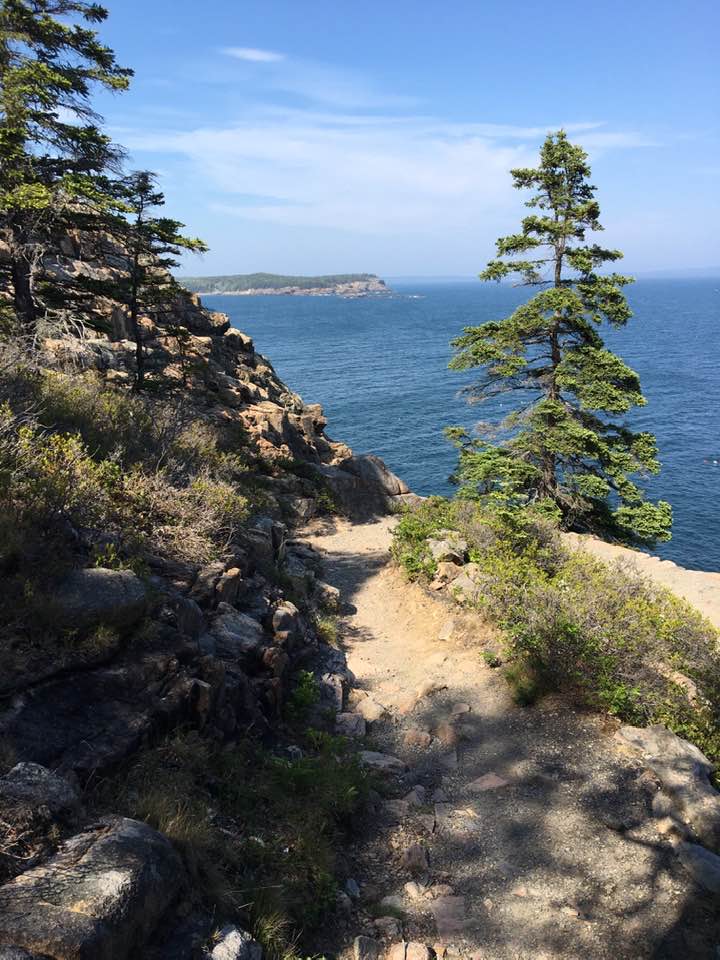
What I did have time for was a half hour or so poking around Sand Beach, and a significantly longer time following a cliff-top trail around Otter Point.  The Otter Point trail is very enjoyable, often forested, and with magnificent views of the Atlantic, and of the cliffs dropping far below your feet.

When you see a map of the park, you note that the western "lobe" of Mount Desert Island is actually larger than that to the east.  I tried exploring it in 2008, however, and wasn't that impressed.  Most of the waterfront property is in private hands, and I was unable to get many ocean views.  On the other hand, if you have time to leave the island, you should drive about fifty miles east to the section of the park on the Schoodic Peninsula.  The loop road about the peninsula offers striking views, and gave me some of my best photographs in 2008.

In conclusion, it's clear that I was able to spend less time hiking and enjoying Acadia Park during last week's visit than I had in 2008.  My primary problem was the time I had to spend trying to get information about the search for my baggage from United Airlines, and securing certain prescription medication that had been in my misplaced baggage.  But beyond that problem, I simply allotted too little time for the actual park visit, relative to the time it took to fly to and from the east coast.

As I concluded in my prior post -- I hope to visit Bar Harbor and Acadia National Park again soon.  And next time, I will plan on a much longer stay. 

------------------------

Photo:  On the cliff-top trail around Otter Point.

Saturday, May 29, 2021

Brief visit to Bar Harbor


Returned home very late Thursday night after a highly enjoyable four days in Maine -- an enjoyment only slightly tarnished by the inability of United Airlines to transfer my baggage in Newark from my Seattle flight on Alaska to their own short flight from Newark to Portland, Maine.  After a couple of days of receiving only automated messages that they were still "searching" for it, it was finally delivered to me in Bar Harbor late Wednesday evening, just in time for my Thursday morning flight home.

After shopping for a few clean socks, and other clothes in Portland, and arranging contact between my doctor in Seattle and a pharmacist in Bar Harbor, I was able to fully enjoy my destination.

I spent Monday night at a La Quinta motel in Portland, and then drove a rental car north to Bar Harbor

on Tuesday.  My GPS said that the trip should take three hours, but workers were doing a lot of road work on U.S. 1 and their temporary road closures -- plus the fact that I was enjoying the drive and was in no hurry -- stretched the journey out to 5½ hours.  As I drove across the short, almost unnoticeable bridge separating Mount Desert Island from the mainland, I was feverishly recalling sights from my only other visit to Maine, in 2008.

The town of Bar Harbor lies adjacent to Acadia National Park, which occupies the center of the island and a portion of the coastal area.  

State Highway 3 which crosses that bridge onto the island continues all the way to Bar Harbor, down Mt. Desert Street through the middle of the town of Bar Harbor, and then loops about the island.  My hotel -- a fairly recently-constructed building, but one built in the style of a traditional New England inn, with just 31 rooms -- was itself on Mt. Desert Street, within easy walking distance of the central business area with all its restaurants.


I spent Tuesday evening, after my arrival, walking about the town, orienting myself, dealing at some length with a local pharmacist, and finally having dinner at a pub that makes the claim of being "The Irish pub closest to Ireland in the U.S."

Wednesday was my one full day in Bar Harbor.  I did the Highway 3 loop around the island, which runs primarily outside the park.  Back in town, I had for lunch an excellent Maine lobster roll on the outdoor deck of the Reading Room, overlooking the harbor.  The "Reading Room" was a famous hang-out and cultural retreat for nationally-prominent leading families in the late nineteenth and early twentieth centuries.  Its clientele is less exclusive these days, but the restaurant still has a genteel atmosphere, especially compared to the pub culture that pervades most of the town center.

That afternoon after lunch was to be the best part of my stay, and the  part that most makes me anxious to return.  The park service has its own loop road, somewhat parallel to Highway 3 but located entirely within the park.  I stopped at various areas, especially along the coast -- Sand Beach, which is one of the rare sandy beaches in New England, and Otter Point, with its highly scenic coastal walk above the ocean.

That night, I noted that the path from town to Bar Island seemed to have emerged from the sea -- it's open for only four hours during each low tide, and I'd been hoping to make the crossing.  By the time I reached the approach, however, the sea was already sweeping across the lowest point of the path.  One brave person on the other side took off his shoes and waded across, rather than spending the night stranded on the island -- he was successful, but the current was strong.  The isthmus is actually the "bar" that gives Bar Harbor its name.

Thursday morning, I had a leisurely breakfast at the hotel, wandered through town one last time, and headed back to Portland -- this time on I-95, rather than risk arriving late for my flight by traveling U.S. 1 again.

It was a short three days in Bar Harbor, but I felt I had seen and experienced a lot.  The Maine coast is somewhat similar to the Washington coast physically, but is different culturally and has a long and interesting history worth absorbing during one's travels.  I definitely hope to return again soon -- next time, for a much longer stay.

----------------------------------

Photos (top to bottom)

1.  Map of Bar Harbor and environs

2.  Hikers on eastern edge of island, looking out to sea.

3.  Lobster roll and IPA, at the "Reading Room"

4.  On trail near Otter Point

5.  Watching the trail to Bar Island close as tide comes in

Friday, May 21, 2021

Return of the hunter


A domestic cat shares 95.6 percent of its genes with a tiger.  Whatever its behavioral adaptations, the house cat has changed little from its feral ancestors (its most direct ancestor being the wildcat), which in turn are closely related to other members of the Felidae family.  All are carnivorous.  All are predators.

All that being true, it's impressive that so many humans -- those worth knowing -- are capable of bonding so closely to Felis catus.  

My two black panthers turn eleven months old next week.  From rambunctious kittens back in August, when I acquired them, they have become sleek, well-built nearly-adult cats, athletic and intelligent, with wry senses of humor.  And more than any other cats I've ever "owned," they pride themselves on their predatory skills.

For a while, they were proudly bringing their conquests into the house -- up to my bedroom, even -- to seek my approval.  A few weeks ago, we had a little dispute when one of them brought a live young rabbit upstairs after I'd dropped off to sleep.  I woke up, spoke intemperately, carried the cat downstairs, rabbit-in-mouth, and thrust him onto the back deck.  In shock, he dropped the rabbit, which, thanking its lucky stars, escaped apparently unscathed.  Physically, if not mentally.

They seem to have decided between themselves that I've proved myself unworthy of their displays, and have since discreetly seized and dismembered small mammals and birds out of my sight.  They are predators, and it comes naturally, although -- as I say -- the five cats I've had before these two jokers were far less bloodthirsty.  They preferred to eat indoors, and they preferred kibble.

All of this is prelude to my telling you that Castor wandered off about dinner time Wednesday night, and hadn't returned by the time I went to bed.  This wasn't unprecedented, and I thought nothing about it.  I began to worry the next morning, when he still hadn't returned  home.  By Thursday night, I was panicking, especially since I'm leaving for Maine on Monday, and need both cats to be secured inside when I leave.  

I pored over relevant internet information.  I was told that indoor-outdoor cats like mine often disappear for a day or two, having got interested in something they came upon -- something potentially edible, usually -- and lose track of the time.  Don't worry if your cat goes missing for a day or even a couple of days, the experts said.  In fact, persons with missing cats say that the median time the cat is gone before returning is five days.  Of course, the experts remark, darkly, the cats don't always return.

If they don't return, the writers cooed, don't beat yourself up.  You gave your cat a good life, and, hey, life's a jungle.  "No, no," I was yelling.  Yelling at least mentally.  "Castor isn't even a year old.  He hasn't had a "good life."  He hasn't even had a good year yet!"

Thursday night, last night, I went to bed, disconsolate.  I woke up at midnight, and decided to give the house one more check.  Pollux was asleep on top of the cat ladder, where he always hangs out.  I stroked him, and was startled at how silky  his fur was.  Just like Castor's.  

And of course it was Castor.  He was so sleepy he wouldn't even open his eyes, let alone give an accounting of his behavior over the past couple of days.  By this morning, he was feeling more chipper, but no more talkative.

But neither he nor Pollux has shown any interest in going outside, even while I was out reading on the deck.  Something probably happened.  As many a parent has told himself, "It's just as well that I don't know the details."  

And as many a parent has also told himself, "I could kill him for scaring me."  And then I fed him extra kitty treats as a reward for coming home. 

Wednesday, May 19, 2021

The wily musca


My cats seem to have suddenly developed a devotion to ballet, or perhaps contemporary dance.  I see them leaping about the house, bodies extended in ways both improbable and graceful.  What has brought about this aesthetic transformation in my beasts?

Musca domestica.  The common housefly.  

Somehow, over the past week, my house has been populated by an irritatingly large number of these critters, with more outside the windows, begging for entry.  Why now, and why so many?  I don't know.  It isn't as though they are cicadas, emerging at the end of a seventeen-year cycle.

Houseflies are similar to dogs and cats in being associated with human activities -- especially garbage -- for their food.  The relationship is called "commensal," meaning the fly benefits from the relationship, while the human is neither benefited nor harmed (at least directly).  

It's not surprising that flies are everywhere; the mama fly lays eggs in batches of about a hundred.  What's surprising -- to me, at least -- is how they appeared in my house so suddenly.  Flies do hibernate, if the winter is severe enough, and emerge in the spring -- but we've had moderately warm weather for a couple of months.  So, I don't know the answer.

Fly larvae thrive on food waste, carrion, and feces -- none of which can be found lying about in my house, thank you for asking.  Once hatched, they zip through the larval stage in two to five days.

Whatever and wherever their source, they appeared in force about a week ago.  During the day, they seem attracted by daylight and cluster around my windows.  I tried opening the window briefly, and shooing a couple outside.  I'd then encounter flies from the outside who wanted in, even as I was shoving the inside flies out.

Of course, human ingenuity surpasses that of the little musca.  For example, I have at hand an aerosol can of Raid Multi-Insect® killer.  It doesn't kill flies as fast as it kills tiny "pantry moths," but it kills them without fail.  I worry a bit about causing a lingering death, but conclude that a fly's sense of consciousness has not evolved to the point of causing any real agony, physical or mental.  You'll never hear a fly singing the death scene aria from Traviata.  And besides, their life expectancy is only a couple of weeks.  I'm not cutting them down in their prime, just at the point where they've received their admission letter from Harvard.

I intentionally have not killed them all.  The cats have found they can enjoy their role as predator, toying with the struggling fly before ultimately eating it, without subjecting themselves to the dangers and discomfort of the outdoors.  And I enjoy having the cats stick around the house more, rather than ceaselessly prowling about outside, seeking whom they may devour.

So, who says the human host receives no benefit from the commensal fly?

Saturday, May 15, 2021

Back to indoor eating


I had a sudden craving for fish and chips this morning.  At 11 a.m., I arrived at my favorite breakfast/burger joint.  The parking lot was pretty crowded.  Lots of people inside. 

I walked in, ordered my fish, and grabbed a seat by the windows -- my favorite location -- a seat that was available only because the woman sitting there was about to leave.  In Washington, 50 percent of restaurant tables currently display firmly worded "no-no" signs. 

A year ago, I was freaked out by the crowds in this same restaurant, even though I was masked and just picking up a pre-ordered hamburger.  A month ago -- same restaurant -- I arrived at 11 a.m., saw the cars in the parking lot, and turned around and went home.  Even though I was fully immunized.

Why my sudden courage?  Partly because I've grown gradually used to being immunized and hence, to my way of thinking, immortal.  But mainly because the CDC this week told us that it was fine for immunized folks to mingle with others, indoors or out, without wearing masks.  That was what we all had been waiting for.  That was all I needed to hear.

Still, once I had that fish in my belly, I pondered over my doubts.  Why the CDC's sudden change of attitude?  Why were the floodgates flung open?  And I'm not the only one expressing doubts.  According to the New York Times, just two weeks ago 80 percent of epidemiologists felt we would to need to wear masks indoors in public places for at least another year.  Only five percent felt we could stopping wearing them by this summer.

I was eating indoors.  And while sitting in my booth, I obviously didn't wear a mask.  I was eating and drinking, for God's sake!  And reading my Kindle.  When I eat at this burger joint, it's not a quick grab of something to eat.  It's at least an hour, as I slowly dip my fish in ketchup, and nibble on it gently.  Chew thoughtfully on a French fry.  Stopping occasionally to use my napkin to wipe fish grease and bits of ketchup off my Kindle screen.  My meal isn't just ingestion; it's a full-body experience.

The CDC is said to have changed its guidelines so radically and abruptly for two reasons:  First, the vaccines -- especially the Pfizer and Moderna vaccines -- are very protective.  And recent data shows they also protect against variant strains of the virus, at least to the extent of assuring that the immunized will avoid serious illness, hospitalization, or death.  And second, other recent studies show that even for the small number of immunized persons who do test positive for Covid-19, with or without mild symptoms, their load of virus is too small to be a serious threat to unvaccinated persons with whom they come into contact.

So yes, I'll go back for more fish and chips, even during the crowded noon hours.  I will conscientiously continue to put my mask on any time I get up from the table, and go after more coffee or ketchup, as I did today.  And I will feel relatively safe.  And relatively undangerous to anyone not yet immunized.  (In my zip code, 82.5 percent of all persons 16 years or older have received at least their first shot.)

I'll feel safe, based on the scientific data to date, although I still have a nagging worry -- despite the scientific data -- that the CDC acted when it did primarily in order to protect the economy and, perhaps, to encourage the hesitant to get immunized by offering a reward to those who already had their shots.  

And that perhaps the decision was motivated by the CDC's concern that the natives were getting restless, and needed a few more carrots and fewer sticks.

Monday, May 10, 2021

Fighting voter suppression


America confronts a Republican party that has decided it can't win on the basis of the qualities of its candidates or the appeal of its programs.  So it intends instead to hang on to power by keeping "the wrong sort" of voter from voting.

Professor David Domke is streaming a two-part series of lectures this week, entitled "From Never to Now: The Right to Vote in America in 2021."  He presented his first lecture tonight; the second will be tomorrow.  In the past, I've presented detailed summaries of Dr. Domke's lectures.  I'll try to give a much more abbreviated summary of today's, because the facts he discusses are fairly well known to anyone following contemporary politics.

The election of 2008 left the GOP in shock.  Not only had a black Democrat been elected president, but the Democrats had won a 257-178 majority in the House, a 59-41 majority in the Senate, and 28 out of the 50 governors.  The Republican leadership vowed:  "Never again if we can legally help it."  The plan was not to seek votes from new constituencies or to present a new and more appealing platform.  

The plan instead was to limit ability of unfriendly voters to vote.  Some plans had already been underway before 2008, but the 2008 election gave the party new urgency.

1.  Win control of legislatures and gerrymander both Congressional and legislative district boundaries. 

2,  Enact voter ID laws, with the understanding that the states could require specific forms of identification that would be easy for affluent voters to obtain, but more difficult for black, brown, lower income, and young potential voters -- all of whom tend Democratic.

3.  Cut the number of days available for voting.  In the South, especially, reduce voting on Sundays, when Black church congregations often showed up in a group after church to cast ballots. 

4.  Reduce the number of available voting places, especially in "undesirable" regions of the state.

5.  Voter registration purge.  A 1993 federal statute prohibits purging registration because of a failure to vote recently, but purging is legal for voters who have change residences.  Younger and poorer voters tend to move much more often.

All these strategies have been permitted by the Supreme Court in a series of decisions during the past ten years.  All were enormously successful, leading to the Republicans' taking control of  House, Senate, a majority of governors and of state legislatures in the 2016 election.

The Democrats, with the help of organizations such as that headed by Domke, made the partial recovery in 2020 possible.  This was done despite lack of support in critical state legislatures, often by voter initiative.

1.  Automatic voter registration -- for example, when a driver's license is issued or renewed.  This is Domke's favorite instrument.

2.  Same day registration -- the voter registers at the same time he votes.

3.  Early in-person voting.

4.  Mail and/or liberal absentee voting.

Domke warns that the 2020 election results, and especially the senatorial results in Georgia, stunned the Republicans once more.  The vow "Never Again" is being heard once more, explaining the frenzy of voting restrictions in many states' legislatures over the past few weeks.  Domke warns that the Republicans to date have fought more desperately and more effectively than the Democrats, and that their effort to make voting difficult can be defeated only by intense political efforts.