Saturday, November 30, 2019

Thanksgiving in Challis


The snow lay thin and apologetic over the world. That wide grey sweep was the lawn, with the straggling trees of the orchard still dark beyond; the white squares were the roofs of the garage, the old barn, the rabbit hutches, the chicken coops. Further back there were only the flat fields of Dawson's farm, dimly white-striped. All the broad sky was grey, full of more snow that refused to fall. There was no colour anywhere.

--Susan Cooper, The Dark is Rising

I'm writing now from my home in Seattle.  Last  Saturday I also was at home in Seattle.  But in between, I spent five days, including Thanksgiving, at my sister's home near Challis, Idaho, about a five hour drive northeast of Boise.

To those of you from elsewhere, Washington and Idaho are both parts of the Pacific Northwest.  But, please believe me, Washington and Idaho -- certainly, Seattle and Challis -- are two different worlds.  Different obviously scenically and topographically, but it's more than that.  Returning from Challis also feels like a return from a different era of American history.

Each morning, I'd be the first person up, holding a cup of coffee as I stared out the windows.  Kathy's house is actually about nine miles west of Challis, literally on the boundary of Challis National Forest and in the shadow of hills that rise above her pasture land.  Those hills loomed directly above us, but in any other direction there were other  hills, if more distant.  Brown hills, at this time of year, after the leaves had fallen and grass had dried.

Brown until the second day or so of my visit, when the hills no longer were brown, but white.  White with snow.  The ranch property remained accessible by road, although the road became covered with snow, but the snow cuts us off, if only psychologically.  We feel very alone.  Just our family members, a roaring fireplace, two dogs, and five horses.  The dogs hang out in the house, begging to be taken for long walks (walks for us, mad dashes for the dogs).  The horses hang out in the fields, the fields covered with snow.  Never complaining, just asking for daily access to fresh hay and for some occasional affectionate company.

I know I romanticize, but I felt transplanted to the prairies of the nineteenth century, where families homesteaded and farmed and lived isolated from each other.  To Little House on the Prairie, maybe, but with TV and better food.

The loneliness isn't scary, but -- to a city boy -- a bit eerie.  The dark comes early in late November, and the dawn comes late.  I stare out the windows into the dark, knowing that not only our horses are out there, but coyotes and deer and elk and beavers and rabbits.  Wolves, I ask my sister?  Bears?  Probably not.  Extremely doubtful.  But nothing is certain.  Not in late November, in the dark, when the hunger of winter falls across the land.

When not chatting or staring into the fire or studying the dark outside the window, I was re-reading Susan Cooper's five-book series, The Dark is Rising, which I discussed in this blog in March 2012.  A fantasy series set deep in the history and landscape and peoples of England and Wales.

The atmosphere of those books no doubt influenced my vague sense of the uncanny as I spent my days and nights in the snows, in the isolated, hilly land west of Challis.

The snow fell softly but persistently as Friday, the day of my return to Seattle, approached.  A drive of 162 miles loomed ahead of me, taking not the shortest but the least hilly return to the airport at Hailey.  The on-line reports from the Idaho Department of Transportation were a bit unnerving, as they continued to warn of a possibly heavy snowfall on the roads I'd be taking.

I left Challis early and -- not to prolong the drama -- arrived at the Hailey airport with plenty of time to spare.  But the drive south down U.S. 93 through falling snow and hanging mist added to my sense that I was passing through enchanted lands.  The highway was virtually deserted -- I drove for miles without seeing another car.  As I left Challis behind, the road became increasingly covered with snow, with more dry snow falling from the sky and blowing across the roadway, across my windshield.  The highway runs, for the most part, straight and flat through a long valley, as it hugs the base of the Lost River Range to the east.

But the Lost River Range seemed lost indeed, obscured by the mist and steadily falling snow.  At times, however, the highway moved close enough to the hills that they became faintly visible, hanging like ghost mountains over the road.  From past drives in summer, I knew that those hills were reasonably high but hardly Alpine in dimensions.  But on Friday, as they revealed themselves through the mist -- mystical, looming, colorless forms of rock and snow -- they suggested old, grainy photographs of the mighty peaks in Alaska.  And then, as the road moved farther west, the hills disappeared back into the mist, only to reappear minutes later as the road once more approached them.

My flight back to Seattle was uneventful.  But as the plane rose above the clouds, I saw a very slim crescent moon hanging outside my window, with Venus shining brightly nearer the horizon.  These two lights stayed just outside my window for the entire first half of the flight, a fitting conclusion to a week that was magical -- magical if only in my own imagination.

And if I'd looked at that moon more closely, I now discover that I would also have seen Saturn shining and almost touching the moon's upper horn.  But that would have been one wonder too many. 

Sunday, November 17, 2019

Keep on learning


Like ordination to the priesthood, law school leaves an indelible mark on your soul.  At least, it sure feels that way.

I retired from active law practice years ago.  I haven't argued a case in court for even longer.  And yet, I still consider myself a lawyer.  I can't imagine not being a lawyer.  And I can't imagine myself voluntarily going onto "inactive status" in the bar association -- as many attorneys do, upon retirement. 

And that explains why, year after year, I continue paying dues to the bar association.  Keeping my membership "active."  Keeping my powder dry.  Just in case a legal emergency should occur, one that requires me to leap feet first into the courtroom, filing motions, serving subpoenas, arguing precedents, and generally making a pest out of myself.  Or in case the governor pleads with me to accept a judgeship.

But continued membership in the bar requires more than payment of exorbitant annual dues.  It also requires complying with continuing legal education requirements.  In Washington, every attorney on active status must submit to 45 hours of legal education every three years.  To keep himself up to date.  Just in case those long hours representing his clients don't do the trick sufficiently.

These credits are earned, traditionally, by attending seminars -- what are called CLE ("continuing legal education") seminars -- on any subjects that he or she may find interesting or useful.  In recent years, he can also earn a portion of those credits from his home or the office by watching streamed videos of past seminars on the computer.

Until this year, I've always earned all my credits by actually attending seminars in person.  The legal community is still small enough that you're apt to meet and chat with colleagues you haven't seen for a while, and it's interesting to watch the presenters in person.  This year, however, which is the third year of my reporting cycle, meaning that I must report 45 hours of CLE by the end of next month, I have earned some of my credits online.

Why?  Because it dawned on me only in September that I still needed 16 credits by the end of the year.  A certain panic set in.  I quickly watched a three hour presentation on arbitration before leaving for Thailand in October.  That left 13 credits to go.

Somehow, this seemed like an incredible hurdle.  Just sitting for 13 hours in front of a screen, paying attention to lectures?  Hardly the same as studying for a final exam, or writing a term paper, right?  But there I was.  Apparently, my tolerance for being required to do anything associated with a deadline has practically vanished since I retired.

All this leads up to my good news that since Wednesday I have earned 12.75 of the necessary 13 hours.  And the experience was actually a pleasure.  I'd been worried that it would be far more difficult to pay attention to lectures on a screen than to watch them in person.  Actually,the opposite may be true.  I have fewer distractions at home than I do sitting with a crowd in a seminar room.  And I can take a break whenever I want, for as long as I want.  Thus, I watched the first seminar, "Advanced Trial Practice and Insights," in three separate segments over a two day period.  I watched the second, "Insurance Law Update," in four segments over a three day period. 

The ability to pace one's watching however you wish avoids that sinking feeling by noon during the course of a six or seven hour seminar that you'll never make it through the long afternoon.

I was lucky in one respect.  Both seminars were on subjects still of interest to me, and both were given by excellent speakers with years of practice in the fields they were discussing.  Watching was not drudgery. 

Nevertheless, I'm glad it's over.  Of course, I still have to pick up another 15-minute lecture some time before December 31.  I feel I can live with that. 

Thursday, November 14, 2019

Going a-viking


I'm one-fourth Norwegian, by way of my paternal grandfather.  It generally doesn't mean much.  My Norwegian genes merely add a hint of flavoring to my otherwise vanilla British ancestry.

But many of the kids I grew up with were still living their Scandinavian ancestry.  Little Norwegian flags adorned their houses.  Luther League meetings on Wednesday nights were compulsory for the kids.  Girls wore candles in their hair for Lucia celebrations.  Their families may even have eaten lutefisk in the privacy of their homes, but I can't swear to that.  (If so, they didn't brag about it.)

Following law school, I lived for nine years in Ballard, a once independent city of largely Scandinavian residents.  When it was annexed by Seattle in 1907, it was the second largest city in the county.  My living there had nothing to do with its Scandinavian flavor, but that flavor was certainly still discernible.  In recent years, with inward migration from other parts of the country, especially California, Ballard's Scandinavian roots have become somewhat attenuated, perhaps more an historical bragging point than a present day reality. 

Ballard high school, with students of every ethnicity, nevertheless proudly calls its teams the "Vikings."

Despite changing demographics, the neighborhood has been the site of the National Nordic Museum since 1980, a museum that moved into its new permanent building last year.  The museum is a major attraction in Ballard, but one I hadn't visited until today.

It was my friend Pat's suggestion that we meet at the museum this morning, to be followed by lunch.  I'm not sure what I was expecting, but the building is large and very impressive, its strong, clean lines suggestive of Scandinavian design.  The museum is dedicated to the history, culture, and economy of Norway, Sweden, Denmark, Finland, Iceland, and a number of small autonomous islands.  The history of Scandinavia, from its early occupation by the Sami peoples at the end of the last ice age to the present, is carefully explained and illustrated, stage by stage. 

Beginning with the nineteenth century, considerable space is given to immigration from each of the Scandinavian countries to America, especially to the Mid-West, centered around Minnesota, and later to the Pacific Northwest.  On display are fascinating exhibits of household goods and children's toys brought from the Old World, and of farming and other industrial equipment used and developed once in America.  While immigrants to the Mid-West tended to be farmers, those to the Northwest were most likely either loggers or fishermen.

Also on display are some beautiful, full-wall films showing the natural wonders of the Scandinavian countries.  These films both show why Scandinavian immigrants felt at home in the Pacific Northwest, and force us, their viewers, to wonder why we haven't spent more vacation time back in the "home country."

I was raised without any real sense of ethnic background -- it was stripped away somehow before I came along.  But the Nordic Museum illustrates why so many Scandinavian immigrants remain devoted to their ancestral home, why they keep -- as a Scandinavian-American in one of the films mentions -- one foot in America, but the other in Scandinavia. 

I walked out of the museum feeling a small prickling of pride in my apparently recessive one-fourth Norwegian genes, and the way Ballard continues to embody the Scandinavian immigrant exprience.

Pat and I then had curry for lunch at an Indian restaurant a block from the museum.

Sunday, November 10, 2019

Armistice Day


Tell the innocent visitor from another world that two people were killed at Sarajevo, and that the best that Europe could do about it was to kill eleven million more.
--A.A. Milne

One hundred one years ago tomorrow -- on the eleventh hour of the eleventh day of the eleventh month -- the first World War came to an end.  The armistice had been agreed to six hours earlier, but by its terms, the killing continued until 11 a.m., Paris time.

Maybe there was a logistical necessity for the delay, but the idea of senior statesmen prolonging the fighting until an esthetically pleasing hour -- if that's what indeed happened -- seems a proper symbol for everything that caused and prolonged the war.

As we all know, now, World War I ended a particular form of European civilization, brought about a new barbarism, and paved the way to World War II twenty years later.  It was caused by a then-fashionable nationalism, where nations as entities were viewed as more important than the human beings who lived in those nations.  As Eric Maria Remarque wrote in his novel, All Quiet on the Western Front:

Tjaden reappears. He is still quite excited and again joins the conversation, wondering just how a war gets started.
"Mostly by one country badly offending another," answers Albert with a slight air of superiority.
Then Tjaden pretends to be obtuse. "A country? I don't follow. A mountain in Germany cannot offend a mountain in France. Or a river, or a wood, or a field of wheat." 
... "Then I haven't any business here at all ... I don't feel myself offended."


It all sounds so obvious.  And seemed so even when Remarque published his novel in 1929. And so after World War II, we vowed never to allow nationalism to overcome common sense, to allow national leaders to treat their nations as individuals who could be insulted, whose pride needed defending.  We helped set up NATO to unify by alliance the military forces of Europe, together with Canada and the USA.  And we encouraged the integration of Europe in the European Community.

Now we have a leader who, apparently, hates alliances, except insofar as an alliance is a facade behind which one nation (ours) can control the actions of others.  A man with no personal friends, only sycophants who come and go according to his whim, he finds friendships and alliances among nations incomprehensible.  He appears determined to return the world to 1914, with the United States perhaps standing in for the then dominant British Empire. 

Such a return to 1914 would be to court disaster.  But it won't happen.  The world, especially Europe, is a different place today, and globalization is too far advanced to be reversed by any one nation's president.  


And that president may have only one more year to work his "magic." 

And so, as we remember the end of World War I, let's renew the vows our fathers made in the past:  "Never again."

Friday, November 8, 2019

The History of Living Forever


Conrad lives in a small town in Maine. He is a brilliantly precocious science student who has skipped two grades as he worked his way through the public school system. He lost his mother in an auto accident when he was ten, and his distraught father took to drinking and showed little further interest in him.  Conrad now lives with an aunt. 

The summer he turns 16, he falls desperately in love with -- has an affair with -- Mr. Tampari ("Sammy" to Conrad), a brilliant biochemist who, strangely enough, has ended up teaching chemistry to high school students.

Jake Wolff's novel, The History of Living Forever, is a complex, frustrating, and yet somehow inspiring study of scientific obsession, adolescent and adult loneliness, and human insecurity, peppered with enough biochemical scientific studies (real or fictional) and data to persuade you that you've attended a series of college lectures. 

The first day of class, as Conrad begins his junior year after a summer of romantic intoxication, the school announces that Mr.Tampari has been discovered dead, apparently from a drug overdose.  The death is considered accidental.  But Conrad finds that Sammy has left him a gift -- a box containing all his diaries, one for each year since he was eight years old, and a handwritten book of "recipes," entitled "The Elixir of Life."  Did he in fact commit suicide?

Sammy has also given indications that he wants Conrad to carry on his research, whatever that research may have been.  Conrad is devastated by Sammy's death, and by a suspicion that Conrad's love for his teacher was in fact reciprocated by nothing much beyond mild affection.  Otherwise, how could he have left Sammy behind, alone?

Conrad, now in his 40s, is the narrator, but the real story is Sammy's.  This is no conventional gay love story -- nor, alternatively viewed, a story of a teacher's sexual abuse of a student.  (Conrad concedes that, even 25 or so years later, he still remembers his relationship with Sammy as an intense "romance.")  Their relationship is a plot device that explains a strong bond between two highly intelligent people, both almost fanatically immersed in bio-scientific studies.

Sammy's diaries begin when he was eight years old.  He was painfully brilliant even then.

At school, he is so much smarter than his classmates that he feels the weight of their stupidity on his chest -- even after the bell rings, like waking up from a nightmare to find yourself suffocating, still, under the heart-crushing burden of your fear.

Sammy has no friends.  He is convinced his parents don't love him.  He believes that, somehow, he is "broken."  "Broken," in the sense that he is incapable of feeling love, feeling emotion, feeling joy, feeling sadness, feeling excitement.  He is numb.

But he soldiers on.  He has no real enthusiasms, not even reading.

In bed each night, he cries from 10:00 to 10:15 (he sets the timer on his bedside clock).  It's almost a relief, this crying, though he can't explain from what.

Years later, Sammy concludes that he is and always has been, in some sense, mentally ill.

As a child, his psychiatrist told him that he needed a hobby.  He learned, from a club to which his father belonged, of the ancient quest for an elixir -- not an elixir that necessarily allowed one to live forever, but that served as a panacea for any diseases that the taker might have.  Sammy's single-minded quest for such an elixir provides him the structure, the direction, the focus that his life needed.

The book, in chapters throughout, provides case histories of alchemists, scientists, and deluded amateurs who had hoped to develop such an elixir, case histories that Sammy carefully studied. 

A recurring ingredient in past recipes had been the element mercury.  The "blue mass" that Abraham Lincoln took to fight depression contained such mercury.  At age 13, Sammy reconstructed this "blue mass," and consumed a large dosage himself, writing up his experiment as his first entry in his "recipe book."  The result?  "Almost died," he wrote, laconically. . 

His brush with death did not deter him.  He continued, obsessively, throughout life to find a "recipe" for the elixir that would cure all ills, and that would cure his own self-diagnosed "mental illness."  The novel strikes the reader as a source book on the history of various misguided attempts to develop such a panacea, and a treasury of human biochemistry.  Unfortunately, the book is an untrustworthy biochemistry resource, with carefully documented science combined with ideas and hopes by the ancients, by Sammy, and finally by Conrad that amount to scientific quackery.  As the author firmly warns in his introduction

You will find within its pages a number of recipes, all of which seem to promise great benefits to your health and well-being.  To repeat:  this is a work of fiction.  Every recipe in this book, if ingested, will kill you.  Every single one.

From a scientific point of view, certain substances found in nature have the beneficial ability to remove free radicals from the human body, free radicals that may contribute to the aging and degenerative process.  These substances cannot, in any significant amount, however,  cross the brain-blood barrier.  But mercury can cross that barrier.  Sammy's recipes, in effect, used mercury to drag the drugs with it across the barrier.  But mercury is a poison, and will kill if it remains in the brain for any length of time, and the body quickly attacks its ability to cross the barrier once it's detected in the brain.  This attack by the body is counterproductive, because it leaves the mercury trapped on the brain side of the barrier. 

Thus, many early experiments with mercury, used in sufficient amounts, resulted in death.  In Wolff's novel, Conrad comes eventually to believe that he can overcome this hazard by concluding the experiment with electroshock, such as used in fighting depression, which temporarily reopens the brain-blood barrier, allowing the mercury to escape.

Conrad's apparent understanding -- still at the age of 16 --of the scientific basis for the use of various substances, including mercury, in the course of the many attempts to concoct the "elixir of life" -- and his discovery of the use of electroshock therapy to avoid mercury poisoning -- is a central theme of the novel.  If science bores or confuses you -- and there is much about this book that's confusing -- you may want to read a different book.

Conrad's scientific quest to continue Sammy's research, and to apply it to his own dying, alcoholic father, is complicated by a subplot involving competing interests and individuals who are themselves trying to develop the same "elixir of life" for purposes of commercial exploitation.  I'm not sure that this subplot and its villains, which occupies a major portion of the book's central chapters, adds much to the story.  It certainly adds complexity to what is already a complex narrative.

At the end, the father's life is saved, as Conrad uses the last of the drugs that Sammy had left for him.  Whether it has been saved by Conrad's "elixir of life," or by subsequent more conventional diagnosis and treatment, remains an open question -- maybe a bit of both.

As his father recovers in the hospital, Conrad is re-united with his loving aunt who had grown understandably alarmed at Conrad's many absences from home.   And his father expresses his love for him. 

In the final chapter, Conrad -- now in his 40s -- waits fretfully in a hospital to learn whether cancer surgery on his partner has been successful.  He watches a five-year-old boy who is anxiously waiting with his mother for news of his own.  Each time someone comes into the room the boy tenses up, then sighs with disappointment when the news is for someone else.

[M]y God, it's a beautiful thing -- a five-year-old boy, learning his limits, surprising himself and his mother with his first act of patience.  Watching him, I remember all of those feelings:  the fear, the frustration, the hope for the future.  I remember being young, when there was nothing worse than waiting.

Over the years, Conrad has learned that -- for all their common brilliance -- he was not like Sammy.  He was not broken.  When he was 16, he had volunteered the words "I love you" to Sammy, a declaration that Sammy was unable to return.  After Sammy's death, Conrad continued Sammy's research -- partly because of its intrinsic interest, but primarily out of respect for Sammy's wishes.  At the end, he returns his aunt's love and that of his father.  His temporary estrangement from home had been proof that he was a teenager, not that he was broken.

He loves his partner as an adult, and he shows empathy for a small boy, a tiny bird first spreading his wings. 

Wolff says that it took him ten years to write The History of Living Forever, and I can believe it.  It is well-written, beautifully written at times.  It is intelligent, both with respect to science and with respect to human emotion.  It required a second reading for me to write about it in this blog, and I'm sure it still contains enough puzzles to justify, someday, a third.

Saturday, November 2, 2019

Chiang Mai 2019


Protective deity

Returning from Chiang Mai, Thailand, Halloween night, I climbed aboard the light rail from the airport at 9:30 p.m., and was confronted by ghoulish riders of all ages.  If I hadn't just returned from three weeks of viewing "protective deities" in and about Thai wats (temples), I might have been intimidated.  (And actually, many Thais nowadays celebrate Halloween -- minus the trick or treating -- in much the same way as we do.  Or maybe it is just the Western expats, of whom there are many in the Chiang Mai area.)

My sister had rented the same home in the Hang Dong area, southwest of the Old Town, that she had rented last year, and I stayed with her.  The rental contains two separate buildings facing a small, jungle-like courtyard, with Kathy's bedroom and the kitchen and living room in the main building.  It's an attractive residence, at the end of a long driveway, surrounded by pasture and farm land, as well as other residential units.

My visit was uneventful, perhaps, compared with my one-week visit to Italy in August, but it was intended as a family gathering and a time for relaxation and contemplation.  Kathy's rental is in an area networked with small roads -- some only theoretically two-laned -- which are lightly traveled and excellent for bicycling.

We biked to nearby restaurants for meals, we biked to my great niece's school, we biked to Denny's new rental home -- in a gated community that could easily be mistaken for California -- not far beyond the school.  I biked out occasionally for a morning coffee.  Denny has a motor scooter and Jessie, his fiancée,  has a car.  But mostly we relied on our bikes or, for longer trips into the city, on the local, and very inexpensive equivalent of Uber.

For a little variety, Kathy, Clinton and I did spend two nights at a hotel just outside the wall of the Old Town mid-way though my visit, and at a small, ten-room boutique hotel inside the walls the night before I flew home.   And my entire family (insofar as in Thailand) spent a night at a resort in Chiang Dao, about fifty miles north of Chiang Mai.  A beautiful rural area, dominated by the mountain, Doi Chiang Dao.  We did a hike to a wat part way up the mountain, and explored some famous limestone caves -- many Buddhist shrines and precarious limestone footing!

Finally, I should mention that one night, Kathy and I biked to a small outdoor restaurant a mile or so from her house.  The meal was good, but what was most memorable was the Vietnamese pale ale I was served.  The restaurant owner, a Thai graduate of William & Mary who spoke with the assurance of a native American, assured us that the brewery was owned by a friend of his.  The label was "Heart of Darkness," and was accompanied by appropriate graphics.  Their website assures us:

Heart of Darkness is all about duality. Good and evil. Sane and insane. Big, bold, crafted brews that will challenge the way you think about beer. Thirst quenching, session beers that will have you bouncing off the walls. Hop bombs that will give you a kick-to-the-teeth, while still being still balanced and smashable. Whatever your taste, we’ve got it….

Their beers, under the Heart of Darkness label, include Kurtz's Insane IPA, Futile Purpose Cucumber Pilsner, Dream Alone Pale Ale, and Pitiless Folly Pale Ale.

Panyaden School
Secondary school campus

Well, you get the picture.  Take that, LBJ!

This is Denny's third year teaching at the Panyaden School (6th, 7th, and 8th grades this year), and our third autumn visit with him.  I anticipate another, perhaps longer, visit a year from now.

Friday, October 11, 2019

Travel reflections


Seattle's light rail, which I frequently praise, has let me down with respect to my trip tomorrow morning to the airport.  The rails are being modified over the weekend, to allow a connection with the new line, under construction, that will tie Seattle to the suburbs east of Lake Washington.  No rail traffic through downtown, which means I'd have to make connections with a shuttle bus, carrying heavy luggage, and then a second connection back on to the rail.

Instead, I'll do it the old fashioned way, and take an airport shuttle.  Unfortunately, this means making an earlier start, so I'm off to bed now.

But first -- I've been reading portions of Paul Fussell's book Abroad, about travel writing between the world wars.  He points out that much of what we consider travel literature from that period is actually collections of essays on various topics, tied together by the author's travels.  Essays, as such, back then like now, were unmarketable.  But travel was popular.  Thus, writers churned out essays with enough travel thrown in to help the medicine go down.

I realize, of course, that much of my writing about my travels follows that course precisely.  And nonapologetically.  To do otherwise, would be simply to write a diary of what I saw and did, without reflection.  You'd be better off reading a Rough Guide.  Travel invites -- even forces -- reflection on what one sees, on what one feels, on what one's philosophy and beliefs might be and how new experiences reinforce those beliefs or cause them to be reconsidered. 

If they didn't, you might as well avoid the discomfort of travel and simply buy a picture book.

If I weren't in a hurry to get to bed, I'd develop this thought more eloquently.  Instead, I'll rely on Fussell's reflections on the reflections of another author, Samuel Hynes.

What distinguishes the travel books of the 30's from earlier classics ... is the way, Hynes says, these writers between the wars "turned their travels into interior journeys and parables of their times, making landscape and incident -- the factual materials of reportage -- do the work of symbol and myth -- the materials of fable."   And since the journey is "the most insistent of thirties metaphors, one might say that the travel books simply act out, in the real world, the basic trope of the generation."  Acting out a trope, like perceiving the metaphor lodging always in the literal, is the essential act of  poetry.  It is also the essential act of both traveling and writing about it.

Heady stuff, and not much of my travel writing (or maybe even my travel experience) lives up to it.  But I do try to blend my exterior observations with my interior reflections -- the continuing, unconscious work of the introvert.

I doubt if my summary of my trip to Chiang Mai will be much more than a summary of a diary.  But I'll try to more consciously "act out the trope of our generation" in some of my travel writings in the future.  (But don't call me on it!)

Tuesday, October 8, 2019

Return to Chiang Mai


School assembly honoring
Loy Krathong (festival of lights)
November 22, 2018

October is upon us in the Northwest Corner.  Just a week or so ago, I was strolling about  in shirtsleeves, a warm sun at my back.  Today -- the last few days, actually -- we've had intermittent rain, highs around 50, and lows down into the upper 30s. 

Odd, this seems to happen every year about this time.

But for me, I will escape temporarily from the seeming certainties of nature's cycles.  I fly to Chiang Mai, Thailand, on Saturday.  To Chiang Mai where the highs, day after day, are in the low 90s and the lows in the low 70s.  A bit of rain forecast this coming week, at least, in what must be the tail end of the summer monsoons.  I return to Seattle on Halloween evening.

This will be the third straight autumn that I've spent two or three weeks visiting my nephew Denny in Chiang Mai.  As mentioned  in earlier postings, Denny has been teaching sixth grade at an international school.  This year, the school is expanding to seventh grade, on its way to becoming an integrated elementary/high school, and Denny, besides teaching, will be working to develop a new curriculum for the new grades. 

Denny's dad lives with him in Chiang Mai, after retiring as a physician in Sonoma, California, and Denny has also been joined by his fiancée from Sonoma.  My sister -- Denny's mother -- will also be visiting at roughly the same time as will I.  In other words, my family is forming its own little expat community in Chiang Mai.

Clearly, my visit will be more a family gathering than a tourist-oriented excursion.  I'll be living at Denny's house, which is in the semi-rural suburbs of Chiang Mai.  As last year, I've been promised a bicycle for transportation, which is ideal for that area.  Some or all of us may also venture away from Chiang Mai for a little exploration -- maybe by car into the highlands near the Burmese border, or by train to Bangkok.  Nothing definite has been planned; sometimes it's fun not to know what's going to happen, to just go with the flow.

Either way, you'll hear about it once I return.  I may get one more posting in on this blog before Saturday -- or I may not -- but I did want to let my legions of fans know where I'm going and why this blog will suddenly go silent until my return at the first of November. 

At the first of November.  When I'll return to Seattle, and can safely expect the local weather to have deteriorated even further as we edge into winter.

Monday, October 7, 2019

Veni, vidi, relinquavi


If Turkey does anything that I, in my great and unmatched wisdom, consider to be off limits, I will totally destroy and obliterate the Economy of Turkey (I’ve done before!).
--President Donald Trump (10-7-2019)


Translated into normal presidential language -- "If Turkey should respond to the withdrawal of American troops in an unacceptable manner, the American government will respond with severe economic sanctions."

Note the difference between warning about an American response, and Mr. Trump's characteristic talent for making it all about himself.  As though Turkey would be offending him personally, and he, in his infinite wisdom, would personally destroy the Turkish economy.  There are other disturbing aspects about the President's tweet today, but his repeated use of the pronoun "I" is what catches my eye.

L'etat c'est moi.

It's but the latest of recent bizarre statements from the President.  Claiming that the Speaker of the House was guilty of treason.  Calling for her "impeachment," as well as the "impeachment" of the chairman of the committee investigating Mr. Trump himself, and the "impeachment" of a senator from his own party.  Denouncing a teenage girl who has moved the world by campaigning against global warming.  And admitting that he committed what most would agree were impeachable offenses, but asserting they weren't.

The President is a graduate of Wharton Business School at Penn, although with grades that must remain forever secret.  Even if he barely graduated, he did graduate.  His ignorance of the Constitution and the political process seems strange, and his inability to work with people with ideas different from his own seems peculiar in a man educated in one of the best business schools in the nation.

Even if his peculiarities of spelling and grammar are part of the Twitter idiom, they seem odd in a person with at least a high school education who is trying to appeal to countrymen who speak more conventionally.

And Trump seems to be getting stranger and stranger as the threat of his impeachment increases.  It occurs to me that he may be cracking up, or breaking down, or falling apart.

But maybe not.  Maybe he's still planning ahead.  Maybe he realizes that, at this point, he can no longer avoid impeachment in the House, even if his loyalists in the Senate will refuse to convict him.  Maybe he doesn't want to be the third President in history to be impeached, especially on the basis not only of collusion with foreign powers, but on the less explicitly stated bases of incompetence, lack of leadership ability, traits showing weakness (or absence) of character, and serious personality disorders.

Maybe he wants to be persuaded to resign.  To resign not because of his guilt or stupidity, but because of an onset of mental illness, however temporary, over which he has no control, for which he has no personal blame.  After a period of rest and relaxation at Mar-a-Lago, and "treatment" by a friendly therapist, he can return to the business world, restored to vigor and mental health.  The world for which he was educated.  The art of the deal, deals among businessmen who respect each other.  The owner of great skyscrapers and well-plotted golf courses.  Casinos.  Resorts designed for the rich and tasteless.

Or, he could return to the work that really got him to where he is now.  Reality television.  Firing young people on national television who have risked just this very humiliation, in exchange for the hopes of fame and money.  The talent and love that he has carried with him to the presidency -- dismissing underlings with scorn and humiliation.

Let's look into it.  Maybe we can make a deal.

Friday, October 4, 2019

St. Francis


Statue by Beniamino Bufano
It is no use walking anywhere to preach unless our walking is our preaching.

--St. Francis of Assisi

Jorge Mario Bergoglio and I have one very small feature in common.  Upon being confirmed as a youth, I chose St. Francis as my patron, and on being elected pope, Bergoglio chose the name "Francis" for his papal name.  Not "Pope Ignatius," as one might have expected of the first Jesuit pope, but the name of the founder of the Franciscan Order.

Today is the Feast Day of St. Francis of Assisi, and on this day I sometimes blog some observation about his life.  Today, I merely offer the quotation above, as a summary of his life.  He reminded his followers that, while religious exhortation and argument may at times be useful, the best sermon a preacher can offer is the example of his own life. 

Unsettling, because it's so much easier to tell folks to "do as I say, not as I do."  But as Pope Francis himself has exhorted his flock,

Take action! Live life to the full! And when others see the witness you give, they may ask: why do you live this way?

Easier said than done, but St. Francis would have agreed.  He would have insisted that the effort was worth making.

Thursday, October 3, 2019

Party on, dudes


In Seattle, the air is cooler and the skies darker.  Summer is ending, but still lingers in the green leaves of the trees, leaves touched only in places by shades of yellow, depleted only rarely by falling from the trees.  October has arrived, gradually and gently.

Happy Halloween!

What, you exclaim?  Halloween is still another four weeks!

Ah, my child, like me you are of the old school.  When I was a kid, Halloween was a day, not a season.  It was foreshadowed a day or two before October 31 itself, when our mother brought home a pumpkin (yes, just one!) for us to hollow out and cut into a face.  And admittedly, there were two or three years when I attended a Halloween party, the weekend before Halloween, at my grandmother's country club, proudly swooping around in my Batman costume -- but if the party was early, it was simply to avoid keeping the young ones up late on a school night.

The night itself was observed by trick or treating, and a family fire in the fireplace in front of which we ate hot dogs and other junk food.  The trick or treating was for kids, of course.  By, say, 14 you would be embarrassed to go from door to door, unless you were assisting a younger sibling.

The idea of an adult attending an adult Halloween Party would have been preposterous -- like gathering for cocktails on swings at a play park.

And that was it.  When the last hot dog was eaten, the holiday was over.

Now, of course, Halloween is an entire season -- in my neighborhood, the first yard decorations began going up two weeks ago.  Thanksgiving is still a more prestigious holiday, perhaps -- a legal holiday, two days off of work or school.  But in the extent and intensity of its preparations, Halloween is now easily ahead of Thanksgiving, and is creeping up on Christmas.

In fact, Thanksgiving may be suffering "holiday exhaustion" from being squeezed at either end by the Halloween and Christmas extravaganzas.  How else explain the lamentable tendency for guests at Thanksgiving dinners to spring up, even before dessert, and rush downtown to get an early start on their Friday Eve Christmas shopping.  The Pilgrim Fathers would weep.

In effect, the Nation now celebrates a continuous orgy of holiday celebrations, from late September until the final whistle of the Super Bowl in January.  This leaves out Martin Luther King Day, but all that boring talk about civil rights is a downer -- and it's hard to think of appropriate house decorations.

So, as I began, Happy Halloween.  Happy Autumn Festival.  Let's party with increasing frenzy, as the days, week by week, grow shorter and darker.  And let's ignore thoughts of any disturbing metaphors.

Sunday, September 29, 2019

Tannhäuser Overture


Everyone's interest in classical music had to begin somewhere, and at some time.  While I remember checking out scratchy 78 rpm records in high school from my town's public library -- the William Tell Overture comes to mind -- my interest didn't really gel until college. 

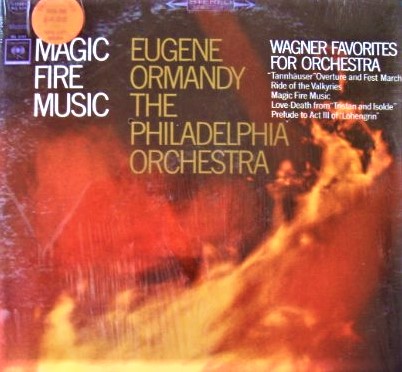
I can't honestly recall the first piece that really caught my fancy, but during my junior year I had a roommate with an excellent "hi-fi," and a fairly extensive collection of LPs.  I remember specifically an album of Wagner's orchestral music entitled "Magic Fire Music."  I played it, repeatedly, and the piece I liked the best was the overture to Tannhäuser.  It's eminently hummable, right?  You play it early in the day, and it goes through your mind until nightfall.

As a bit of a gift to those of us who still consider Stravinsky's Rite of Spring to be pretty avant-garde stuff, the Seattle Symphony this week, as part of its regular season, presented a program that I attended last night of three pieces from the Romantic era.  The first, not surprisingly, was the  Tannhäuser Overture.  (The other two, equally well-loved or hackneyed, depending on your disposition, were Dvořák's Cello Concerto in B minor, and Mussorgsky's Pictures at an Exhibition.)

I doubt that I was the first lad to cut his musical teeth on the Tannhäuser overture, or on Wagner in general.  Wagner has an appeal to young males that is, while not exactly sexual, at least hormonal.  Somewhat similar to the appeal of race car accidents and hard tackling in football, but combined with the spiritual transcendence you find in certain Church of England hymns.  Wagner appealed to the Nazis; his music is also used at weddings. . 

When I was twenty, the recordings of Wagner's music that I played repeatedly, performed as scored by a full orchestra, might as well have been performed on a pipe organ.  The sound was a single wave that washed over me and receded, over and over.  The appeal was all loudness and emotion and confrontation with overwhelming force.

Listening to Tannhäuser's overture last night -- and especially watching it played by the orchestra -- was my first experience with its live performance, other than as played by a darkened orchestra in the pit before the full opera.  It was enjoyable watching how various themes worked together, and how various instruments contributed, each in its own way, to the overall effect.  A classmate back in college pointed out to me how, in Wagner, the strings build up tension and the horns resolve that tension, but that was pretty much the extent of my musical analysis.

I've never played an instrument in an orchestra.  For me it's often difficult to perceive how various instruments are working together, and off each other, when listening to a recording.  Which suggests one good reason to attend a live performance -- you can watch the sections of the orchestra at work.  You can see how the various pulleys and gears of the orchestral machine act together to produce the overall effect -- an effect that would still be enjoyable, but different, were the piece to be transcribed for organ, or any other solo instrument.

And yes.  The major theme of the Tannhäuser Overture still rings in my head today.  I quietly hum it to myself.

Thursday, September 26, 2019

Toadstools


You chase them out the door, and they come in through the window.  This has to serve as my inexact metaphor for chasing rats and mice out of your walls, and the next day discovering hideous toadstools flourishing in your back yard.

Let me pause.  I've pointed out that my horror of rats, and to a lesser degree mice, has no logical basis.  Pet rats, in fact, such as are owned in great quantity by my nephew, are cuddly and affectionate and reputedly as intelligent as dogs.  (But not, I suspect, as intelligent as cats.)  Toadstools -- which is really just a pejorative term for mushrooms, supposedly mushrooms that are harmful but in reality a pejorative applied to mushrooms that have, subjectively, an "ick" factor -- are similar.

I eat mushrooms on my pizza.  As a kid, I loved mushrooms in my mom's meat loaf.  Cream of mushroom soup?  Sure.  Small, button mushrooms, like small furry mice, are cute. 

But enough of apologizing for my distaste.  The fungi (to be linguistically neutral) in my back yard -- whether poisonous or merely visually obnoxious --  are, in my opinion, toadstools.  They are huge and ugly (rat-like, to continue my analogy).  And I regard them with horror.  And they proliferate, just as do their animal cousins in the family rodentia.

I took a photo of the prime offender, and posted it on Facebook, a couple of days ago.  I announced that I had seven toadstools in my yard, of which this was the granddaddy.  The next day, I discovered I had twice that number, many now in a diffeent area of the yard.  Today, I began extermination procedures, plucking them up with my bare hands, dropping them into a bag, and depositing them in my yard waste bin.  (They are solid and meaty, fortunately, not the pustules of all that's impure, about to burst upon my hands, as they at first appeared.)

What are these things?  Well, they are the final (or perhaps penultimate) stage of mushroom development, the stage analogous to a dandelion when it gets all fuzzy and prepares to send its seeds parachuting into the air.  However, the mushroom sends forth spores, not seeds.  Same essential effect, from my point of view.  What are the stages of a mushroom's life, you ask?  I shall answer.

1.  Inoculation
2.  Spore germination
3.  Mycelial expansion
4.  Hyphal knot
5.  Primordia formation
6.  Fruitbody selection
7.  Mature fruitbody
8.  Spore release


Remember, the test is tomorrow, so study hard.


All you need to know -- or rather, all I need to know -- is that the mushroom fruits that I plucked from my yard today were merely the more successful of the fruits that were produced by a fungus that apparently permeates invisibly a wide portion of my backyard, especially those portions that are rich in moss.  Which at the moment, means much of my yard.


The little buggers will keep popping up, and I'll keep hacking them down.  Sooner or later, the fungus will give up and slink off to more salubrious backyards.  Or, more realistically, you'll find me blogging about research I've done on how one eliminates mushroom fungi from his lawn, when harvesting the fruit seems only to encourage it to greater efforts.


Sunday, September 22, 2019

Couging it. Redux. All over again.


Your assignment, should you choose to accept it, is to re-read my post from 2013 entitled "Couging It."   A post, describing with awe and wonder, the miraculous ability of the Washington State Cougars to lose games that they have in the bag.

Times change and teams evolve.  So we thought.  The Cougars, after their 2013 debacle, became a more predictably good team.  They seemed to have an excellent chance of winning the Pac-12 title this year.  As of this time, yesterday, they were 3-0, and ranked No. 19 nationally.

They had a late night game scheduled, a home game against hapless 0-3 UCLA.  They went into the game 18½-point favorites.  Part way through the third quarter, they had pulled to a 49-17 point lead. 

And then the hex went into effect.  By the end of the third quarter, the Bruins had cut the Cougars' lead to 49-38.  It got worse. Down four points with possession of the ball and about a minute left to play, the WSU quarterback -- who otherwise played an excellent game -- fumbled the ball while in the process of being sacked.  UCLA won 67-63.

According to Cougar Coach Mike Leach, "Our guys got frantic and panicked. We collapsed in every phase of the game."  Yeah, well that's the hex.  That's not normal.  That's couging it.

The Cougs dropped out of the Top 25.  UCLA, at 1-3, didn't receive even a single vote, despite their "amazing" comeback.  Well, it would be "amazing" if you weren't playing against the team that has spawned a term that describes the supernatural ability to snatch defeat from the jaws of victory.

"Couging it."

Nice game, Cougs.  It was fascinating enough to keep me watching until its stunning conclusion at 11:30 p.m. (on the West Coast).

Friday, September 20, 2019

New York, again revisited


As I've mentioned, I returned Tuesday from a four day visit to New York.  Just a quick visit, one I make every two or three years, to make sure the Big Apple is still a town that I feel appealing.  (Yes.)  And one in which I wish that I owned a three or four story town house on the Upper West Side.  (Yes!!)

This year, I didn't really visit any place I hadn't seen before.  My viewing of the Broadway show Dear Evan Hansen (see Wednesday's discussion) was my only pre-planned activity.  My iPhone app shows that in four days I walked 38.4 miles, which suggests my major activity. 

I also spent a number of hours wandering the Metropolitan Museum.  The Met's displays have been shuffled around during renovation work.  As a result, I spent quite some time viewing its displays of medieval armor and armaments, which I don't recall ever having noticed in the past.

I once more stayed at a hotel on the Upper West Side -- on W. 87th, just off Broadway.  I'm impressed by all the kids in that part of town -- walking to school with or without parents, biking around, zooming around on push scooters, running in school cross-country groups in Central Park.  New York parents seem refreshingly willing to let their children gambol about on their own.  In my Seattle neighborhood, the stern oversight of helicopter parents is just now beginning to ease off from what we've seen over the last couple of decades.  

Anyway, rather than describe places I walked, which I've really already described after past visits, I thought I'd just post a few representative photos.  And here they are. 


Lincoln Center at twilight

Night people, silhouetted against Lincoln Center fountain
Music Box, W. 45th St., 
Dinner at "Fred's"
Amsterdam at W. 83rd
Columbia University, at W. 116th
An easy walk from my hotel 


Dakota Apartments, viewed from
the Reservoir in Central Park

World Trade Center, Building 1
 
Weird new NY skyline
Looking south from the Central Park Big Meadow